 Add to Chrome
 Add to Firefox
 Add to Edge
An Agentic Approach for Active Data Collection, Travel Behavior Modeling, and Weather-Sensitive Demand Prediction
Aug 20, 2026
Travel behavior research increasingly combines digital data collection with predictive modeling, yet these stages are often developed and evaluated separately. This study proposes a three-agent workflow integrating conversational data collection, structured data processing, and behavioral prediction. A chatbot-administered, image-augmented stated-preference survey collected mode choices from student commuters across five predefined weather scenarios, yielding 454 respondent-scenario observations. Weather-related associations were analyzed using a multinomial logit model, while logistic regression and random forest provided machine-learning benchmarks. Nine locally deployed large language models (LLMs), ranging from 2 to 35 billion parameters, were evaluated across four zero-shot prompt-and-context conditions and extended through persona, few-shot, and vision-based configurations. Random forest achieved 69.6% five-class accuracy, while the best text-only zero-shot LLM reached 69.9% without task-specific fitting. Habitual travel information produced the most consistent gains, Expert framing generally outperformed Role-Play, and persona information was most useful when habitual travel information was unavailable. Few-shot prompting improved prediction for several models, with gains stabilizing after a small number of examples. Using the same weather images shown to respondents, the best vision-based configuration reached 71.5% five-class accuracy, indicating that visual context may provide additional predictive information for selected models. Overall, the study shows how conversational surveys, structured data processing, conventional behavioral modeling, machine learning, and multimodal LLM prediction can be coordinated within an auditable multi-agent workflow.

RPM-Distill: Physiology-guided Adaptive Cross-modal Distillation for Robust Remote Physiological Measurement
Jun 26, 2026Video-based remote physiological measurement (RPM) is highly accessible but remains fragile under varying illumination, skin tones, and motion. Radio frequency (RF) radar is largely invariant to illumination and appearance, providing complementary cardio-respiratory micro-motion cues; however, requiring radar at inference is often impractical due to its limited ubiquity and deployment overhead. We propose RPM-Distill, a physiology-guided cross-modal distillation framework that leverages synchronized radar only during training while retaining video-only inference. Our key observation is that although RGB and RF waveforms differ in sensing physics and time-domain morphology, they share similar latent periodic rhythm in the frequency domain. We thus distill physiology-structured spectral evidence to improve robustness, via losses that (i) anchor the fundamental peak, (ii) match the off-peak background distribution, and (iii) preserve spectral morphology and sharpness. To avoid negative transfer under sample-level teacher quality and alignment uncertainty, a spectral policy network predicts sample-level distillation gates and component weights from the student--teacher spectral relation map, learned with a meta bilevel objective on a small labeled validation split. Through extensive experiments in challenging conditions and cross-dataset settings, RPM-Distill brings 81\% MAE and 21\% correlation improvement over unimodal baselines. Code is at https://github.com/WJULYW/RPM-Distill.
When Agents Meet Electric Bus Fleet Operations: Pricing Behavior, Trade-offs, and Policy Implications in an Aggregator Framework
Jun 24, 2026Agentic systems are changing how complex operational tasks are coordinated, introducing a new paradigm for connecting heterogeneous data sources and automating processes. Electric bus fleets provide a relevant test case. Their operation requires continuous coordination between service reliability, battery state-of-charge, charger availability, electricity prices, route-energy uncertainty, and vehicle-to-grid (V2G) opportunities. This paper proposes an agentic aggregator framework that streamlines this decision environment by coupling an optimization-based electric bus scheduling model with supervisory agents for disturbance detection, tariff adaptation, and schedule evaluation. The optimization core enforces physical feasibility across routes, chargers, batteries, and V2G exchanges, while the agentic layer interprets changing operating conditions, triggers real-time re-optimization when needed, and defines how flexibility value is allocated between the aggregator and the public transport operator (PTO). A realistic depot case study evaluates day-ahead and real-time operations under profit-based and operation-based coordination modes, considering service delays, route-energy deviations, electricity price shocks, and combined disturbances. The results show that agentic aggregation can support adaptive fleet-grid coordination by maintaining feasible schedules, activating re-optimization selectively, and improving the use of charging and V2G flexibility. However, they also reveal a critical trade-off: the same agentic capability that reduces operational complexity can extract value from the PTO when configured around profit-oriented pricing. These findings suggest that agentic aggregators can become useful for managing electric bus V2G operations, but their deployment in public-fleet contexts requires transparent coordination modes, auditable tariff-setting, and explicit value-sharing rules.
LLM Agents for Combinatorial Efficient Frontiers: Investment Portfolio Optimization
Jan 02, 2026Investment portfolio optimization is a task conducted in all major financial institutions. The Cardinality Constrained Mean-Variance Portfolio Optimization (CCPO) problem formulation is ubiquitous for portfolio optimization. The challenge of this type of portfolio optimization, a mixed-integer quadratic programming (MIQP) problem, arises from the intractability of solutions from exact solvers, where heuristic algorithms are used to find approximate portfolio solutions. CCPO entails many laborious and complex workflows and also requires extensive effort pertaining to heuristic algorithm development, where the combination of pooled heuristic solutions results in improved efficient frontiers. Hence, common approaches are to develop many heuristic algorithms. Agentic frameworks emerge as a promising candidate for many problems within combinatorial optimization, as they have been shown to be equally efficient with regard to automating large workflows and have been shown to be excellent in terms of algorithm development, sometimes surpassing human-level performance. This study implements a novel agentic framework for the CCPO and explores several concrete architectures. In benchmark problems, the implemented agentic framework matches state-of-the-art algorithms. Furthermore, complex workflows and algorithm development efforts are alleviated, while in the worst case, lower but acceptable error is reported.
Security Risks of Agentic Vehicles: A Systematic Analysis of Cognitive and Cross-Layer Threats
Dec 18, 2025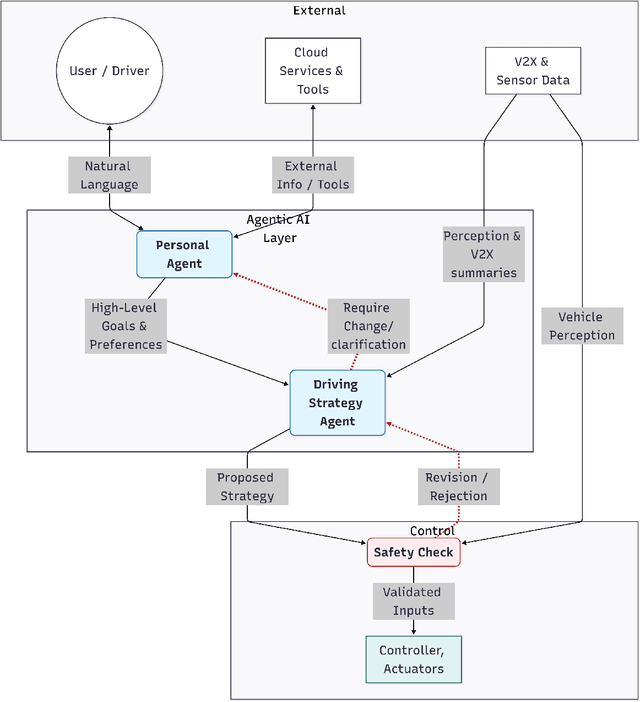
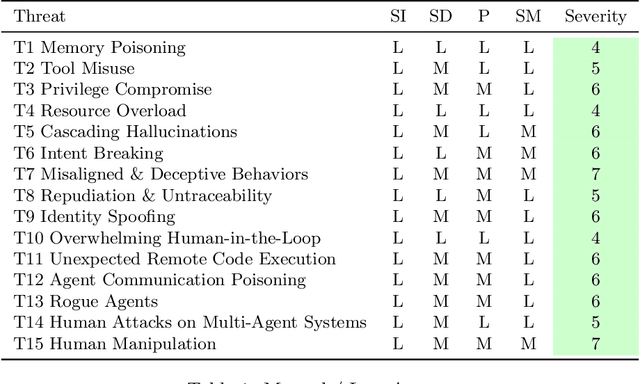
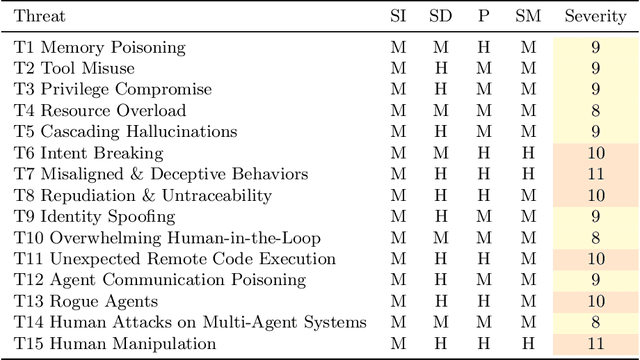
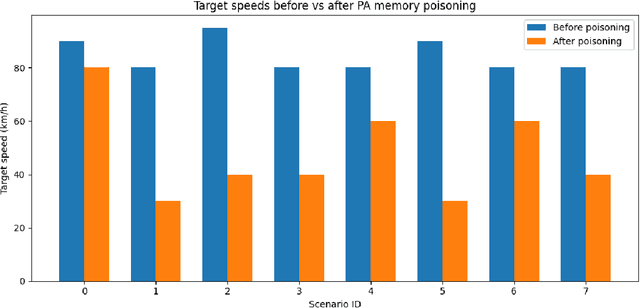
Agentic AI is increasingly being explored and introduced in both manually driven and autonomous vehicles, leading to the notion of Agentic Vehicles (AgVs), with capabilities such as memory-based personalization, goal interpretation, strategic reasoning, and tool-mediated assistance. While frameworks such as the OWASP Agentic AI Security Risks highlight vulnerabilities in reasoning-driven AI systems, they are not designed for safety-critical cyber-physical platforms such as vehicles, nor do they account for interactions with other layers such as perception, communication, and control layers. This paper investigates security threats in AgVs, including OWASP-style risks and cyber-attacks from other layers affecting the agentic layer. By introducing a role-based architecture for agentic vehicles, consisting of a Personal Agent and a Driving Strategy Agent, we will investigate vulnerabilities in both agentic AI layer and cross-layer risks, including risks originating from upstream layers (e.g., perception layer, control layer, etc.). A severity matrix and attack-chain analysis illustrate how small distortions can escalate into misaligned or unsafe behavior in both human-driven and autonomous vehicles. The resulting framework provides the first structured foundation for analyzing security risks of agentic AI in both current and emerging vehicle platforms.
RAST-MoE-RL: A Regime-Aware Spatio-Temporal MoE Framework for Deep Reinforcement Learning in Ride-Hailing
Dec 13, 2025Ride-hailing platforms face the challenge of balancing passenger waiting times with overall system efficiency under highly uncertain supply-demand conditions. Adaptive delayed matching creates a trade-off between matching and pickup delays by deciding whether to assign drivers immediately or batch requests. Since outcomes accumulate over long horizons with stochastic dynamics, reinforcement learning (RL) is a suitable framework. However, existing approaches often oversimplify traffic dynamics or use shallow encoders that miss complex spatiotemporal patterns. We introduce the Regime-Aware Spatio-Temporal Mixture-of-Experts (RAST-MoE), which formalizes adaptive delayed matching as a regime-aware MDP equipped with a self-attention MoE encoder. Unlike monolithic networks, our experts specialize automatically, improving representation capacity while maintaining computational efficiency. A physics-informed congestion surrogate preserves realistic density-speed feedback, enabling millions of efficient rollouts, while an adaptive reward scheme guards against pathological strategies. With only 12M parameters, our framework outperforms strong baselines. On real-world Uber trajectory data (San Francisco), it improves total reward by over 13%, reducing average matching and pickup delays by 10% and 15% respectively. It demonstrates robustness across unseen demand regimes and stable training. These findings highlight the potential of MoE-enhanced RL for large-scale decision-making with complex spatiotemporal dynamics.
Position: Simulating Society Requires Simulating Thought
Jun 08, 2025Simulating society with large language models (LLMs), we argue, requires more than generating plausible behavior -- it demands cognitively grounded reasoning that is structured, revisable, and traceable. LLM-based agents are increasingly used to emulate individual and group behavior -- primarily through prompting and supervised fine-tuning. Yet they often lack internal coherence, causal reasoning, and belief traceability -- making them unreliable for analyzing how people reason, deliberate, or respond to interventions. To address this, we present a conceptual modeling paradigm, Generative Minds (GenMinds), which draws from cognitive science to support structured belief representations in generative agents. To evaluate such agents, we introduce the RECAP (REconstructing CAusal Paths) framework, a benchmark designed to assess reasoning fidelity via causal traceability, demographic grounding, and intervention consistency. These contributions advance a broader shift: from surface-level mimicry to generative agents that simulate thought -- not just language -- for social simulations.
Certifiably-Correct Mapping for Safe Navigation Despite Odometry Drift
Apr 25, 2025Accurate perception, state estimation and mapping are essential for safe robotic navigation as planners and controllers rely on these components for safety-critical decisions. However, existing mapping approaches often assume perfect pose estimates, an unrealistic assumption that can lead to incorrect obstacle maps and therefore collisions. This paper introduces a framework for certifiably-correct mapping that ensures that the obstacle map correctly classifies obstacle-free regions despite the odometry drift in vision-based localization systems (VIO}/SLAM). By deflating the safe region based on the incremental odometry error at each timestep, we ensure that the map remains accurate and reliable locally around the robot, even as the overall odometry error with respect to the inertial frame grows unbounded. Our contributions include two approaches to modify popular obstacle mapping paradigms, (I) Safe Flight Corridors, and (II) Signed Distance Fields. We formally prove the correctness of both methods, and describe how they integrate with existing planning and control modules. Simulations using the Replica dataset highlight the efficacy of our methods compared to state-of-the-art techniques. Real-world experiments with a robotic rover show that, while baseline methods result in collisions with previously mapped obstacles, the proposed framework enables the rover to safely stop before potential collisions.
Analyzing sequential activity and travel decisions with interpretable deep inverse reinforcement learning
Mar 17, 2025Travel demand modeling has shifted from aggregated trip-based models to behavior-oriented activity-based models because daily trips are essentially driven by human activities. To analyze the sequential activity-travel decisions, deep inverse reinforcement learning (DIRL) has proven effective in learning the decision mechanisms by approximating a reward function to represent preferences and a policy function to replicate observed behavior using deep neural networks (DNNs). However, most existing research has focused on using DIRL to enhance only prediction accuracy, with limited exploration into interpreting the underlying decision mechanisms guiding sequential decision-making. To address this gap, we introduce an interpretable DIRL framework for analyzing activity-travel decision processes, bridging the gap between data-driven machine learning and theory-driven behavioral models. Our proposed framework adapts an adversarial IRL approach to infer the reward and policy functions of activity-travel behavior. The policy function is interpreted through a surrogate interpretable model based on choice probabilities from the policy function, while the reward function is interpreted by deriving both short-term rewards and long-term returns for various activity-travel patterns. Our analysis of real-world travel survey data reveals promising results in two key areas: (i) behavioral pattern insights from the policy function, highlighting critical factors in decision-making and variations among socio-demographic groups, and (ii) behavioral preference insights from the reward function, indicating the utility individuals gain from specific activity sequences.
FASIONAD++ : Integrating High-Level Instruction and Information Bottleneck in FAt-Slow fusION Systems for Enhanced Safety in Autonomous Driving with Adaptive Feedback
Mar 11, 2025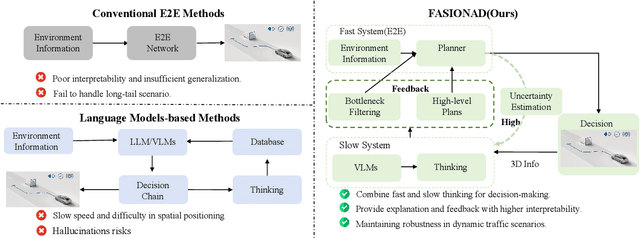
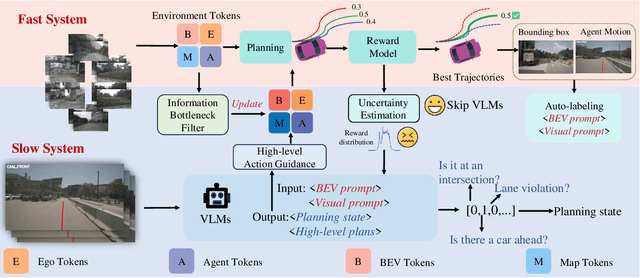
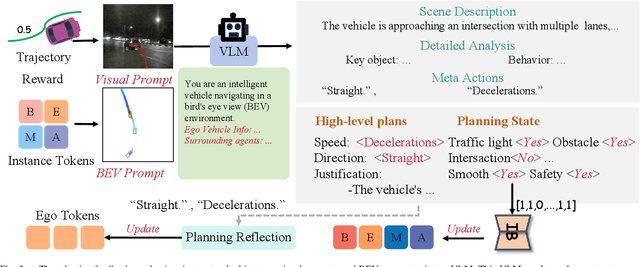
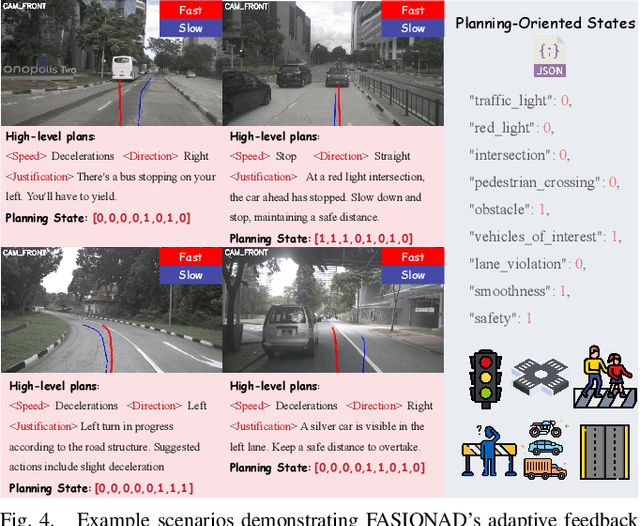
Ensuring safe, comfortable, and efficient planning is crucial for autonomous driving systems. While end-to-end models trained on large datasets perform well in standard driving scenarios, they struggle with complex low-frequency events. Recent Large Language Models (LLMs) and Vision Language Models (VLMs) advancements offer enhanced reasoning but suffer from computational inefficiency. Inspired by the dual-process cognitive model "Thinking, Fast and Slow", we propose $\textbf{FASIONAD}$ -- a novel dual-system framework that synergizes a fast end-to-end planner with a VLM-based reasoning module. The fast system leverages end-to-end learning to achieve real-time trajectory generation in common scenarios, while the slow system activates through uncertainty estimation to perform contextual analysis and complex scenario resolution. Our architecture introduces three key innovations: (1) A dynamic switching mechanism enabling slow system intervention based on real-time uncertainty assessment; (2) An information bottleneck with high-level plan feedback that optimizes the slow system's guidance capability; (3) A bidirectional knowledge exchange where visual prompts enhance the slow system's reasoning while its feedback refines the fast planner's decision-making. To strengthen VLM reasoning, we develop a question-answering mechanism coupled with reward-instruct training strategy. In open-loop experiments, FASIONAD achieves a $6.7\%$ reduction in average $L2$ trajectory error and $28.1\%$ lower collision rate.