 Add to Chrome
 Add to Firefox
 Add to Edge
RAST-MoE-RL: A Regime-Aware Spatio-Temporal MoE Framework for Deep Reinforcement Learning in Ride-Hailing
Dec 13, 2025
Ride-hailing platforms face the challenge of balancing passenger waiting times with overall system efficiency under highly uncertain supply-demand conditions. Adaptive delayed matching creates a trade-off between matching and pickup delays by deciding whether to assign drivers immediately or batch requests. Since outcomes accumulate over long horizons with stochastic dynamics, reinforcement learning (RL) is a suitable framework. However, existing approaches often oversimplify traffic dynamics or use shallow encoders that miss complex spatiotemporal patterns. We introduce the Regime-Aware Spatio-Temporal Mixture-of-Experts (RAST-MoE), which formalizes adaptive delayed matching as a regime-aware MDP equipped with a self-attention MoE encoder. Unlike monolithic networks, our experts specialize automatically, improving representation capacity while maintaining computational efficiency. A physics-informed congestion surrogate preserves realistic density-speed feedback, enabling millions of efficient rollouts, while an adaptive reward scheme guards against pathological strategies. With only 12M parameters, our framework outperforms strong baselines. On real-world Uber trajectory data (San Francisco), it improves total reward by over 13%, reducing average matching and pickup delays by 10% and 15% respectively. It demonstrates robustness across unseen demand regimes and stable training. These findings highlight the potential of MoE-enhanced RL for large-scale decision-making with complex spatiotemporal dynamics.

Uncertainty Quantification of Spatiotemporal Travel Demand with Probabilistic Graph Neural Networks
Mar 07, 2023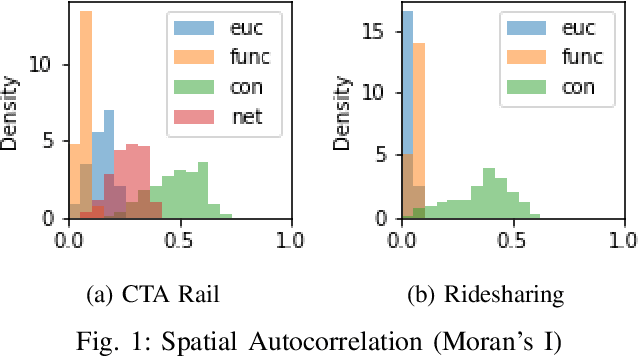
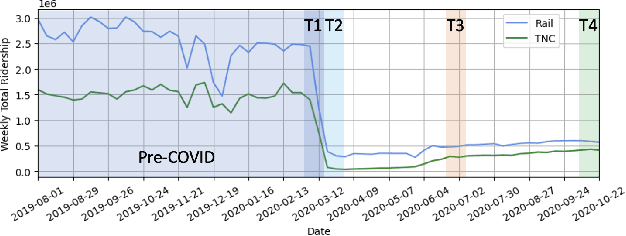
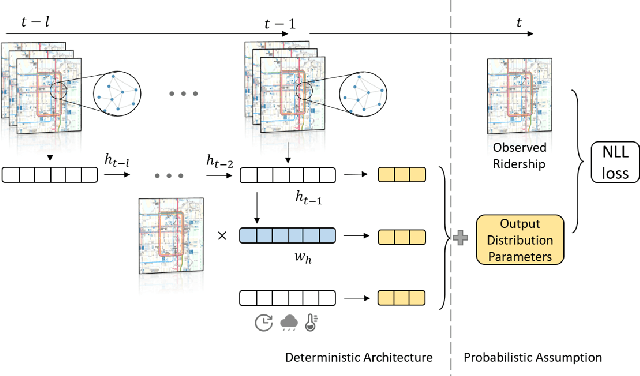
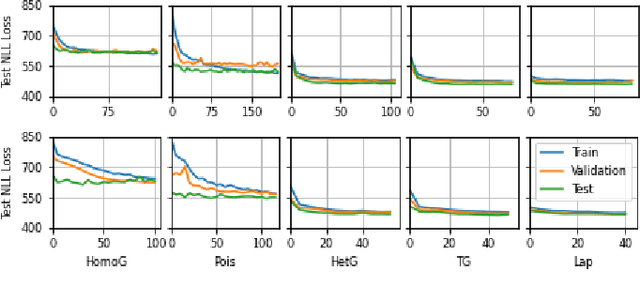
Recent studies have significantly improved the prediction accuracy of travel demand using graph neural networks. However, these studies largely ignored uncertainty that inevitably exists in travel demand prediction. To fill this gap, this study proposes a framework of probabilistic graph neural networks (Prob-GNN) to quantify the spatiotemporal uncertainty of travel demand. This Prob-GNN framework is substantiated by deterministic and probabilistic assumptions, and empirically applied to the task of predicting the transit and ridesharing demand in Chicago. We found that the probabilistic assumptions (e.g. distribution tail, support) have a greater impact on uncertainty prediction than the deterministic ones (e.g. deep modules, depth). Among the family of Prob-GNNs, the GNNs with truncated Gaussian and Laplace distributions achieve the highest performance in transit and ridesharing data. Even under significant domain shifts, Prob-GNNs can predict the ridership uncertainty in a stable manner, when the models are trained on pre-COVID data and tested across multiple periods during and after the COVID-19 pandemic. Prob-GNNs also reveal the spatiotemporal pattern of uncertainty, which is concentrated on the afternoon peak hours and the areas with large travel volumes. Overall, our findings highlight the importance of incorporating randomness into deep learning for spatiotemporal ridership prediction. Future research should continue to investigate versatile probabilistic assumptions to capture behavioral randomness, and further develop methods to quantify uncertainty to build resilient cities.