 Add to Chrome
 Add to Firefox
 Add to Edge
Particle-based Fast Jet Simulation at the LHC with Variational Autoencoders
Mar 01, 2022
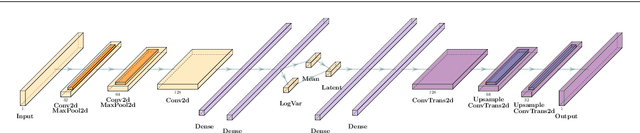
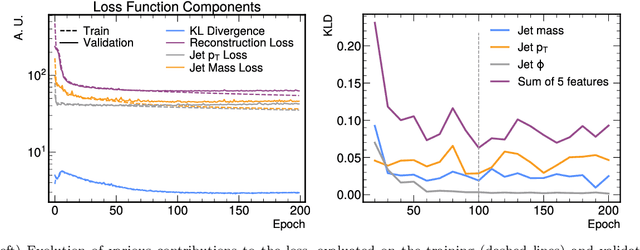
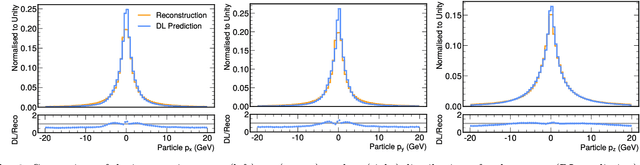
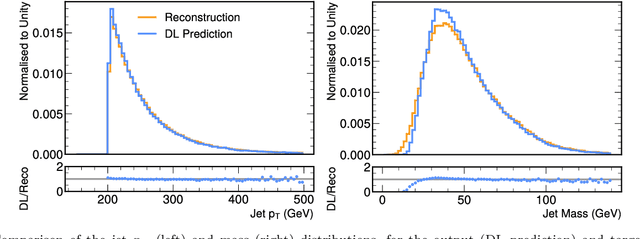
We study how to use Deep Variational Autoencoders for a fast simulation of jets of particles at the LHC. We represent jets as a list of constituents, characterized by their momenta. Starting from a simulation of the jet before detector effects, we train a Deep Variational Autoencoder to return the corresponding list of constituents after detection. Doing so, we bypass both the time-consuming detector simulation and the collision reconstruction steps of a traditional processing chain, speeding up significantly the events generation workflow. Through model optimization and hyperparameter tuning, we achieve state-of-the-art precision on the jet four-momentum, while providing an accurate description of the constituents momenta, and an inference time comparable to that of a rule-based fast simulation.

Machine Learning for Particle Flow Reconstruction at CMS
Mar 01, 2022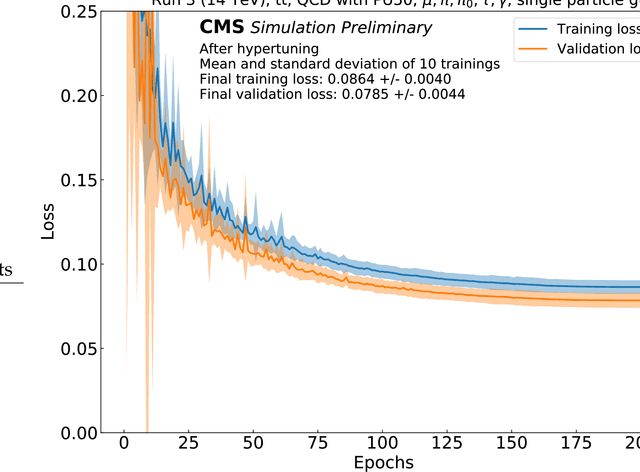
We provide details on the implementation of a machine-learning based particle flow algorithm for CMS. The standard particle flow algorithm reconstructs stable particles based on calorimeter clusters and tracks to provide a global event reconstruction that exploits the combined information of multiple detector subsystems, leading to strong improvements for quantities such as jets and missing transverse energy. We have studied a possible evolution of particle flow towards heterogeneous computing platforms such as GPUs using a graph neural network. The machine-learned PF model reconstructs particle candidates based on the full list of tracks and calorimeter clusters in the event. For validation, we determine the physics performance directly in the CMS software framework when the proposed algorithm is interfaced with the offline reconstruction of jets and missing transverse energy. We also report the computational performance of the algorithm, which scales approximately linearly in runtime and memory usage with the input size.
Graph Neural Networks for Charged Particle Tracking on FPGAs
Dec 03, 2021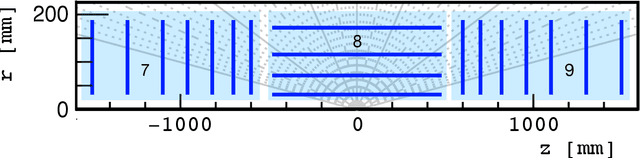

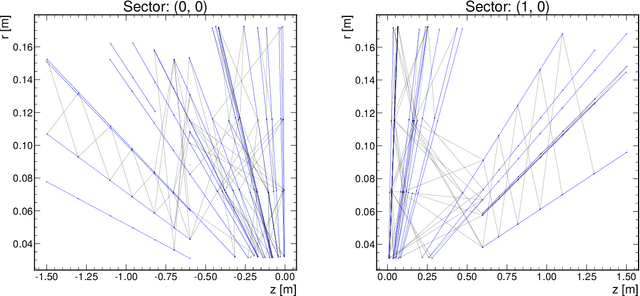
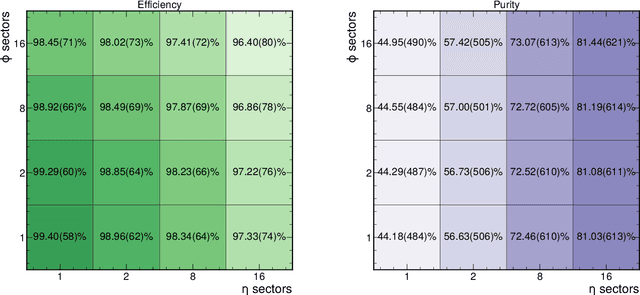
The determination of charged particle trajectories in collisions at the CERN Large Hadron Collider (LHC) is an important but challenging problem, especially in the high interaction density conditions expected during the future high-luminosity phase of the LHC (HL-LHC). Graph neural networks (GNNs) are a type of geometric deep learning algorithm that has successfully been applied to this task by embedding tracker data as a graph -- nodes represent hits, while edges represent possible track segments -- and classifying the edges as true or fake track segments. However, their study in hardware- or software-based trigger applications has been limited due to their large computational cost. In this paper, we introduce an automated translation workflow, integrated into a broader tool called $\texttt{hls4ml}$, for converting GNNs into firmware for field-programmable gate arrays (FPGAs). We use this translation tool to implement GNNs for charged particle tracking, trained using the TrackML challenge dataset, on FPGAs with designs targeting different graph sizes, task complexites, and latency/throughput requirements. This work could enable the inclusion of charged particle tracking GNNs at the trigger level for HL-LHC experiments.
Particle Graph Autoencoders and Differentiable, Learned Energy Mover's Distance
Nov 24, 2021
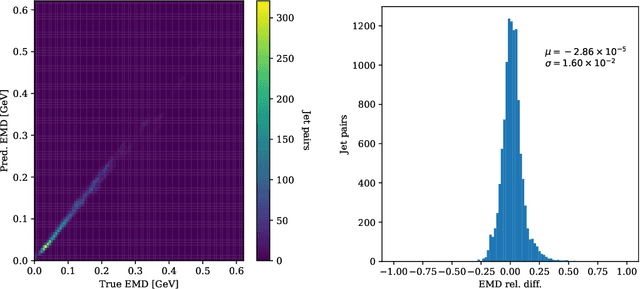
Autoencoders have useful applications in high energy physics in anomaly detection, particularly for jets - collimated showers of particles produced in collisions such as those at the CERN Large Hadron Collider. We explore the use of graph-based autoencoders, which operate on jets in their "particle cloud" representations and can leverage the interdependencies among the particles within a jet, for such tasks. Additionally, we develop a differentiable approximation to the energy mover's distance via a graph neural network, which may subsequently be used as a reconstruction loss function for autoencoders.
Explaining machine-learned particle-flow reconstruction
Nov 24, 2021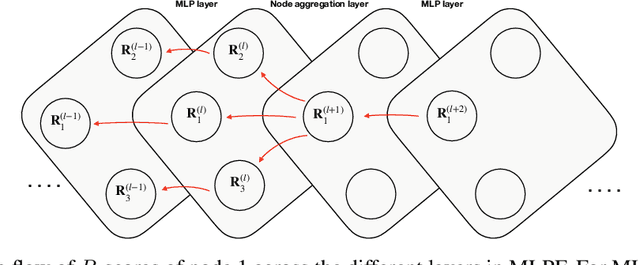

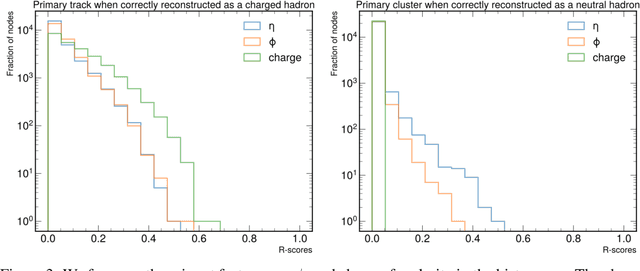
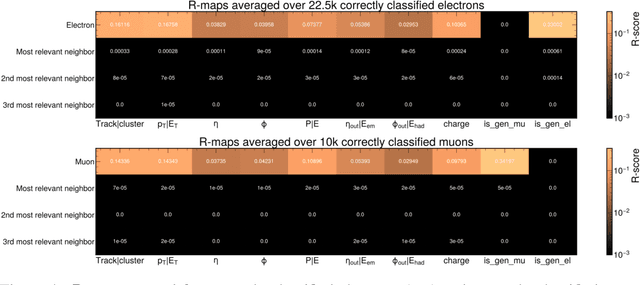
The particle-flow (PF) algorithm is used in general-purpose particle detectors to reconstruct a comprehensive particle-level view of the collision by combining information from different subdetectors. A graph neural network (GNN) model, known as the machine-learned particle-flow (MLPF) algorithm, has been developed to substitute the rule-based PF algorithm. However, understanding the model's decision making is not straightforward, especially given the complexity of the set-to-set prediction task, dynamic graph building, and message-passing steps. In this paper, we adapt the layerwise-relevance propagation technique for GNNs and apply it to the MLPF algorithm to gauge the relevant nodes and features for its predictions. Through this process, we gain insight into the model's decision-making.
Applications and Techniques for Fast Machine Learning in Science
Oct 25, 2021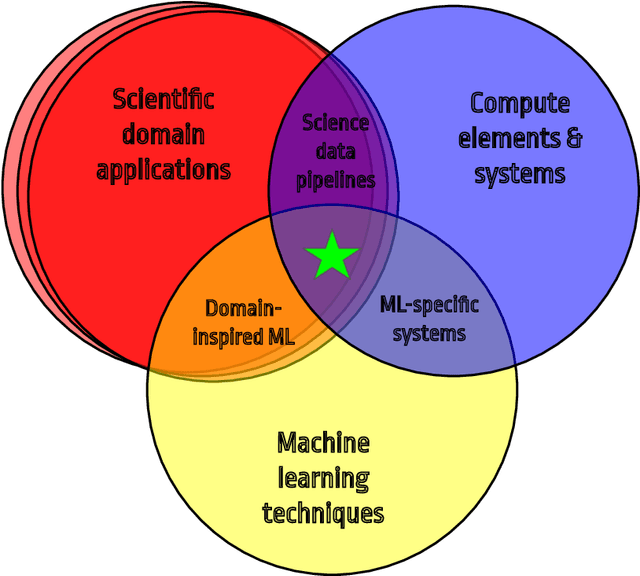
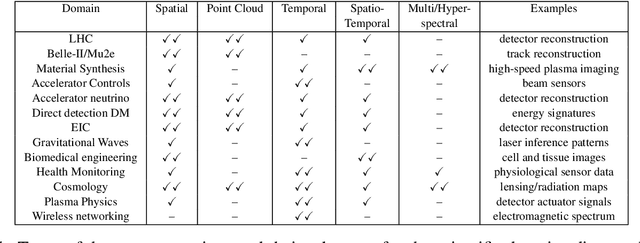
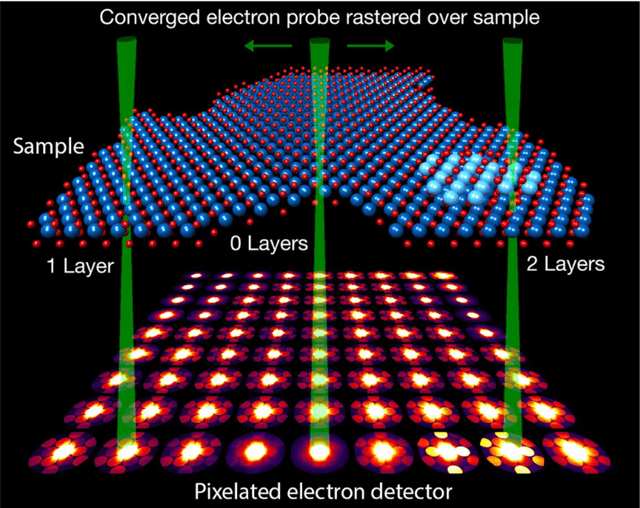
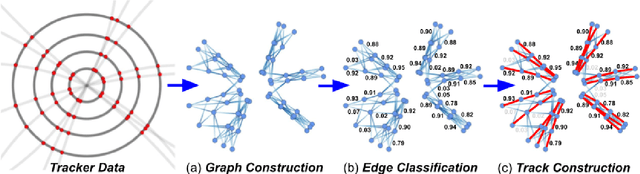
In this community review report, we discuss applications and techniques for fast machine learning (ML) in science -- the concept of integrating power ML methods into the real-time experimental data processing loop to accelerate scientific discovery. The material for the report builds on two workshops held by the Fast ML for Science community and covers three main areas: applications for fast ML across a number of scientific domains; techniques for training and implementing performant and resource-efficient ML algorithms; and computing architectures, platforms, and technologies for deploying these algorithms. We also present overlapping challenges across the multiple scientific domains where common solutions can be found. This community report is intended to give plenty of examples and inspiration for scientific discovery through integrated and accelerated ML solutions. This is followed by a high-level overview and organization of technical advances, including an abundance of pointers to source material, which can enable these breakthroughs.
A FAIR and AI-ready Higgs Boson Decay Dataset
Aug 04, 2021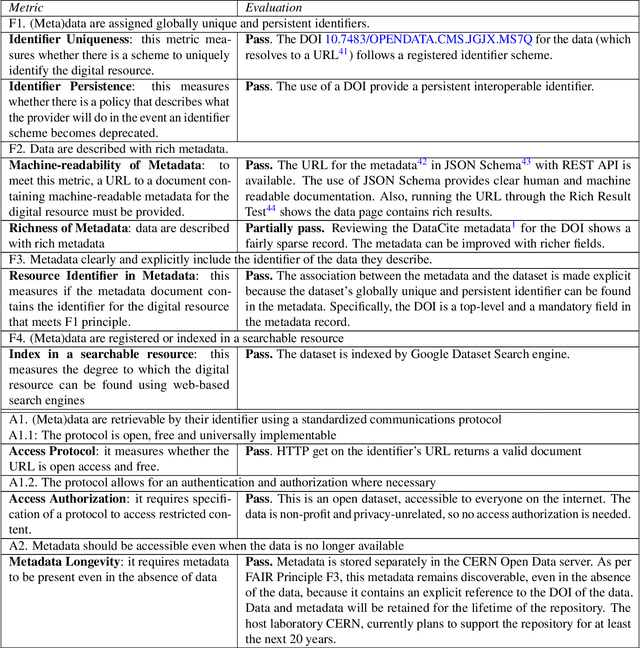
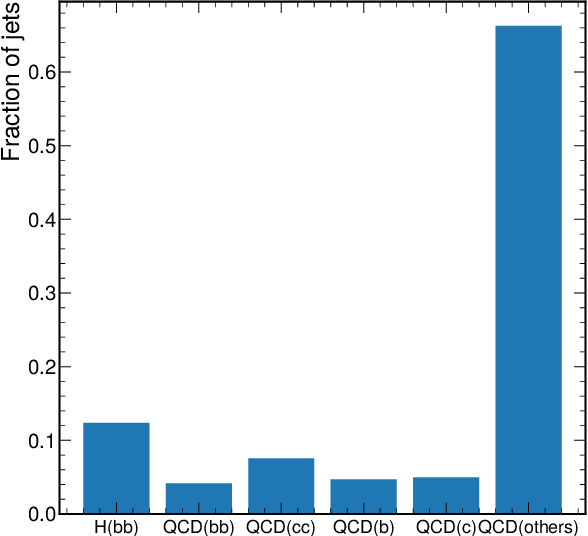
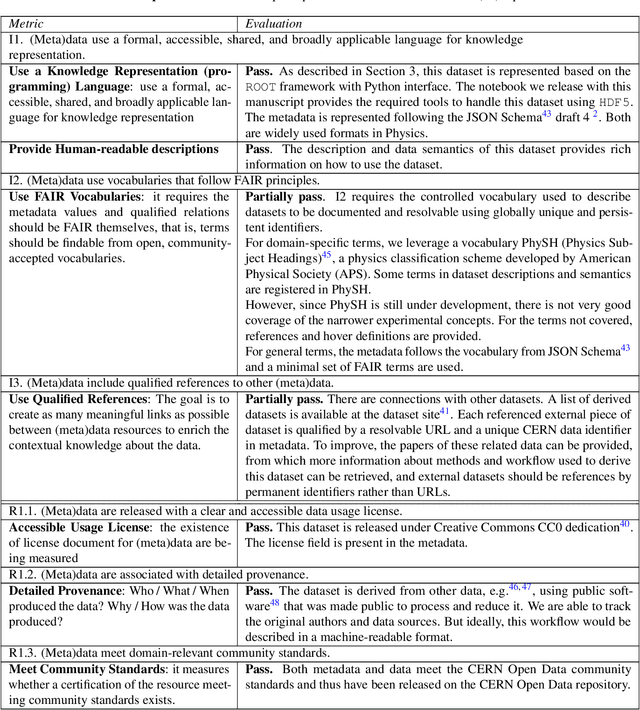
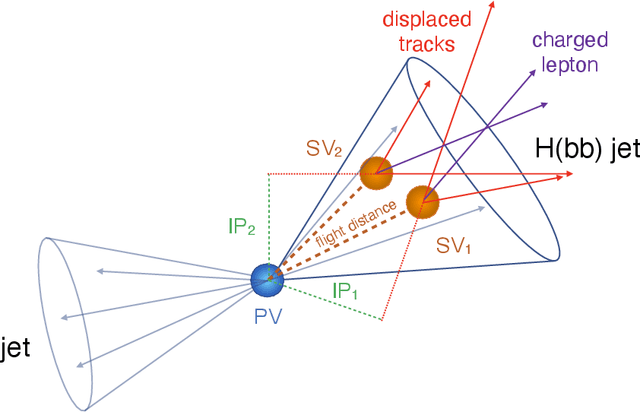
To enable the reusability of massive scientific datasets by humans and machines, researchers aim to create scientific datasets that adhere to the principles of findability, accessibility, interoperability, and reusability (FAIR) for data and artificial intelligence (AI) models. This article provides a domain-agnostic, step-by-step assessment guide to evaluate whether or not a given dataset meets each FAIR principle. We then demonstrate how to use this guide to evaluate the FAIRness of an open simulated dataset produced by the CMS Collaboration at the CERN Large Hadron Collider. This dataset consists of Higgs boson decays and quark and gluon background, and is available through the CERN Open Data Portal. We also use other available tools to assess the FAIRness of this dataset, and incorporate feedback from members of the FAIR community to validate our results. This article is accompanied by a Jupyter notebook to facilitate an understanding and exploration of the dataset, including visualization of its elements. This study marks the first in a planned series of articles that will guide scientists in the creation and quantification of FAIRness in high energy particle physics datasets and AI models.
MLPerf Tiny Benchmark
Jun 28, 2021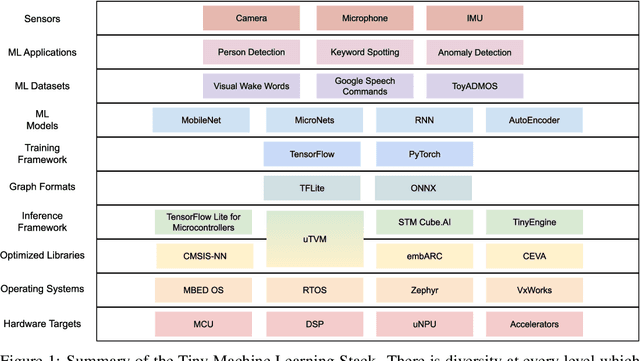
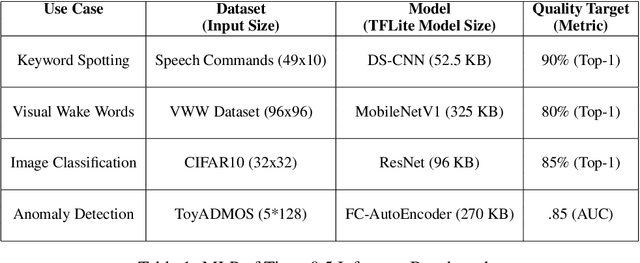
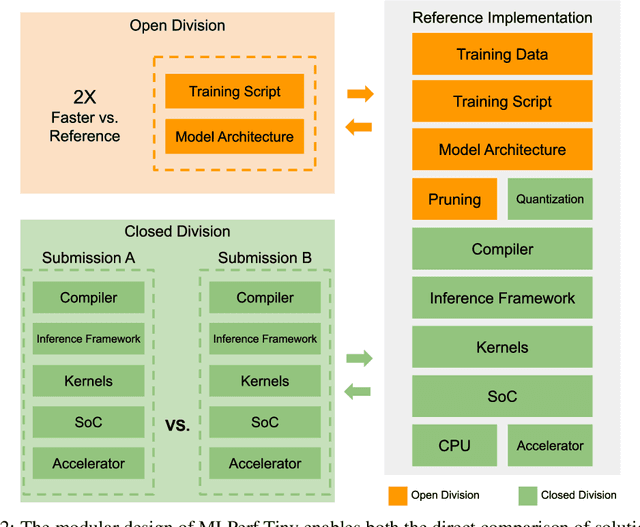
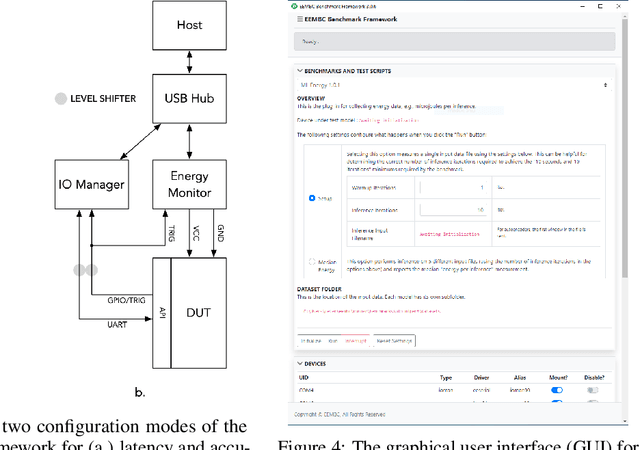
Advancements in ultra-low-power tiny machine learning (TinyML) systems promise to unlock an entirely new class of smart applications. However, continued progress is limited by the lack of a widely accepted and easily reproducible benchmark for these systems. To meet this need, we present MLPerf Tiny, the first industry-standard benchmark suite for ultra-low-power tiny machine learning systems. The benchmark suite is the collaborative effort of more than 50 organizations from industry and academia and reflects the needs of the community. MLPerf Tiny measures the accuracy, latency, and energy of machine learning inference to properly evaluate the tradeoffs between systems. Additionally, MLPerf Tiny implements a modular design that enables benchmark submitters to show the benefits of their product, regardless of where it falls on the ML deployment stack, in a fair and reproducible manner. The suite features four benchmarks: keyword spotting, visual wake words, image classification, and anomaly detection.
Particle Cloud Generation with Message Passing Generative Adversarial Networks
Jun 22, 2021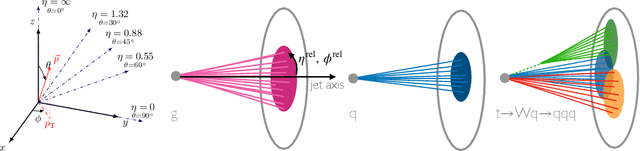
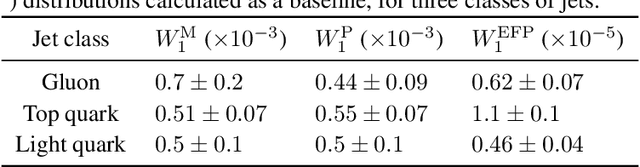

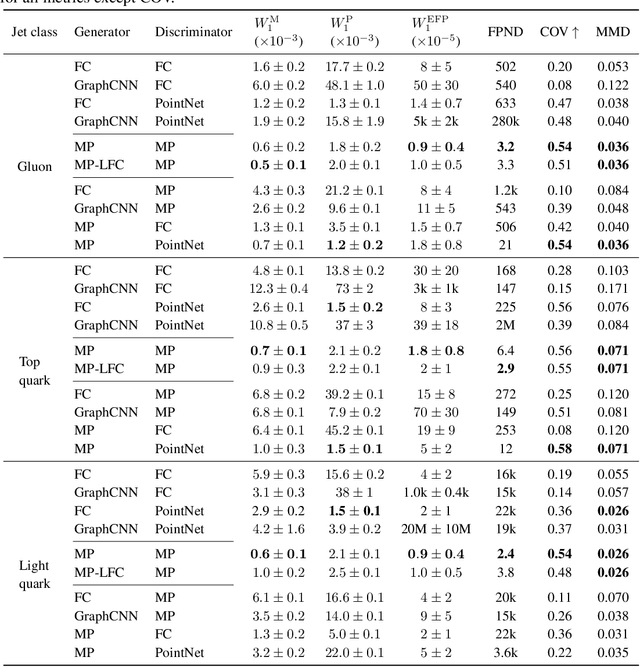
In high energy physics (HEP), jets are collections of correlated particles produced ubiquitously in particle collisions such as those at the CERN Large Hadron Collider (LHC). Machine-learning-based generative models, such as generative adversarial networks (GANs), have the potential to significantly accelerate LHC jet simulations. However, despite jets having a natural representation as a set of particles in momentum-space, a.k.a. a particle cloud, to our knowledge there exist no generative models applied to such a dataset. We introduce a new particle cloud dataset (JetNet), and, due to similarities between particle and point clouds, apply to it existing point cloud GANs. Results are evaluated using (1) the 1-Wasserstein distance between high- and low-level feature distributions, (2) a newly developed Fr\'{e}chet ParticleNet Distance, and (3) the coverage and (4) minimum matching distance metrics. Existing GANs are found to be inadequate for physics applications, hence we develop a new message passing GAN (MPGAN), which outperforms existing point cloud GANs on virtually every metric and shows promise for use in HEP. We propose JetNet as a novel point-cloud-style dataset for the machine learning community to experiment with, and set MPGAN as a benchmark to improve upon for future generative models.
A reconfigurable neural network ASIC for detector front-end data compression at the HL-LHC
May 04, 2021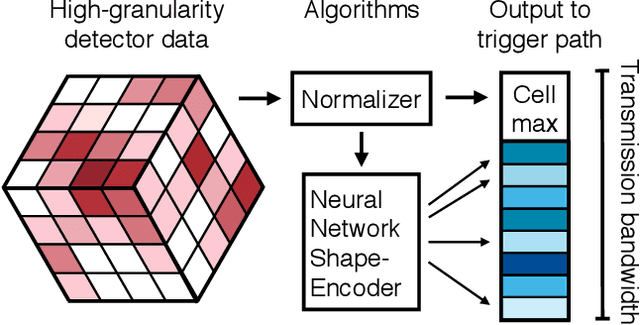
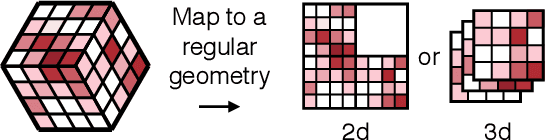
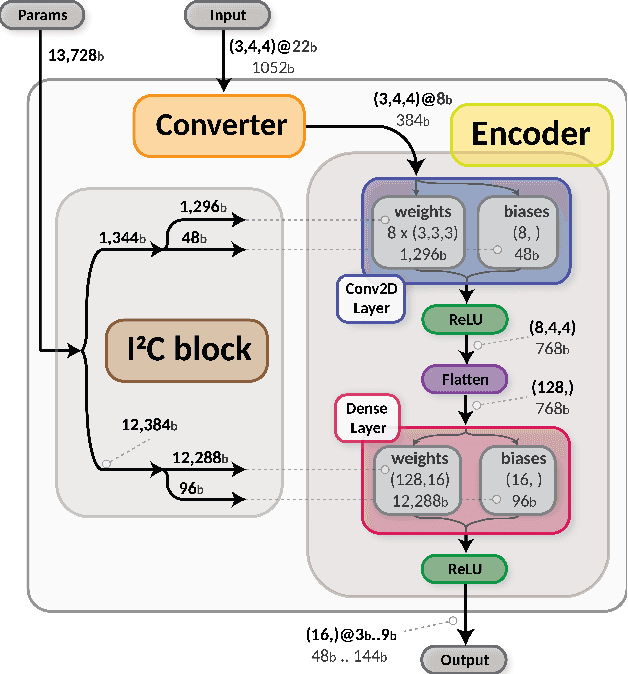
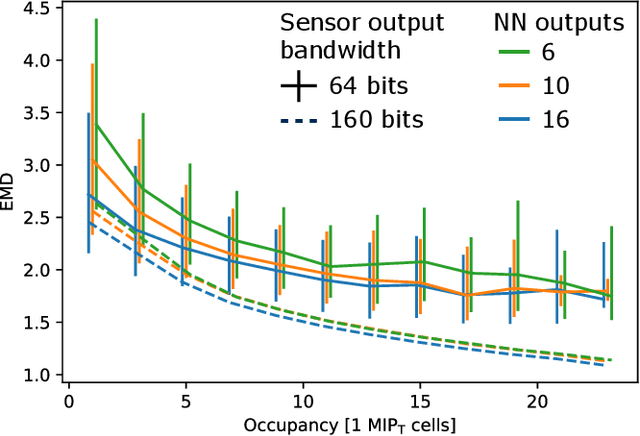
Despite advances in the programmable logic capabilities of modern trigger systems, a significant bottleneck remains in the amount of data to be transported from the detector to off-detector logic where trigger decisions are made. We demonstrate that a neural network autoencoder model can be implemented in a radiation tolerant ASIC to perform lossy data compression alleviating the data transmission problem while preserving critical information of the detector energy profile. For our application, we consider the high-granularity calorimeter from the CMS experiment at the CERN Large Hadron Collider. The advantage of the machine learning approach is in the flexibility and configurability of the algorithm. By changing the neural network weights, a unique data compression algorithm can be deployed for each sensor in different detector regions, and changing detector or collider conditions. To meet area, performance, and power constraints, we perform a quantization-aware training to create an optimized neural network hardware implementation. The design is achieved through the use of high-level synthesis tools and the hls4ml framework, and was processed through synthesis and physical layout flows based on a LP CMOS 65 nm technology node. The flow anticipates 200 Mrad of ionizing radiation to select gates, and reports a total area of 3.6 mm^2 and consumes 95 mW of power. The simulated energy consumption per inference is 2.4 nJ. This is the first radiation tolerant on-detector ASIC implementation of a neural network that has been designed for particle physics applications.