 Add to Chrome
 Add to Firefox
 Add to Edge
Statistical vs. Deep Learning Models for Estimating Substance Overdose Excess Mortality in the US
Dec 25, 2025
Substance overdose mortality in the United States claimed over 80,000 lives in 2023, with the COVID-19 pandemic exacerbating existing trends through healthcare disruptions and behavioral changes. Estimating excess mortality, defined as deaths beyond expected levels based on pre-pandemic patterns, is essential for understanding pandemic impacts and informing intervention strategies. However, traditional statistical methods like SARIMA assume linearity, stationarity, and fixed seasonality, which may not hold under structural disruptions. We present a systematic comparison of SARIMA against three deep learning (DL) architectures (LSTM, Seq2Seq, and Transformer) for counterfactual mortality estimation using national CDC data (2015-2019 for training/validation, 2020-2023 for projection). We contribute empirical evidence that LSTM achieves superior point estimation (17.08% MAPE vs. 23.88% for SARIMA) and better-calibrated uncertainty (68.8% vs. 47.9% prediction interval coverage) when projecting under regime change. We also demonstrate that attention-based models (Seq2Seq, Transformer) underperform due to overfitting to historical means rather than capturing emergent trends. Ourreproducible pipeline incorporates conformal prediction intervals and convergence analysis across 60+ trials per configuration, and we provide an open-source framework deployable with 15 state health departments. Our findings establish that carefully validated DL models can provide more reliable counterfactual estimates than traditional methods for public health planning, while highlighting the need for calibration techniques when deploying neural forecasting in high-stakes domains.

Particle Graph Autoencoders and Differentiable, Learned Energy Mover's Distance
Nov 24, 2021
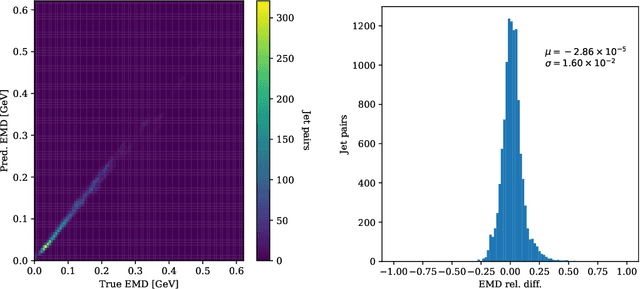
Autoencoders have useful applications in high energy physics in anomaly detection, particularly for jets - collimated showers of particles produced in collisions such as those at the CERN Large Hadron Collider. We explore the use of graph-based autoencoders, which operate on jets in their "particle cloud" representations and can leverage the interdependencies among the particles within a jet, for such tasks. Additionally, we develop a differentiable approximation to the energy mover's distance via a graph neural network, which may subsequently be used as a reconstruction loss function for autoencoders.