 Add to Chrome
 Add to Firefox
 Add to Edge
Principled Gradient-based Markov Chain Monte Carlo for Text Generation
Dec 29, 2023
Recent papers have demonstrated the possibility of energy-based text generation by adapting gradient-based sampling algorithms, a paradigm of MCMC algorithms that promises fast convergence. However, as we show in this paper, previous attempts on this approach to text generation all fail to sample correctly from the target language model distributions. To address this limitation, we consider the problem of designing text samplers that are faithful, meaning that they have the target text distribution as its limiting distribution. We propose several faithful gradient-based sampling algorithms to sample from the target energy-based text distribution correctly, and study their theoretical properties. Through experiments on various forms of text generation, we demonstrate that faithful samplers are able to generate more fluent text while adhering to the control objectives better.

Do Androids Know They're Only Dreaming of Electric Sheep?
Dec 28, 2023We design probes trained on the internal representations of a transformer language model that are predictive of its hallucinatory behavior on in-context generation tasks. To facilitate this detection, we create a span-annotated dataset of organic and synthetic hallucinations over several tasks. We find that probes trained on the force-decoded states of synthetic hallucinations are generally ecologically invalid in organic hallucination detection. Furthermore, hidden state information about hallucination appears to be task and distribution-dependent. Intrinsic and extrinsic hallucination saliency varies across layers, hidden state types, and tasks; notably, extrinsic hallucinations tend to be more salient in a transformer's internal representations. Outperforming multiple contemporary baselines, we show that probing is a feasible and efficient alternative to language model hallucination evaluation when model states are available.
Structure-Aware Path Inference for Neural Finite State Transducers
Dec 21, 2023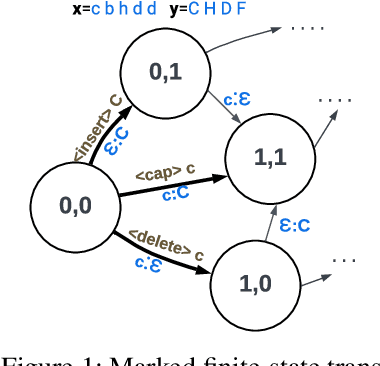

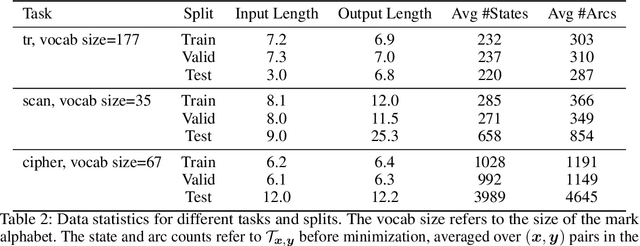
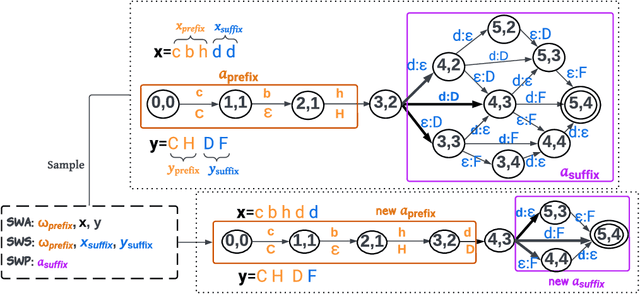
Neural finite-state transducers (NFSTs) form an expressive family of neurosymbolic sequence transduction models. An NFST models each string pair as having been generated by a latent path in a finite-state transducer. As they are deep generative models, both training and inference of NFSTs require inference networks that approximate posterior distributions over such latent variables. In this paper, we focus on the resulting challenge of imputing the latent alignment path that explains a given pair of input and output strings (e.g., during training). We train three autoregressive approximate models for amortized inference of the path, which can then be used as proposal distributions for importance sampling. All three models perform lookahead. Our most sophisticated (and novel) model leverages the FST structure to consider the graph of future paths; unfortunately, we find that it loses out to the simpler approaches -- except on an artificial task that we concocted to confuse the simpler approaches.
A Glitch in the Matrix? Locating and Detecting Language Model Grounding with Fakepedia
Dec 04, 2023
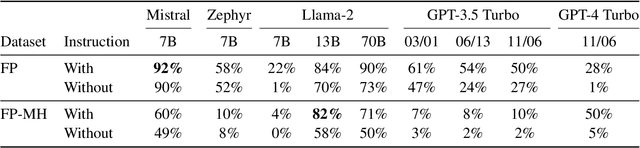


Large language models (LLMs) have demonstrated impressive capabilities in storing and recalling factual knowledge, but also in adapting to novel in-context information. Yet, the mechanisms underlying their in-context grounding remain unknown, especially in situations where in-context information contradicts factual knowledge embedded in the parameters. This is critical for retrieval-augmented generation methods, which enrich the context with up-to-date information, hoping that grounding can rectify the outdated parametric knowledge. In this study, we introduce Fakepedia, a counterfactual dataset designed to evaluate grounding abilities when the parametric knowledge clashes with the in-context information. We benchmark various LLMs with Fakepedia and discover that GPT-4-turbo has a strong preference for its parametric knowledge. Mistral-7B, on the contrary, is the model that most robustly chooses the grounded answer. Then, we conduct causal mediation analysis on LLM components when answering Fakepedia queries. We demonstrate that inspection of the computational graph alone can predict LLM grounding with 92.8% accuracy, especially because few MLPs in the Transformer can predict non-grounded behavior. Our results, together with existing findings about factual recall mechanisms, provide a coherent narrative of how grounding and factual recall mechanisms interact within LLMs.
Interpreting User Requests in the Context of Natural Language Standing Instructions
Nov 16, 2023Users of natural language interfaces, generally powered by Large Language Models (LLMs),often must repeat their preferences each time they make a similar request. To alleviate this, we propose including some of a user's preferences and instructions in natural language -- collectively termed standing instructions -- as additional context for such interfaces. For example, when a user states I'm hungry, their previously expressed preference for Persian food will be automatically added to the LLM prompt, so as to influence the search for relevant restaurants. We develop NLSI, a language-to-program dataset consisting of over 2.4K dialogues spanning 17 domains, where each dialogue is paired with a user profile (a set of users specific standing instructions) and corresponding structured representations (API calls). A key challenge in NLSI is to identify which subset of the standing instructions is applicable to a given dialogue. NLSI contains diverse phenomena, from simple preferences to interdependent instructions such as triggering a hotel search whenever the user is booking tickets to an event. We conduct experiments on NLSI using prompting with large language models and various retrieval approaches, achieving a maximum of 44.7% exact match on API prediction. Our results demonstrate the challenges in identifying the relevant standing instructions and their interpretation into API calls.
SCREWS: A Modular Framework for Reasoning with Revisions
Sep 20, 2023Large language models (LLMs) can improve their accuracy on various tasks through iteratively refining and revising their output based on feedback. We observe that these revisions can introduce errors, in which case it is better to roll back to a previous result. Further, revisions are typically homogeneous: they use the same reasoning method that produced the initial answer, which may not correct errors. To enable exploration in this space, we present SCREWS, a modular framework for reasoning with revisions. It is comprised of three main modules: Sampling, Conditional Resampling, and Selection, each consisting of sub-modules that can be hand-selected per task. We show that SCREWS not only unifies several previous approaches under a common framework, but also reveals several novel strategies for identifying improved reasoning chains. We evaluate our framework with state-of-the-art LLMs (ChatGPT and GPT-4) on a diverse set of reasoning tasks and uncover useful new reasoning strategies for each: arithmetic word problems, multi-hop question answering, and code debugging. Heterogeneous revision strategies prove to be important, as does selection between original and revised candidates.
Toward Interactive Dictation
Jul 08, 2023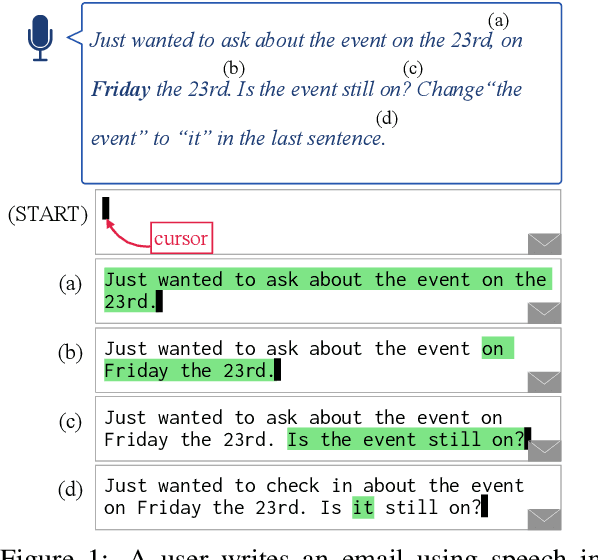
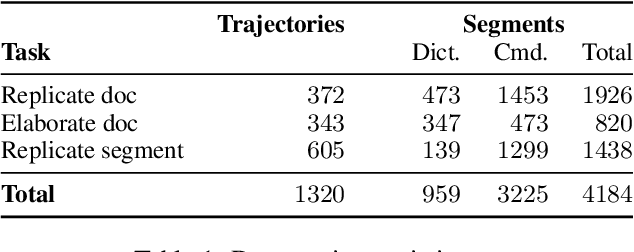
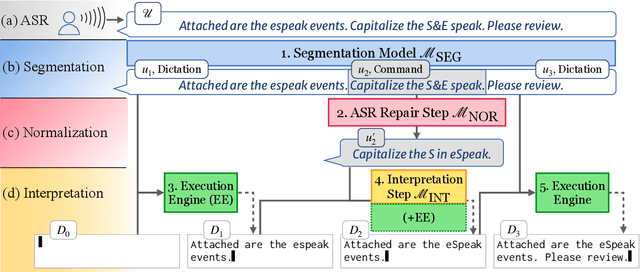
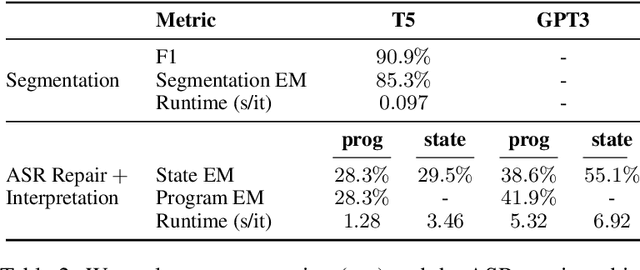
Voice dictation is an increasingly important text input modality. Existing systems that allow both dictation and editing-by-voice restrict their command language to flat templates invoked by trigger words. In this work, we study the feasibility of allowing users to interrupt their dictation with spoken editing commands in open-ended natural language. We introduce a new task and dataset, TERTiUS, to experiment with such systems. To support this flexibility in real-time, a system must incrementally segment and classify spans of speech as either dictation or command, and interpret the spans that are commands. We experiment with using large pre-trained language models to predict the edited text, or alternatively, to predict a small text-editing program. Experiments show a natural trade-off between model accuracy and latency: a smaller model achieves 30% end-state accuracy with 1.3 seconds of latency, while a larger model achieves 55% end-state accuracy with 7 seconds of latency.
Efficient Semiring-Weighted Earley Parsing
Jul 06, 2023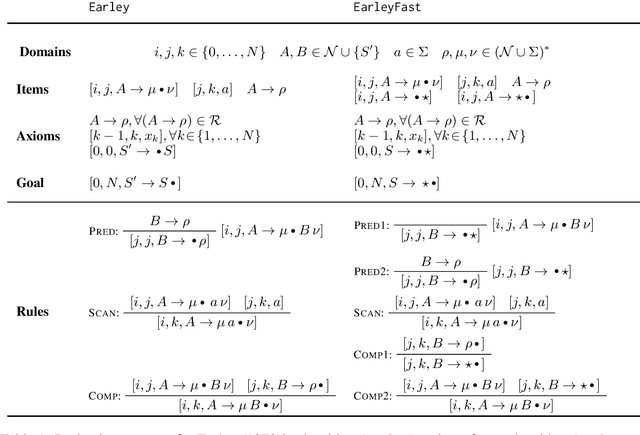
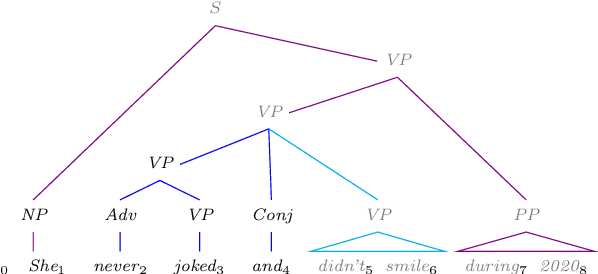
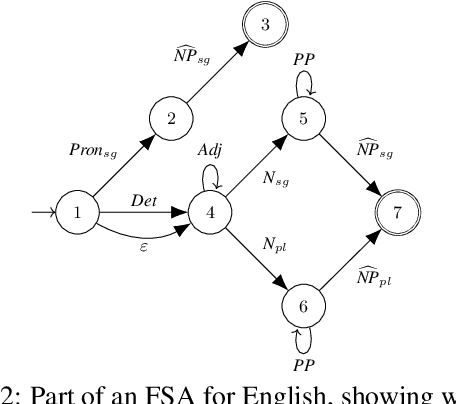
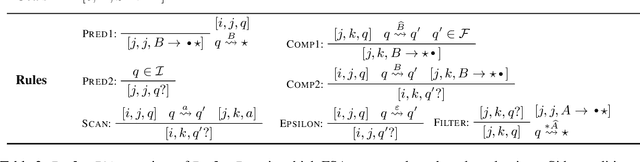
This paper provides a reference description, in the form of a deduction system, of Earley's (1970) context-free parsing algorithm with various speed-ups. Our presentation includes a known worst-case runtime improvement from Earley's $O (N^3|G||R|)$, which is unworkable for the large grammars that arise in natural language processing, to $O (N^3|G|)$, which matches the runtime of CKY on a binarized version of the grammar $G$. Here $N$ is the length of the sentence, $|R|$ is the number of productions in $G$, and $|G|$ is the total length of those productions. We also provide a version that achieves runtime of $O (N^3|M|)$ with $|M| \leq |G|$ when the grammar is represented compactly as a single finite-state automaton $M$ (this is partly novel). We carefully treat the generalization to semiring-weighted deduction, preprocessing the grammar like Stolcke (1995) to eliminate deduction cycles, and further generalize Stolcke's method to compute the weights of sentence prefixes. We also provide implementation details for efficient execution, ensuring that on a preprocessed grammar, the semiring-weighted versions of our methods have the same asymptotic runtime and space requirements as the unweighted methods, including sub-cubic runtime on some grammars.
Decision-Oriented Dialogue for Human-AI Collaboration
Jun 01, 2023We describe a class of tasks called decision-oriented dialogues, in which AI assistants must collaborate with one or more humans via natural language to help them make complex decisions. We formalize three domains in which users face everyday decisions: (1) choosing an assignment of reviewers to conference papers, (2) planning a multi-step itinerary in a city, and (3) negotiating travel plans for a group of friends. In each of these settings, AI assistants and users have disparate abilities that they must combine to arrive at the best decision: assistants can access and process large amounts of information, while users have preferences and constraints external to the system. For each task, we build a dialogue environment where agents receive a reward based on the quality of the final decision they reach. Using these environments, we collect human-human dialogues with humans playing the role of assistant. To compare how current AI assistants communicate in these settings, we present baselines using large language models in self-play. Finally, we highlight a number of challenges models face in decision-oriented dialogues, ranging from efficient communication to reasoning and optimization, and release our environments as a testbed for future modeling work.
Autoregressive Modeling with Lookahead Attention
May 20, 2023To predict the next token, autoregressive models ordinarily examine the past. Could they also benefit from also examining hypothetical futures? We consider a novel Transformer-based autoregressive architecture that estimates the next-token distribution by extrapolating multiple continuations of the past, according to some proposal distribution, and attending to these extended strings. This architecture draws insights from classical AI systems such as board game players: when making a local decision, a policy may benefit from exploring possible future trajectories and analyzing them. On multiple tasks including morphological inflection and Boolean satisfiability, our lookahead model is able to outperform the ordinary Transformer model of comparable size. However, on some tasks, it appears to be benefiting from the extra computation without actually using the lookahead information. We discuss possible variant architectures as well as future speedups.