 Add to Chrome
 Add to Firefox
 Add to Edge
Synthetic Persona Pretraining: Alignment from Token Zero
Aug 13, 2026
As language-model-based AI is increasingly deployed in autonomous settings, aligning its goals and values with those of humans becomes critical. Today, alignment, and the assistant identity itself, are typically introduced only after pretraining, once behavioral priors are already established. This can make values a thin overlay, rather than deeply rooted, and facilitate subsequent misalignment. Pursuing a different paradigm, we introduce Synthetic Persona Pretraining (SPP), which installs the desired assistant persona from token zero in pretraining. First, we annotate pretraining documents with value-aligned first-person reflections derived from a normative value constitution. Second, we pretrain via the standard cross-entropy loss on standard pretraining documents as well as their reflections, which installs the desired persona among a multitude of other personas. Finally, we post-train on user-assistant dialogue data, which binds this desired persona to the assistant identity, a process we call persona binding. By pretraining models up to 3B parameters on 500B tokens, we show that SPP improves constitution following and jailbreak robustness, and reduces the misalignment rate in out-of-distribution moral dilemmas, while preserving capabilities. Early intervention matters: compared with alignment from token zero, introducing SPP only at the end of pretraining yields weaker constitution adherence, does not shift value priorities, and leads to less aligned choices in dilemmas. This advantage depends on persona binding and, importantly, increases with pretraining budget. Overall, our results show that shaping values early is critical for alignment and establish pretraining-time persona interventions as an effective approach to do so.

Tandem Reinforcement Learning with Verifiable Rewards
Jun 26, 2026Reinforcement learning with verifiable rewards (RLVR) has significantly improved the reasoning capability of large language models, reaching expert or even superhuman performance in domains such as competition math. However, whether weaker agents and humans can actually harness this capability is far less certain, with RLVR documented to drift reasoning toward idiosyncratic patterns such as poor readability and language mixing. Tandem training is a recently introduced paradigm that targets this compatibility problem: a trained, stronger senior co-generates each rollout with a frozen, weaker junior, and the two are rewarded as a team, so the senior is pushed to reason in ways the junior can follow. Yet this paradigm has so far been demonstrated only in proof-of-concept settings, leaving open whether it scales to the long chains of thought of the modern RLVR pipeline. In this work, we propose Tandem Reinforcement Learning (TRL), which carries the tandem training paradigm into RLVR. In TRL, the senior and a frozen junior alternate stochastically to co-generate the reasoning, the resulting generation is rewarded, and the standard GRPO loss is applied to the senior. Training Qwen3-4B-Instruct on competition math, we find that TRL matches vanilla GRPO on solo reasoning capability while three properties emerge together from the same rollout structure: stronger handoff robustness with the junior, reduced distributional drift from the junior, and a chain-of-thought more legible to the junior. Our results demonstrate a promising route for RLVR with practical payoffs in multi-model communication and human compatibility.
Tracing Persona Vectors Through LLM Pretraining
May 13, 2026How large language models internally represent high-level behaviors is a core interpretability question with direct relevance to AI safety: it determines what we can detect, audit, or intervene on. Recent work has shown that traits such as evil or sycophancy correspond to linear directions in the internal activations, the so-called persona vectors. Although these vectors are now routinely utilized to inspect and steer model behavior in safety-relevant settings, how these representations are formed during training remains unknown. To address this gap, we trace persona vectors across the pretraining of OLMo-3-7B, finding that persona vectors form remarkably early -- within 0.22% of OLMo-3 pretraining -- and remain effective for steering the fully post-trained instruct models. Although core representations are formed early on, persona vectors continue to refine geometrically and semantically throughout pretraining. We further compare alternative elicitation strategies and find that all yield effective directions, with each strategy surfacing qualitatively distinct facets of the underlying persona. Replicating our analysis on Apertus-8B reveals that our findings transfer qualitatively beyond OLMo-3. Our results establish persona representations as stable features of early pretraining and open a path to studying how training forms, refines, and shapes them.
Beyond the Rabbit Hole: Mapping the Relational Harms of QAnon Radicalization
Jan 25, 2026The rise of conspiracy theories has created far-reaching societal harm in the public discourse by eroding trust and fueling polarization. Beyond this public impact lies a deeply personal toll on the friends and families of conspiracy believers, a dimension often overlooked in large-scale computational research. This study fills this gap by systematically mapping radicalization journeys and quantifying the associated emotional toll inflicted on loved ones. We use the prominent case of QAnon as a case study, analyzing 12747 narratives from the r/QAnonCasualties support community through a novel mixed-methods approach. First, we use topic modeling (BERTopic) to map the radicalization trajectories, identifying key pre-existing conditions, triggers, and post-radicalization characteristics. From this, we apply an LDA-based graphical model to uncover six recurring archetypes of QAnon adherents, which we term "radicalization personas." Finally, using LLM-assisted emotion detection and regression modeling, we link these personas to the specific emotional toll reported by narrators. Our findings reveal that these personas are not just descriptive; they are powerful predictors of the specific emotional harms experienced by narrators. Radicalization perceived as a deliberate ideological choice is associated with narrator anger and disgust, while those marked by personal and cognitive collapse are linked to fear and sadness. This work provides the first empirical framework for understanding radicalization as a relational phenomenon, offering a vital roadmap for researchers and practitioners to navigate its interpersonal fallout.
Integrating Machine-Generated Short Descriptions into the Wikipedia Android App: A Pilot Deployment of Descartes
Jan 12, 2026Short descriptions are a key part of the Wikipedia user experience, but their coverage remains uneven across languages and topics. In previous work, we introduced Descartes, a multilingual model for generating short descriptions. In this report, we present the results of a pilot deployment of Descartes in the Wikipedia Android app, where editors were offered suggestions based on outputs from Descartes while editing short descriptions. The experiment spanned 12 languages, with over 3,900 articles and 375 editors participating. Overall, 90% of accepted Descartes descriptions were rated at least 3 out of 5 in quality, and their average ratings were comparable to human-written ones. Editors adopted machine suggestions both directly and with modifications, while the rate of reverts and reports remained low. The pilot also revealed practical considerations for deployment, including latency, language-specific gaps, and the need for safeguards around sensitive topics. These results indicate that Descartes's short descriptions can support editors in reducing content gaps, provided that technical, design, and community guardrails are in place.
TiME: Tiny Monolingual Encoders for Efficient NLP Pipelines
Dec 16, 2025Today, a lot of research on language models is focused on large, general-purpose models. However, many NLP pipelines only require models with a well-defined, small set of capabilities. While large models are capable of performing the tasks of those smaller models, they are simply not fast enough to process large amounts of data or offer real-time responses. Furthermore, they often use unnecessarily large amounts of energy, leading to sustainability concerns and problems when deploying them on battery-powered devices. In our work, we show how to train small models for such efficiency-critical applications. As opposed to many off-the-shelf NLP pipelines, our models use modern training techniques such as distillation, and offer support for low-resource languages. We call our models TiME (Tiny Monolingual Encoders) and comprehensively evaluate them on a range of common NLP tasks, observing an improved trade-off between benchmark performance on one hand, and throughput, latency and energy consumption on the other. Along the way, we show that distilling monolingual models from multilingual teachers is possible, and likewise distilling models with absolute positional embeddings from teachers with relative positional embeddings.
Carrot, stick, or both? Price incentives for sustainable food choice in competitive environments
Dec 15, 2025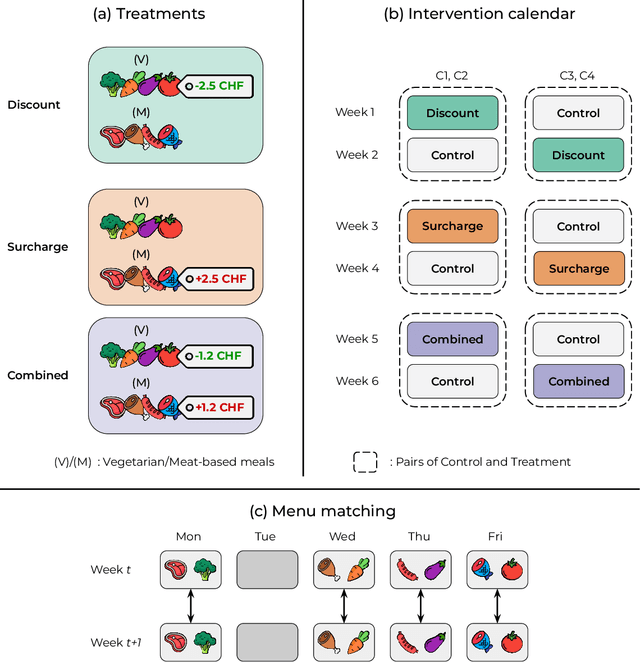
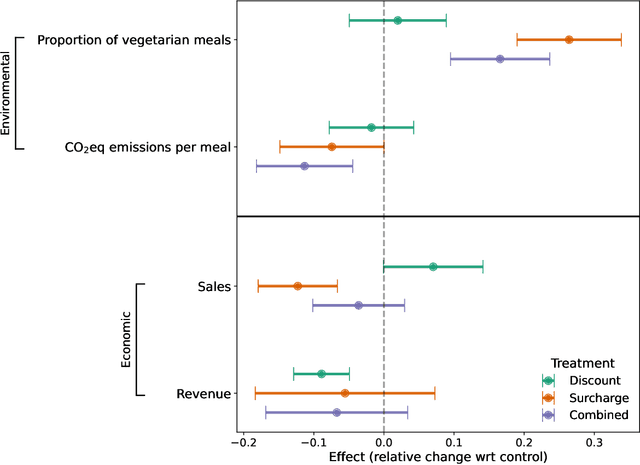
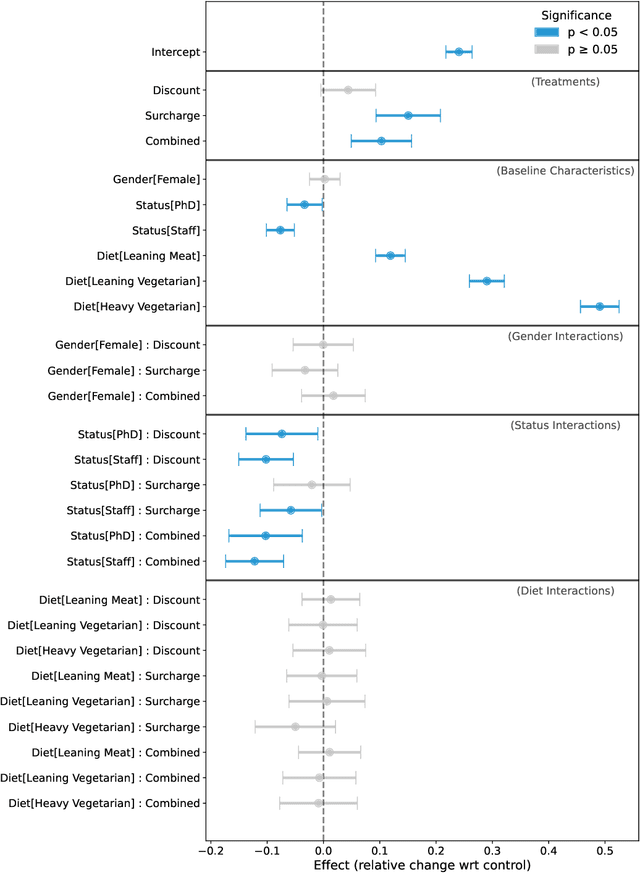
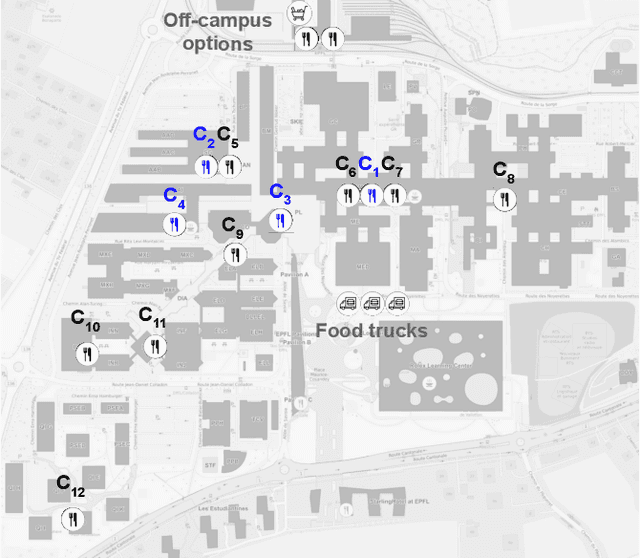
Meat consumption is a major driver of global greenhouse gas emissions. While pricing interventions have shown potential to reduce meat intake, previous studies have focused on highly constrained environments with limited consumer choice. Here, we present the first large-scale field experiment to evaluate multiple pricing interventions in a real-world, competitive setting. Using a sequential crossover design with matched menus in a Swiss university campus, we systematically compared vegetarian-meal discounts (-2.5 CHF), meat surcharges (+2.5 CHF), and a combined scheme (-1.2 CHF=+1.2 CHF) across four campus cafeterias. Only the surcharge and combined interventions led to significant increases in vegetarian meal uptake--by 26.4% and 16.6%, respectively--and reduced CO2 emissions per meal by 7.4% and 11.3%, respectively. The surcharge, while effective, triggered a 12.3% drop in sales at intervention sites and a corresponding 14.9% increase in non-treated locations, hence causing a spillover effect that completely offset environmental gains. In contrast, the combined approach achieved meaningful emission reductions without significant effects on overall sales or revenue, making it both effective and economically viable. Notably, pricing interventions were equally effective for both vegetarian-leaning customers and habitual meat-eaters, stimulating change even within entrenched dietary habits. Our results show that balanced pricing strategies can reduce the carbon footprint of realistic food environments, but require coordinated implementation to maximize climate benefits and avoid unintended spillover effects.
From Model Training to Model Raising
Nov 17, 2025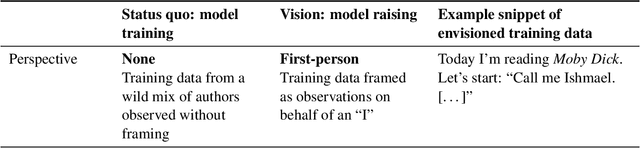
Current AI training methods align models with human values only after their core capabilities have been established, resulting in models that are easily misaligned and lack deep-rooted value systems. We propose a paradigm shift from "model training" to "model raising", in which alignment is woven into a model's development from the start. We identify several key components for this paradigm, all centered around redesigning the training corpus: reframing training data from a first-person perspective, recontextualizing information as lived experience, simulating social interactions, and scaffolding the ordering of training data. We expect that this redesign of the training corpus will lead to an early commitment to values from the first training token onward, such that knowledge, skills, and values are intrinsically much harder to separate. In an ecosystem in which large language model capabilities start overtaking human capabilities in many tasks, this seems to us like a critical need.
Cmprsr: Abstractive Token-Level Question-Agnostic Prompt Compressor
Nov 15, 2025Motivated by the high costs of using black-box Large Language Models (LLMs), we introduce a novel prompt compression paradigm, under which we use smaller LLMs to compress inputs for the larger ones. We present the first comprehensive LLM-as-a-compressor benchmark spanning 25 open- and closed-source models, which reveals significant disparity in models' compression ability in terms of (i) preserving semantically important information (ii) following the user-provided compression rate (CR). We further improve the performance of gpt-4.1-mini, the best overall vanilla compressor, with Textgrad-based compression meta-prompt optimization. We also identify the most promising open-source vanilla LLM - Qwen3-4B - and post-train it with a combination of supervised fine-tuning (SFT) and Group Relative Policy Optimization (GRPO), pursuing the dual objective of CR adherence and maximizing the downstream task performance. We call the resulting model Cmprsr and demonstrate its superiority over both extractive and vanilla abstractive compression across the entire range of compression rates on lengthy inputs from MeetingBank and LongBench as well as short prompts from GSM8k. The latter highlights Cmprsr's generalizability across varying input lengths and domains. Moreover, Cmprsr closely follows the requested compression rate, offering fine control over the cost-quality trade-off.
Interactive Evaluation of Large Language Models for Multi-Requirement Software Engineering Tasks
Aug 26, 2025Standard single-turn, static benchmarks fall short in evaluating the nuanced capabilities of Large Language Models (LLMs) on complex tasks such as software engineering. In this work, we propose a novel interactive evaluation framework that assesses LLMs on multi-requirement programming tasks through structured, feedback-driven dialogue. Each task is modeled as a requirement dependency graph, and an ``interviewer'' LLM, aware of the ground-truth solution, provides minimal, targeted hints to an ``interviewee'' model to help correct errors and fulfill target constraints. This dynamic protocol enables fine-grained diagnostic insights into model behavior, uncovering strengths and systematic weaknesses that static benchmarks fail to measure. We build on DevAI, a benchmark of 55 curated programming tasks, by adding ground-truth solutions and evaluating the relevance and utility of interviewer hints through expert annotation. Our results highlight the importance of dynamic evaluation in advancing the development of collaborative code-generating agents.