 Add to Chrome
 Add to Firefox
 Add to Edge
Localizing and Editing Knowledge in Large Audio-Language Models
Mar 15, 2026
Large Audio-Language Models (LALMs) have shown strong performance in speech understanding, making speech a natural interface for accessing factual information. Yet they are trained on static corpora and may encode incorrect facts. Existing model editing methods localize and update facts in text-only LLMs, but do not account for continuous speech representations, or where knowledge is stored across acoustic or language modules, or their cross-modal module. We construct the first audio benchmark for knowledge localization and editing in LALMs and propose a speech-driven locate-then-edit framework. First, we use speech-aware causal tracing to localize layers and modules that support factual retrieval and then apply editing at identified sites. Experiments show that factual knowledge is jointly encoded in audio and text modules, and that audio editing yields more effective updates than text editing or fine-tuning, enabling fine-grained knowledge control in speech AI systems.

Disentangling Reasoning in Large Audio-Language Models for Ambiguous Emotion Prediction
Mar 09, 2026Speech emotion recognition plays an important role in various applications. However, most existing approaches predict a single emotion label, oversimplifying the inherently ambiguous nature of human emotional expression. Recent large audio-language models show promise in generating richer outputs, but their reasoning ability for ambiguous emotional understanding remains limited. In this work, we reformulate ambiguous emotion recognition as a distributional reasoning problem and present the first systematic study of ambiguity-aware reasoning in LALMs. Our framework comprises two complementary components: an ambiguity-aware objective that aligns predictions with human perceptual distributions, and a structured ambiguity-aware chain-of-thought supervision that guides reasoning over emotional cues. Experiments on IEMOCAP and CREMA-D demonstrate consistent improvements across SFT, DPO, and GRPO training strategies.
Test-Time Adaptation for Speech Emotion Recognition
Jan 21, 2026The practical utility of Speech Emotion Recognition (SER) systems is undermined by their fragility to domain shifts, such as speaker variability, the distinction between acted and naturalistic emotions, and cross-corpus variations. While domain adaptation and fine-tuning are widely studied, they require either source data or labelled target data, which are often unavailable or raise privacy concerns in SER. Test-time adaptation (TTA) bridges this gap by adapting models at inference using only unlabeled target data. Yet, having been predominantly designed for image classification and speech recognition, the efficacy of TTA for mitigating the unique domain shifts in SER has not been investigated. In this paper, we present the first systematic evaluation and comparison covering 11 TTA methods across three representative SER tasks. The results indicate that backpropagation-free TTA methods are the most promising. Conversely, entropy minimization and pseudo-labeling generally fail, as their core assumption of a single, confident ground-truth label is incompatible with the inherent ambiguity of emotional expression. Further, no single method universally excels, and its effectiveness is highly dependent on the distributional shifts and tasks.
E-BATS: Efficient Backpropagation-Free Test-Time Adaptation for Speech Foundation Models
Jun 08, 2025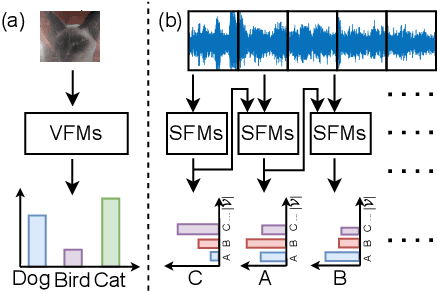
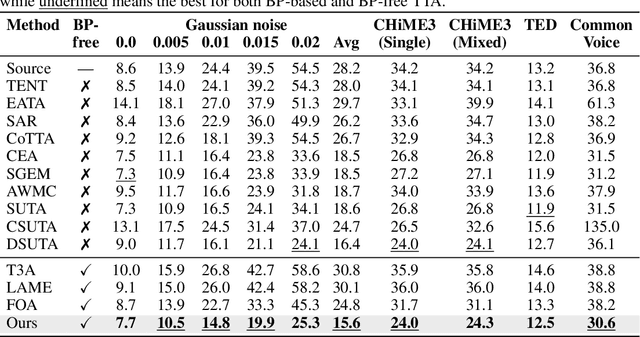

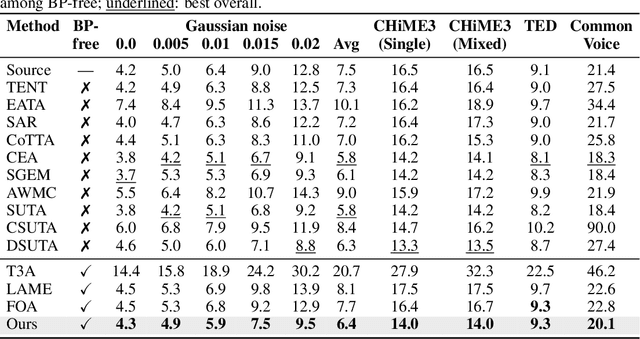
Speech Foundation Models encounter significant performance degradation when deployed in real-world scenarios involving acoustic domain shifts, such as background noise and speaker accents. Test-time adaptation (TTA) has recently emerged as a viable strategy to address such domain shifts at inference time without requiring access to source data or labels. However, existing TTA approaches, particularly those relying on backpropagation, are memory-intensive, limiting their applicability in speech tasks and resource-constrained settings. Although backpropagation-free methods offer improved efficiency, existing ones exhibit poor accuracy. This is because they are predominantly developed for vision tasks, which fundamentally differ from speech task formulations, noise characteristics, and model architecture, posing unique transferability challenges. In this paper, we introduce E-BATS, the first Efficient BAckpropagation-free TTA framework designed explicitly for speech foundation models. E-BATS achieves a balance between adaptation effectiveness and memory efficiency through three key components: (i) lightweight prompt adaptation for a forward-pass-based feature alignment, (ii) a multi-scale loss to capture both global (utterance-level) and local distribution shifts (token-level) and (iii) a test-time exponential moving average mechanism for stable adaptation across utterances. Experiments conducted on four noisy speech datasets spanning sixteen acoustic conditions demonstrate consistent improvements, with 4.1%-13.5% accuracy gains over backpropagation-free baselines and 2.0-6.4 times GPU memory savings compared to backpropagation-based methods. By enabling scalable and robust adaptation under acoustic variability, this work paves the way for developing more efficient adaptation approaches for practical speech processing systems in real-world environments.