 Add to Chrome
 Add to Firefox
 Add to Edge
Soft Filtering: Guiding Zero-shot Composed Image Retrieval with Prescriptive and Proscriptive Constraints
Dec 23, 2025
Composed Image Retrieval (CIR) aims to find a target image that aligns with user intent, expressed through a reference image and a modification text. While Zero-shot CIR (ZS-CIR) methods sidestep the need for labeled training data by leveraging pretrained vision-language models, they often rely on a single fused query that merges all descriptive cues of what the user wants, tending to dilute key information and failing to account for what they wish to avoid. Moreover, current CIR benchmarks assume a single correct target per query, overlooking the ambiguity in modification texts. To address these challenges, we propose Soft Filtering with Textual constraints (SoFT), a training-free, plug-and-play filtering module for ZS-CIR. SoFT leverages multimodal large language models (LLMs) to extract two complementary constraints from the reference-modification pair: prescriptive (must-have) and proscriptive (must-avoid) constraints. These serve as semantic filters that reward or penalize candidate images to re-rank results, without modifying the base retrieval model or adding supervision. In addition, we construct a two-stage dataset pipeline that refines CIR benchmarks. We first identify multiple plausible targets per query to construct multi-target triplets, capturing the open-ended nature of user intent. Then guide multimodal LLMs to rewrite the modification text to focus on one target, while referencing contrastive distractors to ensure precision. This enables more comprehensive and reliable evaluation under varying ambiguity levels. Applied on top of CIReVL, a ZS-CIR retriever, SoFT raises R@5 to 65.25 on CIRR (+12.94), mAP@50 to 27.93 on CIRCO (+6.13), and R@50 to 58.44 on FashionIQ (+4.59), demonstrating broad effectiveness.

DALDA: Data Augmentation Leveraging Diffusion Model and LLM with Adaptive Guidance Scaling
Sep 25, 2024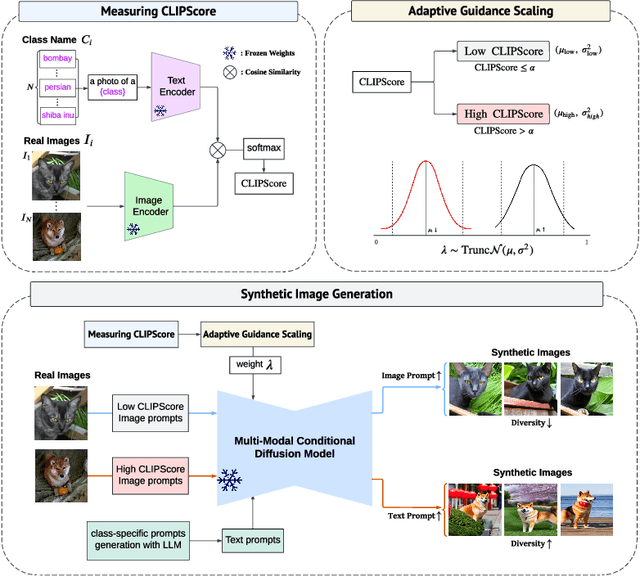


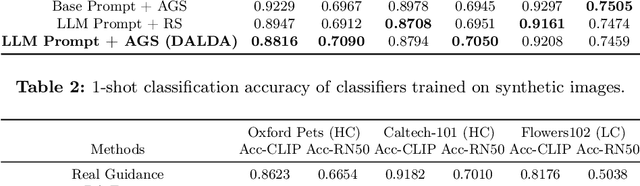
In this paper, we present an effective data augmentation framework leveraging the Large Language Model (LLM) and Diffusion Model (DM) to tackle the challenges inherent in data-scarce scenarios. Recently, DMs have opened up the possibility of generating synthetic images to complement a few training images. However, increasing the diversity of synthetic images also raises the risk of generating samples outside the target distribution. Our approach addresses this issue by embedding novel semantic information into text prompts via LLM and utilizing real images as visual prompts, thus generating semantically rich images. To ensure that the generated images remain within the target distribution, we dynamically adjust the guidance weight based on each image's CLIPScore to control the diversity. Experimental results show that our method produces synthetic images with enhanced diversity while maintaining adherence to the target distribution. Consequently, our approach proves to be more efficient in the few-shot setting on several benchmarks. Our code is available at https://github.com/kkyuhun94/dalda .