 Add to Chrome
 Add to Firefox
 Add to Edge
Understanding Fine-grained Distortions in Reports of Scientific Findings
Feb 19, 2024
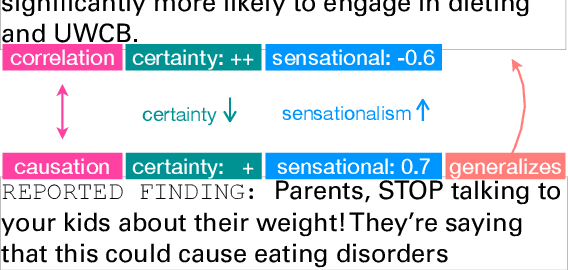
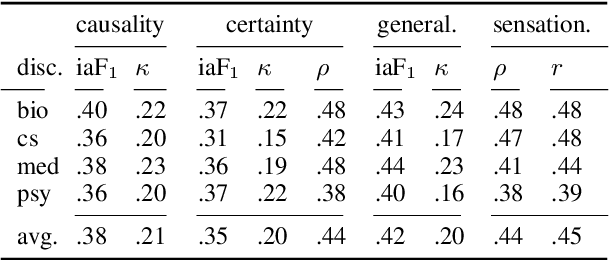
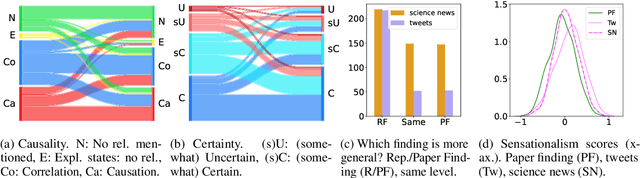
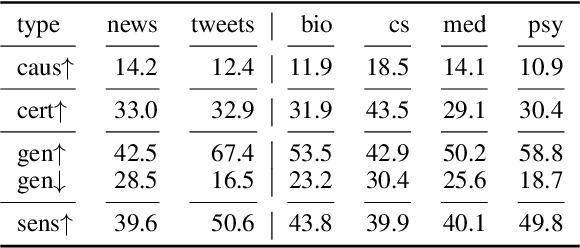
Distorted science communication harms individuals and society as it can lead to unhealthy behavior change and decrease trust in scientific institutions. Given the rapidly increasing volume of science communication in recent years, a fine-grained understanding of how findings from scientific publications are reported to the general public, and methods to detect distortions from the original work automatically, are crucial. Prior work focused on individual aspects of distortions or worked with unpaired data. In this work, we make three foundational contributions towards addressing this problem: (1) annotating 1,600 instances of scientific findings from academic papers paired with corresponding findings as reported in news articles and tweets wrt. four characteristics: causality, certainty, generality and sensationalism; (2) establishing baselines for automatically detecting these characteristics; and (3) analyzing the prevalence of changes in these characteristics in both human-annotated and large-scale unlabeled data. Our results show that scientific findings frequently undergo subtle distortions when reported. Tweets distort findings more often than science news reports. Detecting fine-grained distortions automatically poses a challenging task. In our experiments, fine-tuned task-specific models consistently outperform few-shot LLM prompting.

Semantic Sensitivities and Inconsistent Predictions: Measuring the Fragility of NLI Models
Jan 31, 2024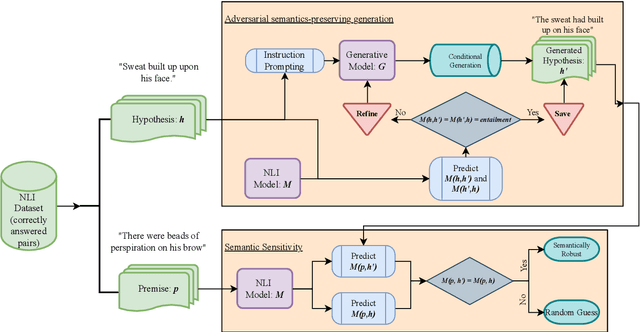
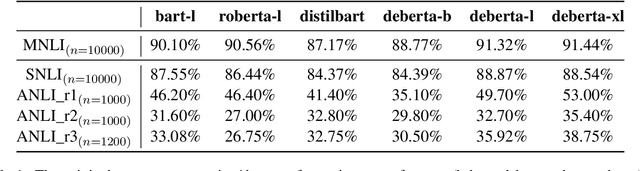
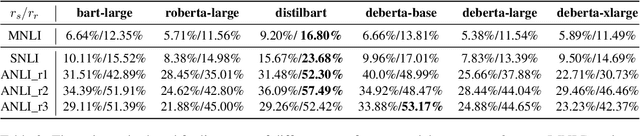
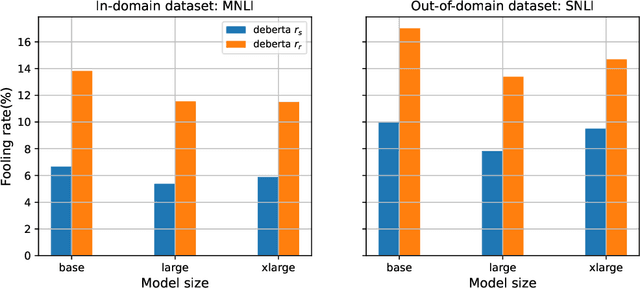
Recent studies of the emergent capabilities of transformer-based Natural Language Understanding (NLU) models have indicated that they have an understanding of lexical and compositional semantics. We provide evidence that suggests these claims should be taken with a grain of salt: we find that state-of-the-art Natural Language Inference (NLI) models are sensitive towards minor semantics preserving surface-form variations, which lead to sizable inconsistent model decisions during inference. Notably, this behaviour differs from valid and in-depth comprehension of compositional semantics, however does neither emerge when evaluating model accuracy on standard benchmarks nor when probing for syntactic, monotonic, and logically robust reasoning. We propose a novel framework to measure the extent of semantic sensitivity. To this end, we evaluate NLI models on adversarially generated examples containing minor semantics-preserving surface-form input noise. This is achieved using conditional text generation, with the explicit condition that the NLI model predicts the relationship between the original and adversarial inputs as a symmetric equivalence entailment. We systematically study the effects of the phenomenon across NLI models for $\textbf{in-}$ and $\textbf{out-of-}$ domain settings. Our experiments show that semantic sensitivity causes performance degradations of $12.92\%$ and $23.71\%$ average over $\textbf{in-}$ and $\textbf{out-of-}$ domain settings, respectively. We further perform ablation studies, analysing this phenomenon across models, datasets, and variations in inference and show that semantic sensitivity can lead to major inconsistency within model predictions.
Grammatical Gender's Influence on Distributional Semantics: A Causal Perspective
Nov 30, 2023How much meaning influences gender assignment across languages is an active area of research in modern linguistics and cognitive science. We can view current approaches as aiming to determine where gender assignment falls on a spectrum, from being fully arbitrarily determined to being largely semantically determined. For the latter case, there is a formulation of the neo-Whorfian hypothesis, which claims that even inanimate noun gender influences how people conceive of and talk about objects (using the choice of adjective used to modify inanimate nouns as a proxy for meaning). We offer a novel, causal graphical model that jointly represents the interactions between a noun's grammatical gender, its meaning, and adjective choice. In accordance with past results, we find a relationship between the gender of nouns and the adjectives which modify them. However, when we control for the meaning of the noun, we find that grammatical gender has a near-zero effect on adjective choice, thereby calling the neo-Whorfian hypothesis into question.
Factcheck-GPT: End-to-End Fine-Grained Document-Level Fact-Checking and Correction of LLM Output
Nov 16, 2023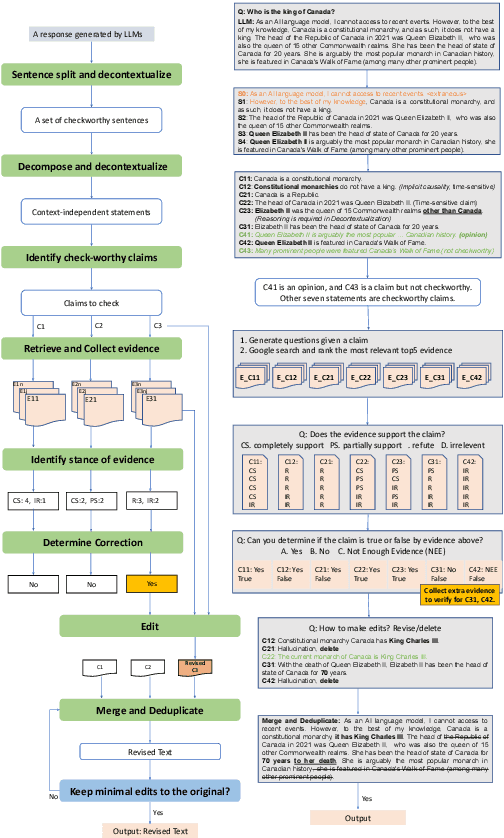


The increased use of large language models (LLMs) across a variety of real-world applications calls for mechanisms to verify the factual accuracy of their outputs. In this work, we present a holistic end-to-end solution for annotating the factuality of LLM-generated responses, which encompasses a multi-stage annotation scheme designed to yield detailed labels concerning the verifiability and factual inconsistencies found in LLM outputs. We design and build an annotation tool to speed up the labelling procedure and ease the workload of raters. It allows flexible incorporation of automatic results in any stage, e.g. automatically-retrieved evidence. We further construct an open-domain document-level factuality benchmark in three-level granularity: claim, sentence and document. Preliminary experiments show that FacTool, FactScore and Perplexity.ai are struggling to identify false claims with the best F1=0.53. Annotation tool, benchmark and code are available at https://github.com/yuxiaw/Factcheck-GPT.
Social Bias Probing: Fairness Benchmarking for Language Models
Nov 15, 2023Large language models have been shown to encode a variety of social biases, which carries the risk of downstream harms. While the impact of these biases has been recognized, prior methods for bias evaluation have been limited to binary association tests on small datasets, offering a constrained view of the nature of societal biases within language models. In this paper, we propose an original framework for probing language models for societal biases. We collect a probing dataset to analyze language models' general associations, as well as along the axes of societal categories, identities, and stereotypes. To this end, we leverage a novel perplexity-based fairness score. We curate a large-scale benchmarking dataset addressing drawbacks and limitations of existing fairness collections, expanding to a variety of different identities and stereotypes. When comparing our methodology with prior work, we demonstrate that biases within language models are more nuanced than previously acknowledged. In agreement with recent findings, we find that larger model variants exhibit a higher degree of bias. Moreover, we expose how identities expressing different religions lead to the most pronounced disparate treatments across all models.
PHD: Pixel-Based Language Modeling of Historical Documents
Nov 04, 2023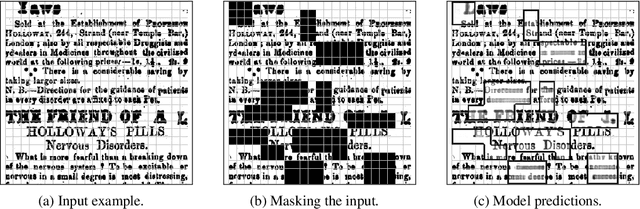
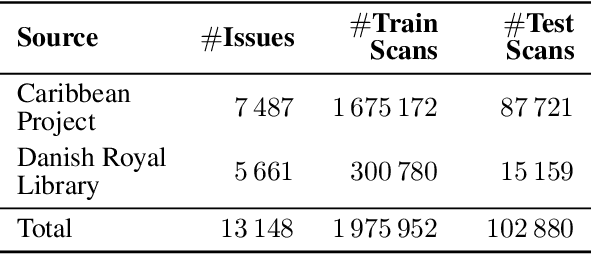
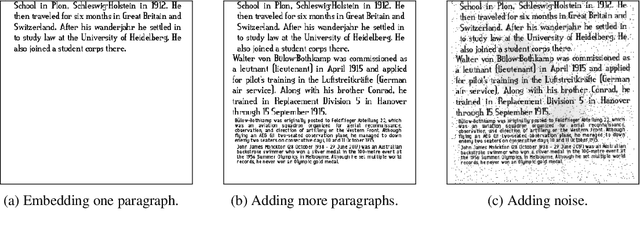
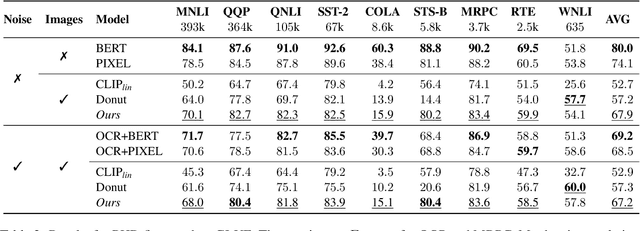
The digitisation of historical documents has provided historians with unprecedented research opportunities. Yet, the conventional approach to analysing historical documents involves converting them from images to text using OCR, a process that overlooks the potential benefits of treating them as images and introduces high levels of noise. To bridge this gap, we take advantage of recent advancements in pixel-based language models trained to reconstruct masked patches of pixels instead of predicting token distributions. Due to the scarcity of real historical scans, we propose a novel method for generating synthetic scans to resemble real historical documents. We then pre-train our model, PHD, on a combination of synthetic scans and real historical newspapers from the 1700-1900 period. Through our experiments, we demonstrate that PHD exhibits high proficiency in reconstructing masked image patches and provide evidence of our model's noteworthy language understanding capabilities. Notably, we successfully apply our model to a historical QA task, highlighting its usefulness in this domain.
People Make Better Edits: Measuring the Efficacy of LLM-Generated Counterfactually Augmented Data for Harmful Language Detection
Nov 02, 2023

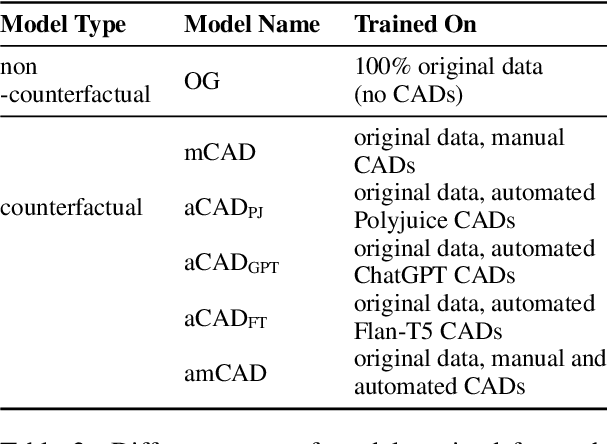

NLP models are used in a variety of critical social computing tasks, such as detecting sexist, racist, or otherwise hateful content. Therefore, it is imperative that these models are robust to spurious features. Past work has attempted to tackle such spurious features using training data augmentation, including Counterfactually Augmented Data (CADs). CADs introduce minimal changes to existing training data points and flip their labels; training on them may reduce model dependency on spurious features. However, manually generating CADs can be time-consuming and expensive. Hence in this work, we assess if this task can be automated using generative NLP models. We automatically generate CADs using Polyjuice, ChatGPT, and Flan-T5, and evaluate their usefulness in improving model robustness compared to manually-generated CADs. By testing both model performance on multiple out-of-domain test sets and individual data point efficacy, our results show that while manual CADs are still the most effective, CADs generated by ChatGPT come a close second. One key reason for the lower performance of automated methods is that the changes they introduce are often insufficient to flip the original label.
Why Should This Article Be Deleted? Transparent Stance Detection in Multilingual Wikipedia Editor Discussions
Oct 23, 2023
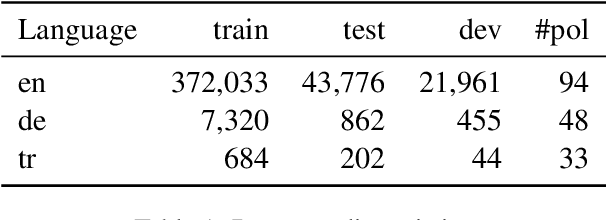
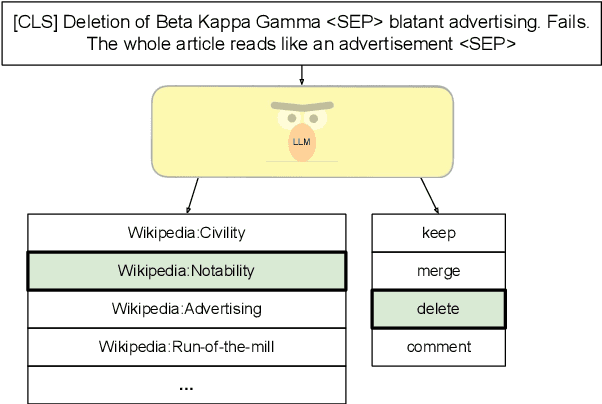
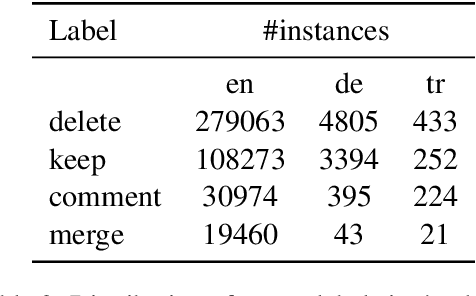
The moderation of content on online platforms is usually non-transparent. On Wikipedia, however, this discussion is carried out publicly and the editors are encouraged to use the content moderation policies as explanations for making moderation decisions. Currently, only a few comments explicitly mention those policies -- 20% of the English ones, but as few as 2% of the German and Turkish comments. To aid in this process of understanding how content is moderated, we construct a novel multilingual dataset of Wikipedia editor discussions along with their reasoning in three languages. The dataset contains the stances of the editors (keep, delete, merge, comment), along with the stated reason, and a content moderation policy, for each edit decision. We demonstrate that stance and corresponding reason (policy) can be predicted jointly with a high degree of accuracy, adding transparency to the decision-making process. We release both our joint prediction models and the multilingual content moderation dataset for further research on automated transparent content moderation.
Explaining Interactions Between Text Spans
Oct 20, 2023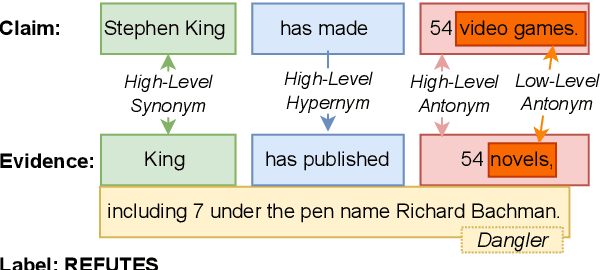
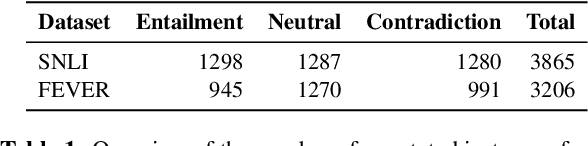
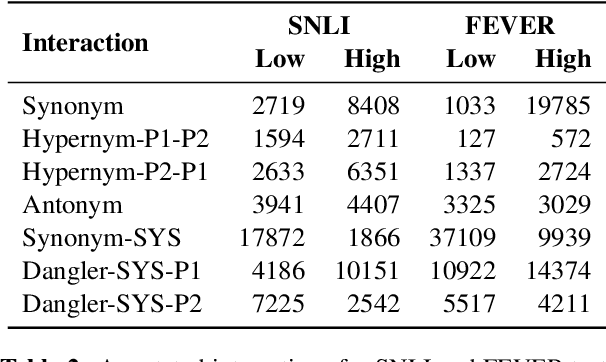
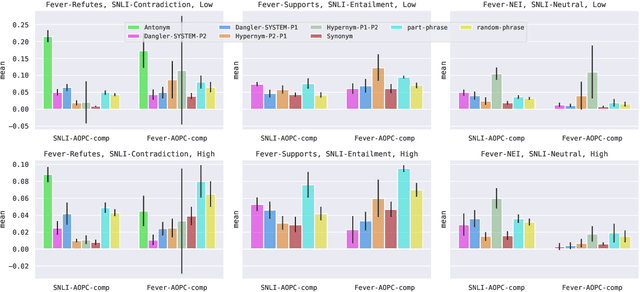
Reasoning over spans of tokens from different parts of the input is essential for natural language understanding (NLU) tasks such as fact-checking (FC), machine reading comprehension (MRC) or natural language inference (NLI). However, existing highlight-based explanations primarily focus on identifying individual important tokens or interactions only between adjacent tokens or tuples of tokens. Most notably, there is a lack of annotations capturing the human decision-making process w.r.t. the necessary interactions for informed decision-making in such tasks. To bridge this gap, we introduce SpanEx, a multi-annotator dataset of human span interaction explanations for two NLU tasks: NLI and FC. We then investigate the decision-making processes of multiple fine-tuned large language models in terms of the employed connections between spans in separate parts of the input and compare them to the human reasoning processes. Finally, we present a novel community detection based unsupervised method to extract such interaction explanations from a model's inner workings.
Factuality Challenges in the Era of Large Language Models
Oct 10, 2023The emergence of tools based on Large Language Models (LLMs), such as OpenAI's ChatGPT, Microsoft's Bing Chat, and Google's Bard, has garnered immense public attention. These incredibly useful, natural-sounding tools mark significant advances in natural language generation, yet they exhibit a propensity to generate false, erroneous, or misleading content -- commonly referred to as "hallucinations." Moreover, LLMs can be exploited for malicious applications, such as generating false but credible-sounding content and profiles at scale. This poses a significant challenge to society in terms of the potential deception of users and the increasing dissemination of inaccurate information. In light of these risks, we explore the kinds of technological innovations, regulatory reforms, and AI literacy initiatives needed from fact-checkers, news organizations, and the broader research and policy communities. By identifying the risks, the imminent threats, and some viable solutions, we seek to shed light on navigating various aspects of veracity in the era of generative AI.