 Add to Chrome
 Add to Firefox
 Add to Edge
CHAMMI-75: pre-training multi-channel models with heterogeneous microscopy images
Dec 23, 2025
Quantifying cell morphology using images and machine learning has proven to be a powerful tool to study the response of cells to treatments. However, models used to quantify cellular morphology are typically trained with a single microscopy imaging type. This results in specialized models that cannot be reused across biological studies because the technical specifications do not match (e.g., different number of channels), or because the target experimental conditions are out of distribution. Here, we present CHAMMI-75, an open access dataset of heterogeneous, multi-channel microscopy images from 75 diverse biological studies. We curated this resource from publicly available sources to investigate cellular morphology models that are channel-adaptive and can process any microscopy image type. Our experiments show that training with CHAMMI-75 can improve performance in multi-channel bioimaging tasks primarily because of its high diversity in microscopy modalities. This work paves the way to create the next generation of cellular morphology models for biological studies.

Factcheck-GPT: End-to-End Fine-Grained Document-Level Fact-Checking and Correction of LLM Output
Nov 16, 2023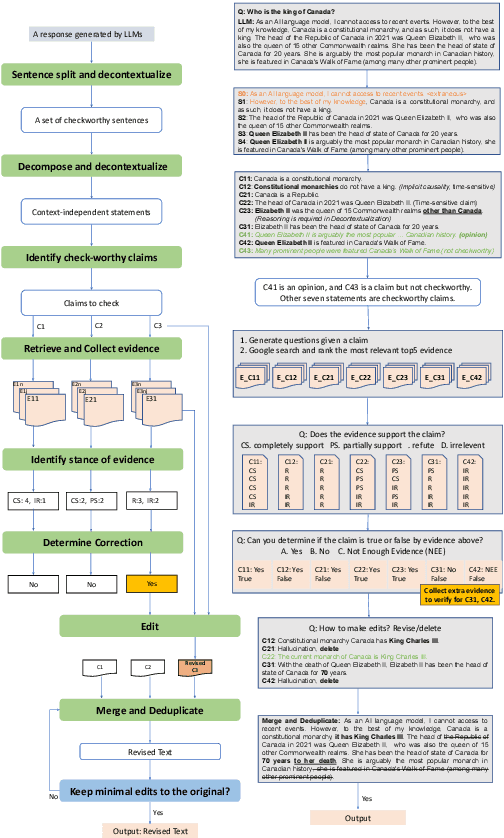


The increased use of large language models (LLMs) across a variety of real-world applications calls for mechanisms to verify the factual accuracy of their outputs. In this work, we present a holistic end-to-end solution for annotating the factuality of LLM-generated responses, which encompasses a multi-stage annotation scheme designed to yield detailed labels concerning the verifiability and factual inconsistencies found in LLM outputs. We design and build an annotation tool to speed up the labelling procedure and ease the workload of raters. It allows flexible incorporation of automatic results in any stage, e.g. automatically-retrieved evidence. We further construct an open-domain document-level factuality benchmark in three-level granularity: claim, sentence and document. Preliminary experiments show that FacTool, FactScore and Perplexity.ai are struggling to identify false claims with the best F1=0.53. Annotation tool, benchmark and code are available at https://github.com/yuxiaw/Factcheck-GPT.