 Add to Chrome
 Add to Firefox
 Add to Edge
CoRCi: Cross-Reconstruction of Coherent Interests Modeling in Cross-Domain Sequential Recommendation
Aug 10, 2026
Cross-Domain Sequential Recommendation (CDSR) aims to alleviate data sparsity by transferring dynamic user interests across related domains. A key challenge lies in effectively bridging these domains. In single-domain modeling, models cannot distinguish between domain-specific and domain-invariant interests. Recent methods merge domain-specific sequences chronologically into a mixed-domain sequence to capture domain-invariant knowledge. However, they typically deploy separate encoders for the mixed-domain sequence and train them with per-domain loss aggregation. This workflow magnifies inter-domain discrepancies and disrupts domain-invariant interest coherence, especially when query target pairs in Seq2Seq originate from different domains. In this paper, we present CoRCi (Cross-Reconstruction for Coherent Interest), a dual-target CDSR framework that tackles these drawbacks. Specifically, CoRCi proposes a Cross-Reconstruction approach that generates mixed-domain representations directly from pre-encoded specific-domain representations via cross-attention. The generated representations are then trained using a single, sequence-level, domain-agnostic loss to preserve the coherence of domain-invariant interests. To further suppress domain discrepancies in mixed-domain modeling, CoRCi introduces FocalNCE, which embeds Focal Loss into the preceding mixed-domain InfoNCE objective. The new loss assigns higher penalties to negatives drawn from the same domain as the query, thereby strengthening domain-invariant alignment. Extensive experiments on four real-world datasets demonstrate that CoRCi consistently outperforms state-of-the-art CDSR counterparts, achieving statistically significant gains across all metrics.

Human-Machine Co-Boosted Bug Report Identification with Mutualistic Neural Active Learning
Apr 20, 2026Bug reports, encompassing a wide range of bug types, are crucial for maintaining software quality. However, the increasing complexity and volume of bug reports pose a significant challenge in sole manual identification and assignment to the appropriate teams for resolution, as dealing with all the reports is time-consuming and resource-intensive. In this paper, we introduce a cross-project framework, dubbed Mutualistic Neural Active Learning (MNAL), designed for automated and more effective identification of bug reports from GitHub repositories boosted by human-machine collaboration. MNAL utilizes a neural language model that learns and generalizes reports across different projects, coupled with active learning to form neural active learning. A distinctive feature of MNAL is the purposely crafted mutualistic relation between the machine learners (neural language model) and human labelers (developers) when enriching the knowledge learned. That is, the most informative human-labeled reports and their corresponding pseudo-labeled ones are used to update the model while those reports that need to be labeled by developers are more readable and identifiable, thereby enhancing the human-machine teaming therein. We evaluate MNAL using a large scale dataset against the SOTA approaches, baselines, and different variants. The results indicate that MNAL achieves up to 95.8% and 196.0% effort reduction in terms of readability and identifiability during human labeling, respectively, while resulting in a better performance in bug report identification. Additionally, our MNAL is model-agnostic since it is capable of improving the model performance with various underlying neural language models. To further verify the efficacy of our approach, we conducted a qualitative case study involving 10 human participants, who rate MNAL as being more effective while saving more time and monetary resources.
Context-Aware Disentanglement for Cross-Domain Sequential Recommendation: A Causal View
Apr 09, 2026Cross-Domain Sequential Recommendation (CDSR) aims to en-hance recommendation quality by transferring knowledge across domains, offering effective solutions to data sparsity and cold-start issues. However, existing methods face three major limitations: (1) they overlook varying contexts in user interaction sequences, resulting in spurious correlations that obscure the true causal relationships driving user preferences; (2) the learning of domain- shared and domain-specific preferences is hindered by gradient conflicts between domains, leading to a seesaw effect where performance in one domain improves at the expense of the other; (3) most methods rely on the unrealistic assumption of substantial user overlap across domains. To address these issues, we propose CoDiS, a context-aware disentanglement framework grounded in a causal view to accurately disentangle domain-shared and domain-specific preferences. Specifically, Our approach includes a variational context adjustment method to reduce confounding effects of contexts, expert isolation and selection strategies to resolve gradient conflict, and a variational adversarial disentangling module for the thorough disentanglement of domain-shared and domain-specific representations. Extensive experiments on three real-world datasets demonstrate that CoDiS consistently outperforms state-of-the-art CDSR baselines with statistical significance. Code is available at:https://anonymous.4open.science/r/CoDiS-6FA0.
Routing Distilled Knowledge via Mixture of LoRA Experts for Large Language Model based Bundle Generation
Aug 24, 2025Large Language Models (LLMs) have shown potential in automatic bundle generation but suffer from prohibitive computational costs. Although knowledge distillation offers a pathway to more efficient student models, our preliminary study reveals that naively integrating diverse types of distilled knowledge from teacher LLMs into student LLMs leads to knowledge conflict, negatively impacting the performance of bundle generation. To address this, we propose RouteDK, a framework for routing distilled knowledge through a mixture of LoRA expert architecture. Specifically, we first distill knowledge from the teacher LLM for bundle generation in two complementary types: high-level knowledge (generalizable rules) and fine-grained knowledge (session-specific reasoning). We then train knowledge-specific LoRA experts for each type of knowledge together with a base LoRA expert. For effective integration, we propose a dynamic fusion module, featuring an input-aware router, where the router balances expert contributions by dynamically determining optimal weights based on input, thereby effectively mitigating knowledge conflicts. To further improve inference reliability, we design an inference-time enhancement module to reduce variance and mitigate suboptimal reasoning. Experiments on three public datasets show that our RouteDK achieves accuracy comparable to or even better than the teacher LLM, while maintaining strong computational efficiency. In addition, it outperforms state-of-the-art approaches for bundle generation.
Does Knowledge Distillation Matter for Large Language Model based Bundle Generation?
Apr 24, 2025LLMs are increasingly explored for bundle generation, thanks to their reasoning capabilities and knowledge. However, deploying large-scale LLMs introduces significant efficiency challenges, primarily high computational costs during fine-tuning and inference due to their massive parameterization. Knowledge distillation (KD) offers a promising solution, transferring expertise from large teacher models to compact student models. This study systematically investigates knowledge distillation approaches for bundle generation, aiming to minimize computational demands while preserving performance. We explore three critical research questions: (1) how does the format of KD impact bundle generation performance? (2) to what extent does the quantity of distilled knowledge influence performance? and (3) how do different ways of utilizing the distilled knowledge affect performance? We propose a comprehensive KD framework that (i) progressively extracts knowledge (patterns, rules, deep thoughts); (ii) captures varying quantities of distilled knowledge through different strategies; and (iii) exploits complementary LLM adaptation techniques (in-context learning, supervised fine-tuning, combination) to leverage distilled knowledge in small student models for domain-specific adaptation and enhanced efficiency. Extensive experiments provide valuable insights into how knowledge format, quantity, and utilization methodologies collectively shape LLM-based bundle generation performance, exhibiting KD's significant potential for more efficient yet effective LLM-based bundle generation.
FAIR-QR: Enhancing Fairness-aware Information Retrieval through Query Refinement
Mar 27, 2025Information retrieval systems such as open web search and recommendation systems are ubiquitous and significantly impact how people receive and consume online information. Previous research has shown the importance of fairness in information retrieval systems to combat the issue of echo chambers and mitigate the rich-get-richer effect. Therefore, various fairness-aware information retrieval methods have been proposed. Score-based fairness-aware information retrieval algorithms, focusing on statistical parity, are interpretable but could be mathematically infeasible and lack generalizability. In contrast, learning-to-rank-based fairness-aware information retrieval algorithms using fairness-aware loss functions demonstrate strong performance but lack interpretability. In this study, we proposed a novel and interpretable framework that recursively refines query keywords to retrieve documents from underrepresented groups and achieve group fairness. Retrieved documents using refined queries will be re-ranked to ensure relevance. Our method not only shows promising retrieval results regarding relevance and fairness but also preserves interpretability by showing refined keywords used at each iteration.
* This is a preprint of our paper accepted at ECIR 2025
ABXI: Invariant Interest Adaptation for Task-Guided Cross-Domain Sequential Recommendation
Jan 25, 2025
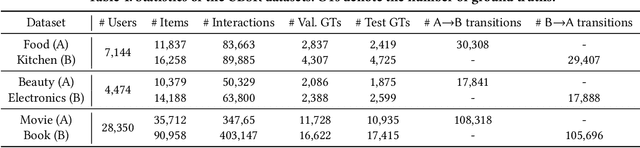
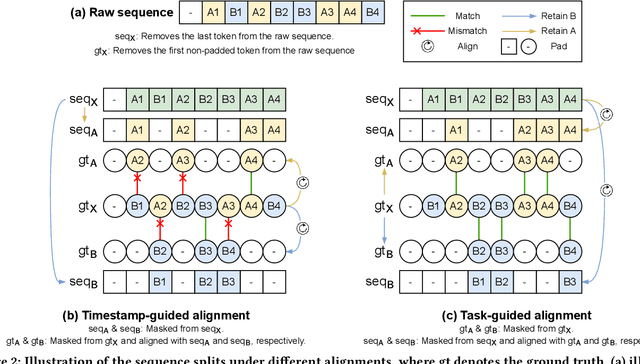
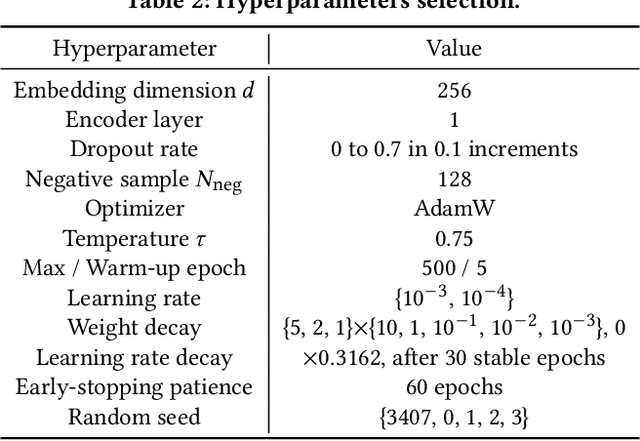
Cross-Domain Sequential Recommendation (CDSR) has recently gained attention for countering data sparsity by transferring knowledge across domains. A common approach merges domain-specific sequences into cross-domain sequences, serving as bridges to connect domains. One key challenge is to correctly extract the shared knowledge among these sequences and appropriately transfer it. Most existing works directly transfer unfiltered cross-domain knowledge rather than extracting domain-invariant components and adaptively integrating them into domain-specific modelings. Another challenge lies in aligning the domain-specific and cross-domain sequences. Existing methods align these sequences based on timestamps, but this approach can cause prediction mismatches when the current tokens and their targets belong to different domains. In such cases, the domain-specific knowledge carried by the current tokens may degrade performance. To address these challenges, we propose the A-B-Cross-to-Invariant Learning Recommender (ABXI). Specifically, leveraging LoRA's effectiveness for efficient adaptation, ABXI incorporates two types of LoRAs to facilitate knowledge adaptation. First, all sequences are processed through a shared encoder that employs a domain LoRA for each sequence, thereby preserving unique domain characteristics. Next, we introduce an invariant projector that extracts domain-invariant interests from cross-domain representations, utilizing an invariant LoRA to adapt these interests into modeling each specific domain. Besides, to avoid prediction mismatches, all domain-specific sequences are aligned to match the domains of the cross-domain ground truths. Experimental results on three datasets demonstrate that our approach outperforms other CDSR counterparts by a large margin. The codes are available in \url{https://github.com/DiMarzioBian/ABXI}.
Multimodal large language model for wheat breeding: a new exploration of smart breeding
Nov 20, 2024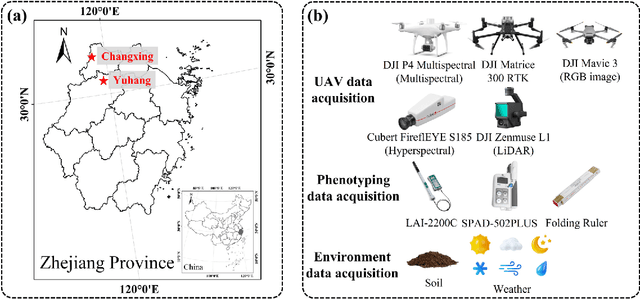
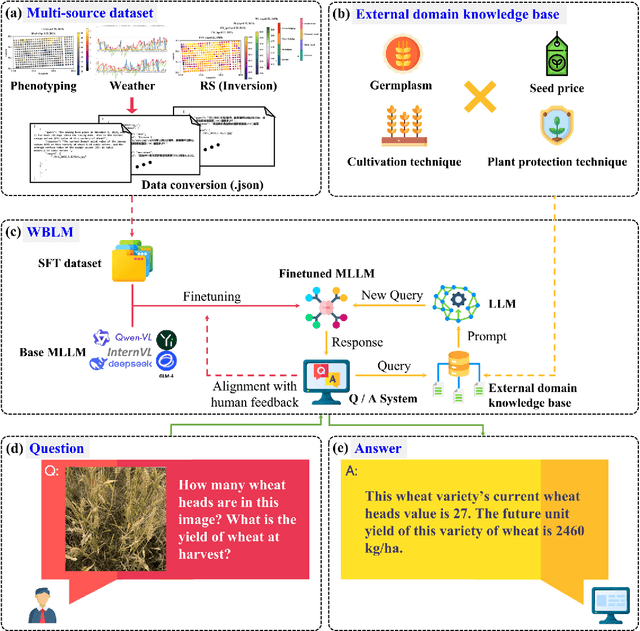
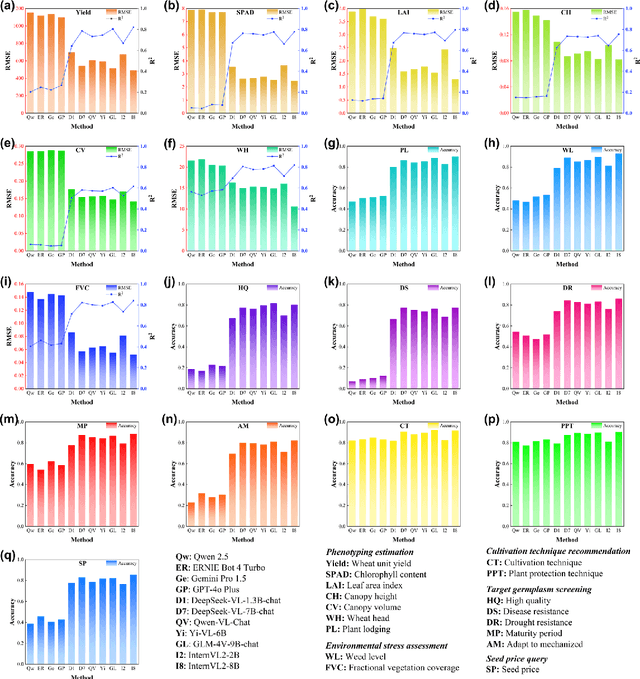
UAV remote sensing technology has become a key technology in crop breeding, which can achieve high-throughput and non-destructive collection of crop phenotyping data. However, the multidisciplinary nature of breeding has brought technical barriers and efficiency challenges to knowledge mining. Therefore, it is important to develop a smart breeding goal tool to mine cross-domain multimodal data. Based on different pre-trained open-source multimodal large language models (MLLMs) (e.g., Qwen-VL, InternVL, Deepseek-VL), this study used supervised fine-tuning (SFT), retrieval-augmented generation (RAG), and reinforcement learning from human feedback (RLHF) technologies to inject cross-domain knowledge into MLLMs, thereby constructing multiple multimodal large language models for wheat breeding (WBLMs). The above WBLMs were evaluated using the newly created evaluation benchmark in this study. The results showed that the WBLM constructed using SFT, RAG and RLHF technologies and InternVL2-8B has leading performance. Then, subsequent experiments were conducted using the WBLM. Ablation experiments indicated that the combination of SFT, RAG, and RLHF technologies can improve the overall generation performance, enhance the generated quality, balance the timeliness and adaptability of the generated answer, and reduce hallucinations and biases. The WBLM performed best in wheat yield prediction using cross-domain data (remote sensing, phenotyping, weather, germplasm) simultaneously, with R2 and RMSE of 0.821 and 489.254 kg/ha, respectively. Furthermore, the WBLM can generate professional decision support answers for phenotyping estimation, environmental stress assessment, target germplasm screening, cultivation technique recommendation, and seed price query tasks.
Towards Fair and Rigorous Evaluations: Hyperparameter Optimization for Top-N Recommendation Task with Implicit Feedback
Aug 14, 2024The widespread use of the internet has led to an overwhelming amount of data, which has resulted in the problem of information overload. Recommender systems have emerged as a solution to this problem by providing personalized recommendations to users based on their preferences and historical data. However, as recommendation models become increasingly complex, finding the best hyperparameter combination for different models has become a challenge. The high-dimensional hyperparameter search space poses numerous challenges for researchers, and failure to disclose hyperparameter settings may impede the reproducibility of research results. In this paper, we investigate the Top-N implicit recommendation problem and focus on optimizing the benchmark recommendation algorithm commonly used in comparative experiments using hyperparameter optimization algorithms. We propose a research methodology that follows the principles of a fair comparison, employing seven types of hyperparameter search algorithms to fine-tune six common recommendation algorithms on three datasets. We have identified the most suitable hyperparameter search algorithms for various recommendation algorithms on different types of datasets as a reference for later study. This study contributes to algorithmic research in recommender systems based on hyperparameter optimization, providing a fair basis for comparison.
PanicleNeRF: low-cost, high-precision in-field phenotypingof rice panicles with smartphone
Aug 04, 2024The rice panicle traits significantly influence grain yield, making them a primary target for rice phenotyping studies. However, most existing techniques are limited to controlled indoor environments and difficult to capture the rice panicle traits under natural growth conditions. Here, we developed PanicleNeRF, a novel method that enables high-precision and low-cost reconstruction of rice panicle three-dimensional (3D) models in the field using smartphone. The proposed method combined the large model Segment Anything Model (SAM) and the small model You Only Look Once version 8 (YOLOv8) to achieve high-precision segmentation of rice panicle images. The NeRF technique was then employed for 3D reconstruction using the images with 2D segmentation. Finally, the resulting point clouds are processed to successfully extract panicle traits. The results show that PanicleNeRF effectively addressed the 2D image segmentation task, achieving a mean F1 Score of 86.9% and a mean Intersection over Union (IoU) of 79.8%, with nearly double the boundary overlap (BO) performance compared to YOLOv8. As for point cloud quality, PanicleNeRF significantly outperformed traditional SfM-MVS (structure-from-motion and multi-view stereo) methods, such as COLMAP and Metashape. The panicle length was then accurately extracted with the rRMSE of 2.94% for indica and 1.75% for japonica rice. The panicle volume estimated from 3D point clouds strongly correlated with the grain number (R2 = 0.85 for indica and 0.82 for japonica) and grain mass (0.80 for indica and 0.76 for japonica). This method provides a low-cost solution for high-throughput in-field phenotyping of rice panicles, accelerating the efficiency of rice breeding.