 Add to Chrome
 Add to Firefox
 Add to Edge
Learning Humanoid Navigation from Human Data
Apr 01, 2026
We present EgoNav, a system that enables a humanoid robot to traverse diverse, unseen environments by learning entirely from 5 hours of human walking data, with no robot data or finetuning. A diffusion model predicts distributions of plausible future trajectories conditioned on past trajectory, a 360 deg visual memory fusing color, depth, and semantics, and video features from a frozen DINOv3 backbone that capture appearance cues invisible to depth sensors. A hybrid sampling scheme achieves real-time inference in 10 denoising steps, and a receding-horizon controller selects paths from the predicted distribution. We validate EgoNav through offline evaluations, where it outperforms baselines in collision avoidance and multi-modal coverage, and through zero-shot deployment on a Unitree G1 humanoid across unseen indoor and outdoor environments. Behaviors such as waiting for doors to open, navigating around crowds, and avoiding glass walls emerge naturally from the learned prior. We will release the dataset and trained models. Our website: https://egonav.weizhuowang.com

Sparse Autoencoders Reveal Interpretable and Steerable Features in VLA Models
Mar 19, 2026Vision-Language-Action (VLA) models have emerged as a promising approach for general-purpose robot manipulation. However, their generalization is inconsistent: while these models can perform impressively in some settings, fine-tuned variants often fail on novel objects, scenes, and instructions. We apply mechanistic interpretability techniques to better understand the inner workings of VLA models. To probe internal representations, we train Sparse Autoencoders (SAEs) on hidden layer activations of the VLA. SAEs learn a sparse dictionary whose features act as a compact, interpretable basis for the model's computation. We find that the large majority of extracted SAE features correspond to memorized sequences from specific training demonstrations. However, some features correspond to interpretable, general, and steerable motion primitives and semantic properties, offering a promising glimpse toward VLA generalizability. We propose a metric to categorize features according to whether they represent generalizable transferable primitives or episode-specific memorization. We validate these findings through steering experiments on the LIBERO benchmark. We show that individual SAE features causally influence robot behavior. Steering general features induces behaviors consistent with their semantic meaning and can be applied across tasks and scenes. This work provides the first mechanistic evidence that VLAs can learn generalizable features across tasks and scenes. We observe that supervised fine-tuning on small robotics datasets disproportionately amplifies memorization. In contrast, training on larger, more diverse datasets (e.g., DROID) or using knowledge insulation promotes more general features. We provide an open-source codebase and user-friendly interface for activation collection, SAE training, and feature steering. Our project page is located at http://drvla.github.io
Locomotion Beyond Feet
Jan 07, 2026Most locomotion methods for humanoid robots focus on leg-based gaits, yet natural bipeds frequently rely on hands, knees, and elbows to establish additional contacts for stability and support in complex environments. This paper introduces Locomotion Beyond Feet, a comprehensive system for whole-body humanoid locomotion across extremely challenging terrains, including low-clearance spaces under chairs, knee-high walls, knee-high platforms, and steep ascending and descending stairs. Our approach addresses two key challenges: contact-rich motion planning and generalization across diverse terrains. To this end, we combine physics-grounded keyframe animation with reinforcement learning. Keyframes encode human knowledge of motor skills, are embodiment-specific, and can be readily validated in simulation or on hardware, while reinforcement learning transforms these references into robust, physically accurate motions. We further employ a hierarchical framework consisting of terrain-specific motion-tracking policies, failure recovery mechanisms, and a vision-based skill planner. Real-world experiments demonstrate that Locomotion Beyond Feet achieves robust whole-body locomotion and generalizes across obstacle sizes, obstacle instances, and terrain sequences.
A Study of Perceived Safety for Soft Robotics in Caregiving Tasks
Mar 26, 2025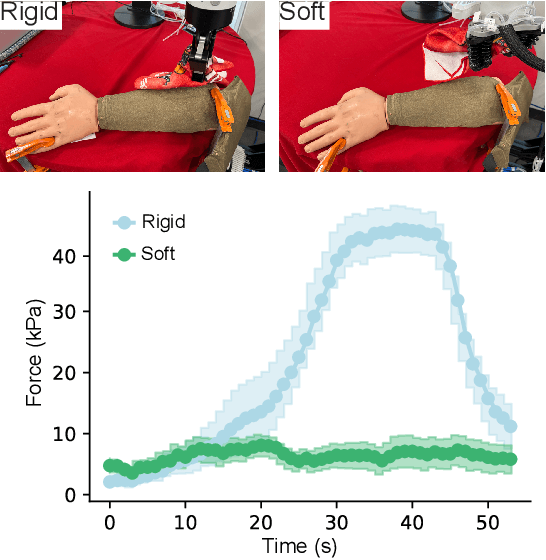
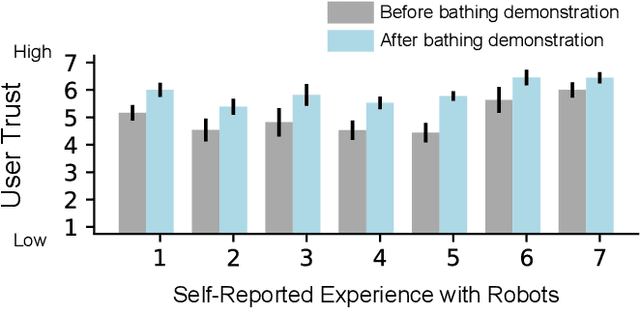
In this project, we focus on human-robot interaction in caregiving scenarios like bathing, where physical contact is inevitable and necessary for proper task execution because force must be applied to the skin. Using finite element analysis, we designed a 3D-printed gripper combining positive and negative pressure for secure yet compliant handling. Preliminary tests showed it exerted a lower, more uniform pressure profile than a standard rigid gripper. In a user study, participants' trust in robots significantly increased after they experienced a brief bathing demonstration performed by a robotic arm equipped with the soft gripper. These results suggest that soft robotics can enhance perceived safety and acceptance in intimate caregiving scenarios.