 Add to Chrome
 Add to Firefox
 Add to Edge
Can Language Models Imagine Without Seeing? Ekphrasis: Measuring Visual Creative Ideation in Text-Only LLMs
Aug 07, 2026
Current evaluations do not isolate whether text-only language models can originate visual concepts before image generation. Fluent visual prose can hide visual-plan failures: an answer may appear creative while repeating familiar visual clichés or failing to specify a renderable scene. We define Visual Creative Ideation (VCI) as the ability to produce textual visual plans that are useful, expressive, and population-novel, and introduce Ekphrasis, a 400-task benchmark spanning Abstraction, Combination, Transformation, and Adaptation. Ekphrasis scores anonymized pairwise comparisons with dimension-specific checklists, aggregates preferences with Bradley-Terry models, and uses Typed Idea Graphs to convert task-specific population clichés into novelty references. Across 14 language models, VCI separates usefulness, expressiveness, and novelty rather than reducing to fluency: strong models achieve similar overall scores through different profiles, and useful plans can remain visually clichéd. A cross-modal grounding study further shows that text-level VCI ordering largely survives faithful rendering and blind image-level preference judgment, supporting Ekphrasis as a measure of visual ideation beyond prose quality.

Isolation as a First-Class Principle for LLM-Agent System Safety: Concepts, Taxonomy, Challenges and Future Directions
Jul 14, 2026The capability of LLM agents to function as the ``brain'' of a system fundamentally expands the scope of analysis beyond a standalone model. Consequently, safety is no longer only about input--output content alignment. It also concerns system behavior and real-world execution outcomes. However, the current literature is fragmented across attack types, applications, and benchmarks. This makes it hard to explain why failures such as prompt injection, tool misuse, and memory poisoning often share the same structural cause, and how they spread through an agent workflow. In this survey, we treat isolation as a first-class principle for LLM-agent system safety. By isolation, we refer to the separation of user inputs, tool access, execution channels, inter-agent communication, and environment-originated context. We organize the literature with a boundary-centric taxonomy of five boundaries: user-agent, agent-tool, agent-execution, agent-agent, and system-environment. This view helps identify where the loss of isolation first occurs, how compromise propagates across boundaries, and which defenses are most relevant at each interface. We also summarize cross-boundary failure paths, discuss open challenges, and outline a research agenda for isolation-by-construction in future agent systems.
SkillRevise: Improving LLM-Authored Agent Skills via Trace-Conditioned Skill Revision
May 31, 2026Agent skills are procedural artifacts that enable LLM agents to execute workflows, verify constraints, and recover from failures. Existing self-evolving methods refine skills using accumulated trajectories. However, they struggle in cold-start settings, where only an initial, imperfect skill is available. Consequently, skill construction defaults to expert authoring or one-shot LLM generation. Expert-authored skills are costly and may not align with how LLM agents actually execute tasks, while one-shot generated skills can be syntactically well formed yet behaviorally weak. To bridge this gap, we propose SkillRevise, an execution-grounded framework designed to iteratively refine these initial skills. SkillRevise diagnoses skill defects from execution evidence, retrieves relevant repair principles from a general memory, and applies execution-anchored edits. By re-executing candidates and measuring empirical utility, it systematically retains the optimal skill version. Evaluated across three benchmarks and five LLMs, SkillRevise substantially outperforms one-shot baselines, improving the base agent's success rate on SkillsBench from 36.05% to 61.63%. Furthermore, the revised skills exhibit strong cross-model transferability, capturing generalized procedural knowledge over model-specific artifacts.
AutoSchemaKG: Autonomous Knowledge Graph Construction through Dynamic Schema Induction from Web-Scale Corpora
May 29, 2025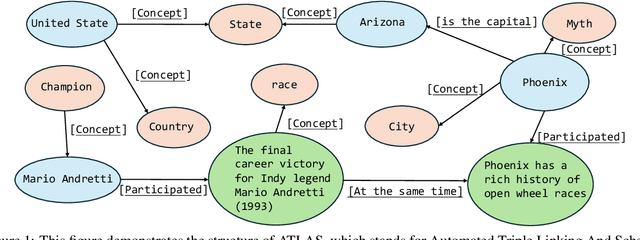
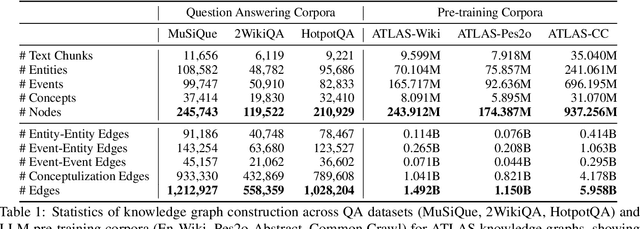
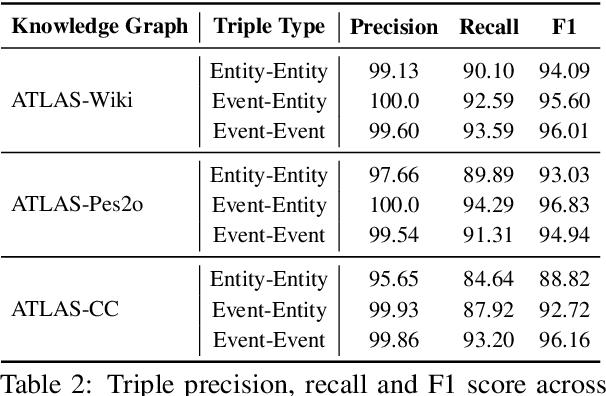
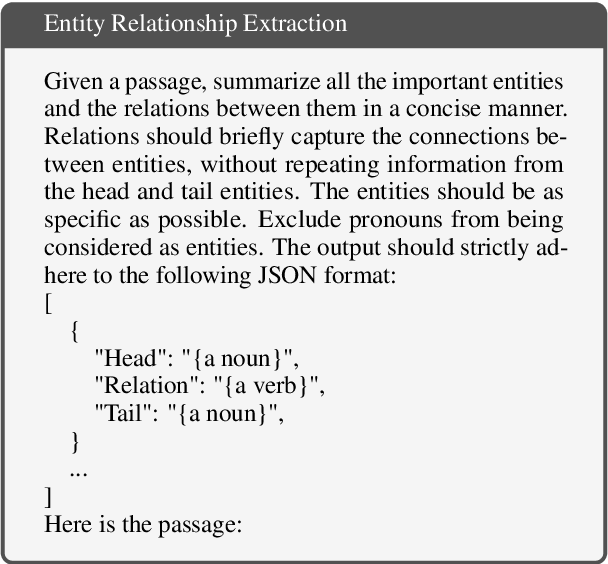
We present AutoSchemaKG, a framework for fully autonomous knowledge graph construction that eliminates the need for predefined schemas. Our system leverages large language models to simultaneously extract knowledge triples and induce comprehensive schemas directly from text, modeling both entities and events while employing conceptualization to organize instances into semantic categories. Processing over 50 million documents, we construct ATLAS (Automated Triple Linking And Schema induction), a family of knowledge graphs with 900+ million nodes and 5.9 billion edges. This approach outperforms state-of-the-art baselines on multi-hop QA tasks and enhances LLM factuality. Notably, our schema induction achieves 95\% semantic alignment with human-crafted schemas with zero manual intervention, demonstrating that billion-scale knowledge graphs with dynamically induced schemas can effectively complement parametric knowledge in large language models.