 Add to Chrome
 Add to Firefox
 Add to Edge
SkillRevise: Improving LLM-Authored Agent Skills via Trace-Conditioned Skill Revision
May 31, 2026
Agent skills are procedural artifacts that enable LLM agents to execute workflows, verify constraints, and recover from failures. Existing self-evolving methods refine skills using accumulated trajectories. However, they struggle in cold-start settings, where only an initial, imperfect skill is available. Consequently, skill construction defaults to expert authoring or one-shot LLM generation. Expert-authored skills are costly and may not align with how LLM agents actually execute tasks, while one-shot generated skills can be syntactically well formed yet behaviorally weak. To bridge this gap, we propose SkillRevise, an execution-grounded framework designed to iteratively refine these initial skills. SkillRevise diagnoses skill defects from execution evidence, retrieves relevant repair principles from a general memory, and applies execution-anchored edits. By re-executing candidates and measuring empirical utility, it systematically retains the optimal skill version. Evaluated across three benchmarks and five LLMs, SkillRevise substantially outperforms one-shot baselines, improving the base agent's success rate on SkillsBench from 36.05% to 61.63%. Furthermore, the revised skills exhibit strong cross-model transferability, capturing generalized procedural knowledge over model-specific artifacts.

AnimeTAB: A new guitar tablature dataset of anime and game music
Oct 06, 2022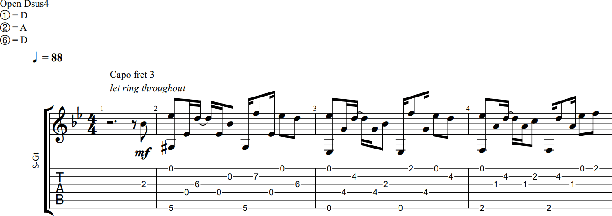
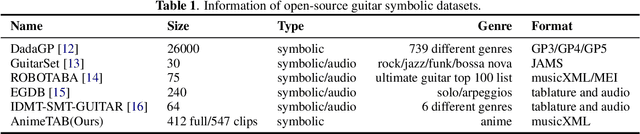
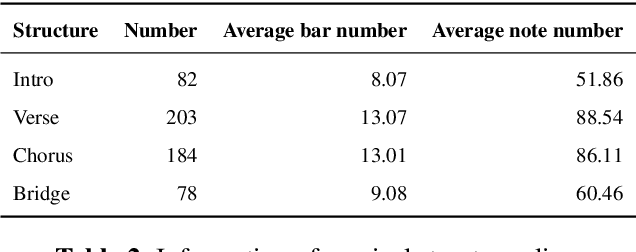
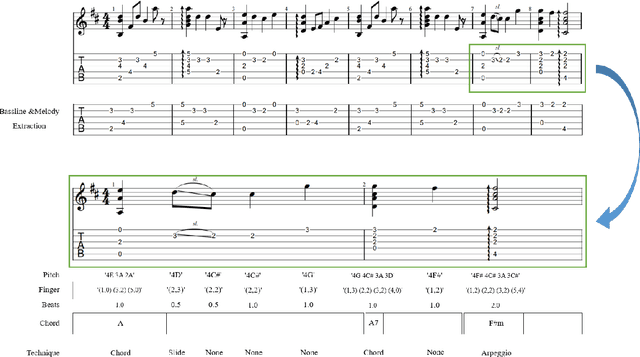
While guitar tablature has become a popular topic in MIR research, there exists no such a guitar tablature dataset that focuses on the soundtracks of anime and video games, which have a surprisingly broad and growing audience among the youths. In this paper, we present AnimeTAB, a fingerstyle guitar tablature dataset in MusicXML format, which provides more high-quality guitar tablature for both researchers and guitar players. AnimeTAB contains 412 full tracks and 547 clips, the latter are annotated with musical structures (intro, verse, chorus, and bridge). An accompanying analysis toolkit, TABprocessor, is included to further facilitate its use. This includes functions for melody and bassline extraction, key detection, and chord labeling, which are implemented using rule-based algorithms. We evaluated each of these functions against a manually annotated ground truth. Finally, as an example, we performed a music and technique analysis of AnimeTAB using TABprocessor. Our data and code have been made publicly available for composers, performers, and music information retrieval (MIR) researchers alike.