 Add to Chrome
 Add to Firefox
 Add to Edge
Bastion: Budget-Aware Speculative Decoding with Tree-structured Block Diffusion Drafting
May 28, 2026
Block-diffusion drafters have recently emerged as a powerful alternative for speculative decoding by predicting multiple future-token distributions in a single parallel step. However, since these parallel predictions are sampled from position-wise marginals rather than fully conditioned sequences, committing to a single greedy path often fails to capture the target model's preferred trajectory. To address this, we propose BASTION, a budget-aware speculative decoding framework with tree-based diffusion drafting. Unlike existing methods that rely on static tree topologies, BASTION dynamically constructs query-dependent trees by balancing draft quality against hardware constraints. Our framework integrates three synergistic components: (1) an acceptance surrogate that estimates expected accepted length via path confidence, (2) an online latency estimator that calibrates a hardware-aware roofline model, and (3) an adaptive best-first expansion that grows the tree until marginal gains no longer justify incremental verification costs. BASTION is training-free, preserves the target model's distribution, and requires no per-setting tuning. Across diverse benchmarks and GPU architectures, BASTION achieves up to a 6.61x speedup over standard autoregressive decoding, outperforming state-of-the-art block-diffusion baselines by 39%.

Multi-modal panoramic 3D outdoor datasets for place categorization
Apr 14, 2026We present two multi-modal panoramic 3D outdoor (MPO) datasets for semantic place categorization with six categories: forest, coast, residential area, urban area and indoor/outdoor parking lot. The first dataset consists of 650 static panoramic scans of dense (9,000,000 points) 3D color and reflectance point clouds obtained using a FARO laser scanner with synchronized color images. The second dataset consists of 34,200 real-time panoramic scans of sparse (70,000 points) 3D reflectance point clouds obtained using a Velodyne laser scanner while driving a car. The datasets were obtained in the city of Fukuoka, Japan and are publicly available in [1], [2]. In addition, we compare several approaches for semantic place categorization with best results of 96.42% (dense) and 89.67% (sparse).
Multi-Drafter Speculative Decoding with Alignment Feedback
Apr 07, 2026Speculative decoding (SD) accelerates large language model (LLM) inference by using a smaller model to draft future tokens, which are then verified by the target LLM. This preserves generation quality by accepting only aligned tokens. However, individual drafters, often trained for specific tasks or domains, exhibit limited effectiveness across diverse applications. To address this, we introduce \textsc{MetaSD}, a unified framework that integrates multiple drafters into the SD process. MetaSD dynamically allocates computational resources to heterogeneous drafters by leveraging alignment feedback and framing drafter selection as a multi-armed bandit problem. Extensive experiments show MetaSD consistently outperforms single-drafter approaches.
UniSAFE: A Comprehensive Benchmark for Safety Evaluation of Unified Multimodal Models
Mar 18, 2026Unified Multimodal Models (UMMs) offer powerful cross-modality capabilities but introduce new safety risks not observed in single-task models. Despite their emergence, existing safety benchmarks remain fragmented across tasks and modalities, limiting the comprehensive evaluation of complex system-level vulnerabilities. To address this gap, we introduce UniSAFE, the first comprehensive benchmark for system-level safety evaluation of UMMs across 7 I/O modality combinations, spanning conventional tasks and novel multimodal-context image generation settings. UniSAFE is built with a shared-target design that projects common risk scenarios across task-specific I/O configurations, enabling controlled cross-task comparisons of safety failures. Comprising 6,802 curated instances, we use UniSAFE to evaluate 15 state-of-the-art UMMs, both proprietary and open-source. Our results reveal critical vulnerabilities across current UMMs, including elevated safety violations in multi-image composition and multi-turn settings, with image-output tasks consistently more vulnerable than text-output tasks. These findings highlight the need for stronger system-level safety alignment for UMMs. Our code and data are publicly available at https://github.com/segyulee/UniSAFE
Learning Geometric and Photometric Features from Panoramic LiDAR Scans for Outdoor Place Categorization
Mar 13, 2026Semantic place categorization, which is one of the essential tasks for autonomous robots and vehicles, allows them to have capabilities of self-decision and navigation in unfamiliar environments. In particular, outdoor places are more difficult targets than indoor ones due to perceptual variations, such as dynamic illuminance over twenty-four hours and occlusions by cars and pedestrians. This paper presents a novel method of categorizing outdoor places using convolutional neural networks (CNNs), which take omnidirectional depth/reflectance images obtained by 3D LiDARs as the inputs. First, we construct a large-scale outdoor place dataset named Multi-modal Panoramic 3D Outdoor (MPO) comprising two types of point clouds captured by two different LiDARs. They are labeled with six outdoor place categories: coast, forest, indoor/outdoor parking, residential area, and urban area. Second, we provide CNNs for LiDAR-based outdoor place categorization and evaluate our approach with the MPO dataset. Our results on the MPO dataset outperform traditional approaches and show the effectiveness in which we use both depth and reflectance modalities. To analyze our trained deep networks we visualize the learned features.
* Published in Advanced Robotics on 31 Jul 2018
MolHIT: Advancing Molecular-Graph Generation with Hierarchical Discrete Diffusion Models
Feb 19, 2026Molecular generation with diffusion models has emerged as a promising direction for AI-driven drug discovery and materials science. While graph diffusion models have been widely adopted due to the discrete nature of 2D molecular graphs, existing models suffer from low chemical validity and struggle to meet the desired properties compared to 1D modeling. In this work, we introduce MolHIT, a powerful molecular graph generation framework that overcomes long-standing performance limitations in existing methods. MolHIT is based on the Hierarchical Discrete Diffusion Model, which generalizes discrete diffusion to additional categories that encode chemical priors, and decoupled atom encoding that splits the atom types according to their chemical roles. Overall, MolHIT achieves new state-of-the-art performance on the MOSES dataset with near-perfect validity for the first time in graph diffusion, surpassing strong 1D baselines across multiple metrics. We further demonstrate strong performance in downstream tasks, including multi-property guided generation and scaffold extension.
KLASS: KL-Guided Fast Inference in Masked Diffusion Models
Nov 07, 2025Masked diffusion models have demonstrated competitive results on various tasks including language generation. However, due to its iterative refinement process, the inference is often bottlenecked by slow and static sampling speed. To overcome this problem, we introduce `KL-Adaptive Stability Sampling' (KLASS), a fast yet effective sampling method that exploits token-level KL divergence to identify stable, high-confidence predictions. By unmasking multiple tokens in each iteration without any additional model training, our approach speeds up generation significantly while maintaining sample quality. On reasoning benchmarks, KLASS achieves up to $2.78\times$ wall-clock speedups while improving performance over standard greedy decoding, attaining state-of-the-art results among diffusion-based samplers. We further validate KLASS across diverse domains, including text, image, and molecular generation, showing its effectiveness as a broadly applicable sampler across different models.
Conditional Synthesis of 3D Molecules with Time Correction Sampler
Nov 01, 2024Diffusion models have demonstrated remarkable success in various domains, including molecular generation. However, conditional molecular generation remains a fundamental challenge due to an intrinsic trade-off between targeting specific chemical properties and generating meaningful samples from the data distribution. In this work, we present Time-Aware Conditional Synthesis (TACS), a novel approach to conditional generation on diffusion models. It integrates adaptively controlled plug-and-play "online" guidance into a diffusion model, driving samples toward the desired properties while maintaining validity and stability. A key component of our algorithm is our new type of diffusion sampler, Time Correction Sampler (TCS), which is used to control guidance and ensure that the generated molecules remain on the correct manifold at each reverse step of the diffusion process at the same time. Our proposed method demonstrates significant performance in conditional 3D molecular generation and offers a promising approach towards inverse molecular design, potentially facilitating advancements in drug discovery, materials science, and other related fields.
Automated Filtering of Human Feedback Data for Aligning Text-to-Image Diffusion Models
Oct 14, 2024
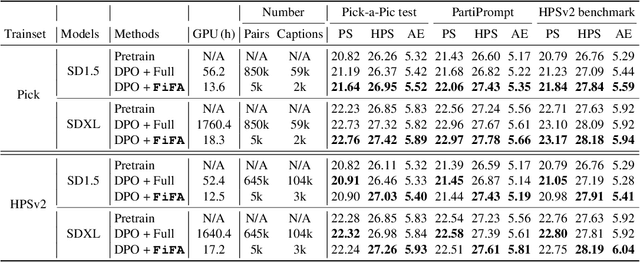
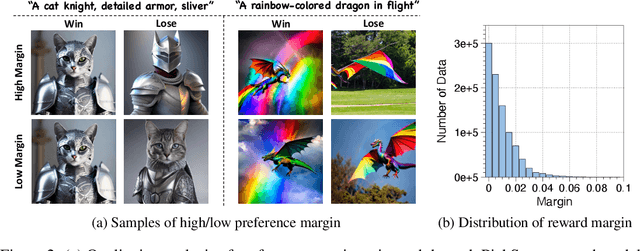
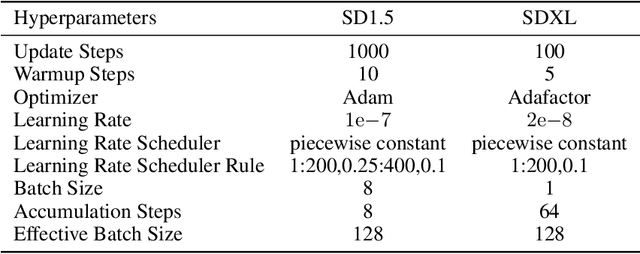
Fine-tuning text-to-image diffusion models with human feedback is an effective method for aligning model behavior with human intentions. However, this alignment process often suffers from slow convergence due to the large size and noise present in human feedback datasets. In this work, we propose FiFA, a novel automated data filtering algorithm designed to enhance the fine-tuning of diffusion models using human feedback datasets with direct preference optimization (DPO). Specifically, our approach selects data by solving an optimization problem to maximize three components: preference margin, text quality, and text diversity. The concept of preference margin is used to identify samples that contain high informational value to address the noisy nature of feedback dataset, which is calculated using a proxy reward model. Additionally, we incorporate text quality, assessed by large language models to prevent harmful contents, and consider text diversity through a k-nearest neighbor entropy estimator to improve generalization. Finally, we integrate all these components into an optimization process, with approximating the solution by assigning importance score to each data pair and selecting the most important ones. As a result, our method efficiently filters data automatically, without the need for manual intervention, and can be applied to any large-scale dataset. Experimental results show that FiFA significantly enhances training stability and achieves better performance, being preferred by humans 17% more, while using less than 0.5% of the full data and thus 1% of the GPU hours compared to utilizing full human feedback datasets.
BAPO: Base-Anchored Preference Optimization for Personalized Alignment in Large Language Models
Jun 30, 2024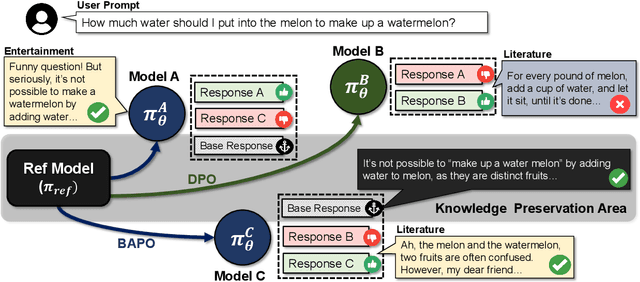
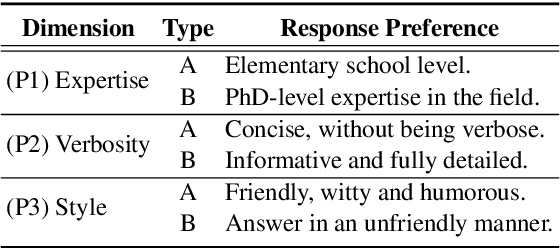
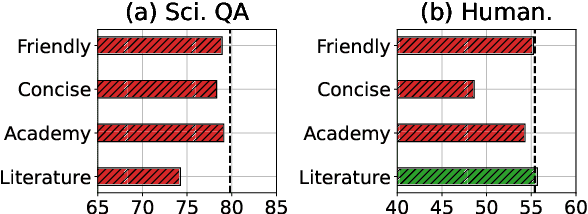
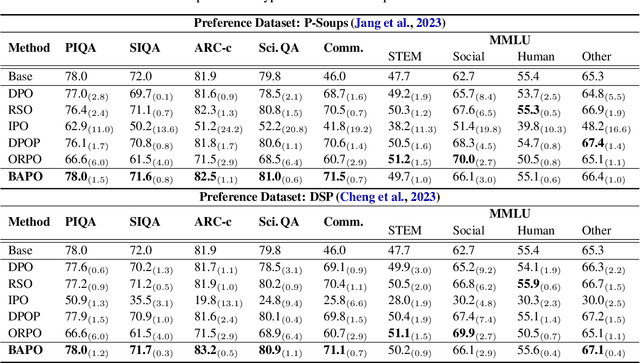
While learning to align Large Language Models (LLMs) with human preferences has shown remarkable success, aligning these models to meet the diverse user preferences presents further challenges in preserving previous knowledge. This paper examines the impact of personalized preference optimization on LLMs, revealing that the extent of knowledge loss varies significantly with preference heterogeneity. Although previous approaches have utilized the KL constraint between the reference model and the policy model, we observe that they fail to maintain general knowledge and alignment when facing personalized preferences. To this end, we introduce Base-Anchored Preference Optimization (BAPO), a simple yet effective approach that utilizes the initial responses of reference model to mitigate forgetting while accommodating personalized alignment. BAPO effectively adapts to diverse user preferences while minimally affecting global knowledge or general alignment. Our experiments demonstrate the efficacy of BAPO in various setups.