 Add to Chrome
 Add to Firefox
 Add to Edge
Multimodal Federated Learning under Dual-Axis Modality Missingness
Aug 10, 2026
Multimodal federated learning (FL) supports collaborative modeling in privacy-sensitive health-sensing and medical settings, but realistic deployments often exhibit dual-axis modality missingness: clients have different modality sets, and individual samples may contain only subsets of the modalities available locally. Existing methods typically address these two axes separately. We propose Flux, a multimodal federated learning framework built around two complementary components. First, modality-aware confidence tempering learns sample-specific confidence for each modality through mask-aware unimodal supervision and fuses the confidence estimates from observed modalities into a sample-adaptive temperature that adjusts predictive sharpness according to evidence quality and completeness. Second, gradient-decoupled private adaptation applies this temperature only to a client-private prediction pathway, while training the shared federated model with a standard, untempered objective. This enables sample-specific, client-local confidence adaptation without allowing confidence-dependent gradients to perturb shared representation learning. Across four multimodal datasets, Flux achieves the highest average macro-F1 on every dataset, outperforming the strongest dataset-specific baseline by 0.8~2.2 points and by 1.6 points on average. Additional analyses demonstrate favorable calibration, temperature sensitivity to both modality missingness and input corruption, and more stable shared optimization under private-only tempering. Our code is available at https://github.com/AdibaOrz/Flux.

UniSAFE: A Comprehensive Benchmark for Safety Evaluation of Unified Multimodal Models
Mar 18, 2026Unified Multimodal Models (UMMs) offer powerful cross-modality capabilities but introduce new safety risks not observed in single-task models. Despite their emergence, existing safety benchmarks remain fragmented across tasks and modalities, limiting the comprehensive evaluation of complex system-level vulnerabilities. To address this gap, we introduce UniSAFE, the first comprehensive benchmark for system-level safety evaluation of UMMs across 7 I/O modality combinations, spanning conventional tasks and novel multimodal-context image generation settings. UniSAFE is built with a shared-target design that projects common risk scenarios across task-specific I/O configurations, enabling controlled cross-task comparisons of safety failures. Comprising 6,802 curated instances, we use UniSAFE to evaluate 15 state-of-the-art UMMs, both proprietary and open-source. Our results reveal critical vulnerabilities across current UMMs, including elevated safety violations in multi-image composition and multi-turn settings, with image-output tasks consistently more vulnerable than text-output tasks. These findings highlight the need for stronger system-level safety alignment for UMMs. Our code and data are publicly available at https://github.com/segyulee/UniSAFE
When and Where to Attack? Stage-wise Attention-Guided Adversarial Attack on Large Vision Language Models
Feb 04, 2026Adversarial attacks against Large Vision-Language Models (LVLMs) are crucial for exposing safety vulnerabilities in modern multimodal systems. Recent attacks based on input transformations, such as random cropping, suggest that spatially localized perturbations can be more effective than global image manipulation. However, randomly cropping the entire image is inherently stochastic and fails to use the limited per-pixel perturbation budget efficiently. We make two key observations: (i) regional attention scores are positively correlated with adversarial loss sensitivity, and (ii) attacking high-attention regions induces a structured redistribution of attention toward subsequent salient regions. Based on these findings, we propose Stage-wise Attention-Guided Attack (SAGA), an attention-guided framework that progressively concentrates perturbations on high-attention regions. SAGA enables more efficient use of constrained perturbation budgets, producing highly imperceptible adversarial examples while consistently achieving state-of-the-art attack success rates across ten LVLMs. The source code is available at https://github.com/jackwaky/SAGA.
QuRe: Query-Relevant Retrieval through Hard Negative Sampling in Composed Image Retrieval
Jul 16, 2025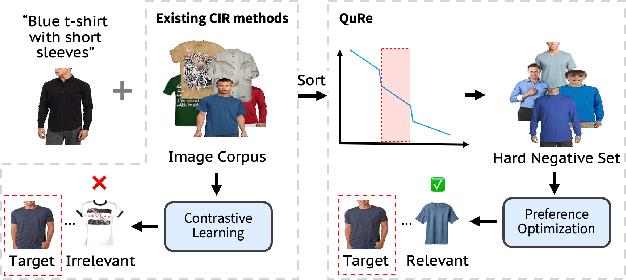
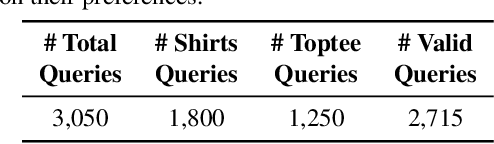
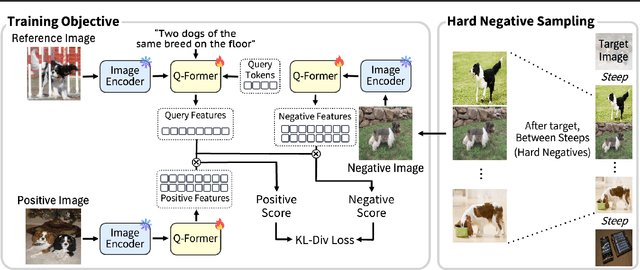
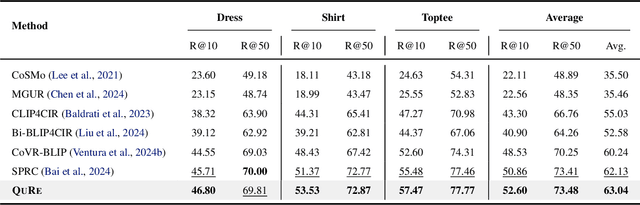
Composed Image Retrieval (CIR) retrieves relevant images based on a reference image and accompanying text describing desired modifications. However, existing CIR methods only focus on retrieving the target image and disregard the relevance of other images. This limitation arises because most methods employing contrastive learning-which treats the target image as positive and all other images in the batch as negatives-can inadvertently include false negatives. This may result in retrieving irrelevant images, reducing user satisfaction even when the target image is retrieved. To address this issue, we propose Query-Relevant Retrieval through Hard Negative Sampling (QuRe), which optimizes a reward model objective to reduce false negatives. Additionally, we introduce a hard negative sampling strategy that selects images positioned between two steep drops in relevance scores following the target image, to effectively filter false negatives. In order to evaluate CIR models on their alignment with human satisfaction, we create Human-Preference FashionIQ (HP-FashionIQ), a new dataset that explicitly captures user preferences beyond target retrieval. Extensive experiments demonstrate that QuRe achieves state-of-the-art performance on FashionIQ and CIRR datasets while exhibiting the strongest alignment with human preferences on the HP-FashionIQ dataset. The source code is available at https://github.com/jackwaky/QuRe.
Federated Learning with Incomplete Sensing Modalities
May 20, 2024Many mobile sensing applications utilize data from various modalities, including motion and physiological sensors in mobile and wearable devices. Federated Learning (FL) is particularly suitable for these applications thanks to its privacy-preserving feature. However, challenges such as limited battery life, poor network conditions, and sensor malfunctions can restrict the use of all available modalities for local model training. Additionally, existing multimodal FL systems also struggle with scalability and efficiency as the number of modality sources increases. To address these issues, we introduce FLISM, a framework designed to enable multimodal FL with incomplete modalities. FLISM leverages simulation technique to learn robust representations that can handle missing modalities and transfers model knowledge across clients with varying set of modalities. The evaluation results using three real-world datasets and simulations demonstrate FLISM's effective balance between model performance and system efficiency. It shows an average improvement of .067 in F1-score, while also reducing communication (2.69x faster) and computational (2.28x more efficient) overheads compared to existing methods addressing incomplete modalities. Moreover, in simulated scenarios involving tasks with a larger number of modalities, FLISM achieves a significant speedup of 3.23x~85.10x in communication and 3.73x~32.29x in computational efficiency.