 Add to Chrome
 Add to Firefox
 Add to Edge
UniSAFE: A Comprehensive Benchmark for Safety Evaluation of Unified Multimodal Models
Mar 18, 2026
Unified Multimodal Models (UMMs) offer powerful cross-modality capabilities but introduce new safety risks not observed in single-task models. Despite their emergence, existing safety benchmarks remain fragmented across tasks and modalities, limiting the comprehensive evaluation of complex system-level vulnerabilities. To address this gap, we introduce UniSAFE, the first comprehensive benchmark for system-level safety evaluation of UMMs across 7 I/O modality combinations, spanning conventional tasks and novel multimodal-context image generation settings. UniSAFE is built with a shared-target design that projects common risk scenarios across task-specific I/O configurations, enabling controlled cross-task comparisons of safety failures. Comprising 6,802 curated instances, we use UniSAFE to evaluate 15 state-of-the-art UMMs, both proprietary and open-source. Our results reveal critical vulnerabilities across current UMMs, including elevated safety violations in multi-image composition and multi-turn settings, with image-output tasks consistently more vulnerable than text-output tasks. These findings highlight the need for stronger system-level safety alignment for UMMs. Our code and data are publicly available at https://github.com/segyulee/UniSAFE

Response Tuning: Aligning Large Language Models without Instruction
Oct 03, 2024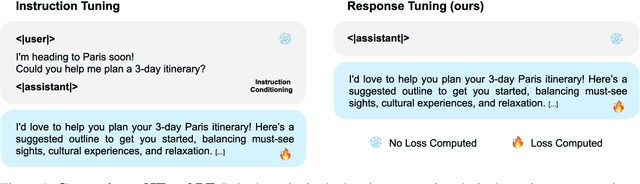
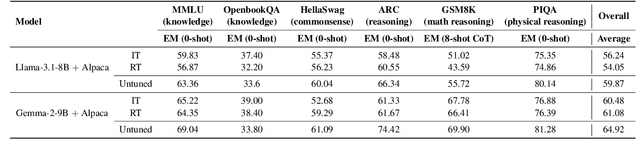
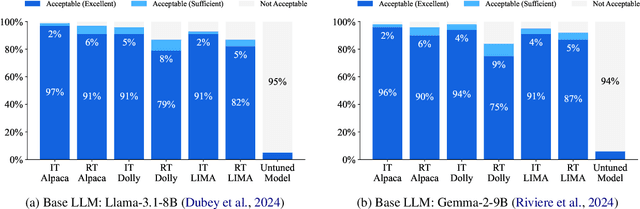
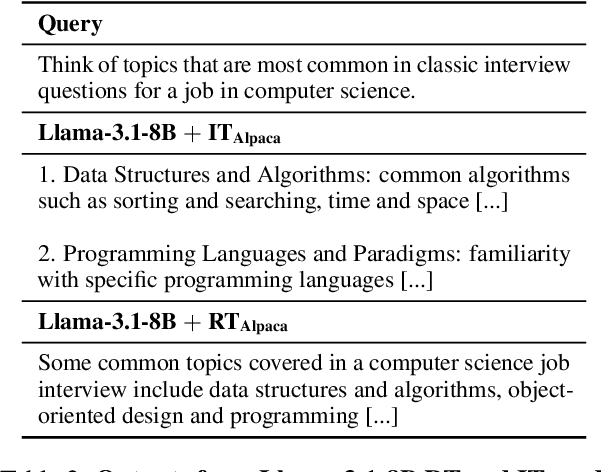
Instruction tuning-supervised fine-tuning using instruction-response pairs-is a foundational step in transitioning pre-trained Large Language Models (LLMs) into helpful and safe chat assistants. Our hypothesis is that establishing an adequate output space can enable such a transition given the capabilities inherent in pre-trained LLMs. To verify this, we propose Response Tuning (RT), which eliminates the instruction-conditioning step in instruction tuning and solely focuses on response space supervision. Our experiments demonstrate that RT models, trained only using responses, can effectively respond to a wide range of instructions and exhibit helpfulness comparable to that of their instruction-tuned counterparts. Furthermore, we observe that controlling the training response distribution can significantly improve their user preference or elicit target behaviors such as refusing assistance for unsafe queries. Our findings illuminate the role of establishing an adequate output space in alignment, highlighting the potential of the extensive inherent capabilities of pre-trained LLMs.