 Add to Chrome
 Add to Firefox
 Add to Edge
UniSAFE: A Comprehensive Benchmark for Safety Evaluation of Unified Multimodal Models
Mar 18, 2026
Unified Multimodal Models (UMMs) offer powerful cross-modality capabilities but introduce new safety risks not observed in single-task models. Despite their emergence, existing safety benchmarks remain fragmented across tasks and modalities, limiting the comprehensive evaluation of complex system-level vulnerabilities. To address this gap, we introduce UniSAFE, the first comprehensive benchmark for system-level safety evaluation of UMMs across 7 I/O modality combinations, spanning conventional tasks and novel multimodal-context image generation settings. UniSAFE is built with a shared-target design that projects common risk scenarios across task-specific I/O configurations, enabling controlled cross-task comparisons of safety failures. Comprising 6,802 curated instances, we use UniSAFE to evaluate 15 state-of-the-art UMMs, both proprietary and open-source. Our results reveal critical vulnerabilities across current UMMs, including elevated safety violations in multi-image composition and multi-turn settings, with image-output tasks consistently more vulnerable than text-output tasks. These findings highlight the need for stronger system-level safety alignment for UMMs. Our code and data are publicly available at https://github.com/segyulee/UniSAFE

FinAI Data Assistant: LLM-based Financial Database Query Processing with the OpenAI Function Calling API
Oct 15, 2025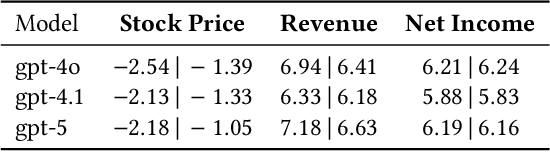
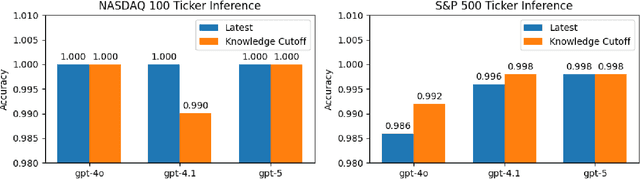
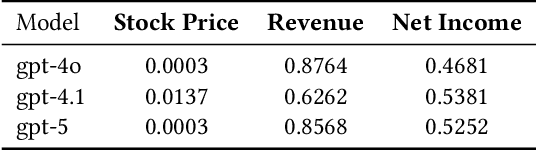
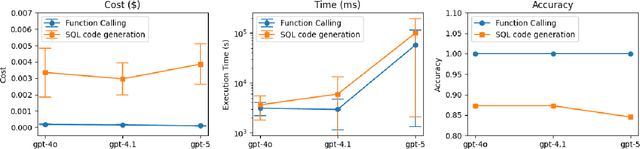
We present FinAI Data Assistant, a practical approach for natural-language querying over financial databases that combines large language models (LLMs) with the OpenAI Function Calling API. Rather than synthesizing complete SQL via text-to-SQL, our system routes user requests to a small library of vetted, parameterized queries, trading generative flexibility for reliability, low latency, and cost efficiency. We empirically study three questions: (RQ1) whether LLMs alone can reliably recall or extrapolate time-dependent financial data without external retrieval; (RQ2) how well LLMs map company names to stock ticker symbols; and (RQ3) whether function calling outperforms text-to-SQL for end-to-end database query processing. Across controlled experiments on prices and fundamentals, LLM-only predictions exhibit non-negligible error and show look-ahead bias primarily for stock prices relative to model knowledge cutoffs. Ticker-mapping accuracy is near-perfect for NASDAQ-100 constituents and high for S\&P~500 firms. Finally, FinAI Data Assistant achieves lower latency and cost and higher reliability than a text-to-SQL baseline on our task suite. We discuss design trade-offs, limitations, and avenues for deployment.
GuruAgents: Emulating Wise Investors with Prompt-Guided LLM Agents
Oct 02, 2025This study demonstrates that GuruAgents, prompt-guided AI agents, can systematically operationalize the strategies of legendary investment gurus. We develop five distinct GuruAgents, each designed to emulate an iconic investor, by encoding their distinct philosophies into LLM prompts that integrate financial tools and a deterministic reasoning pipeline. In a backtest on NASDAQ-100 constituents from Q4 2023 to Q2 2025, the GuruAgents exhibit unique behaviors driven by their prompted personas. The Buffett GuruAgent achieves the highest performance, delivering a 42.2\% CAGR that significantly outperforms benchmarks, while other agents show varied results. These findings confirm that prompt engineering can successfully translate the qualitative philosophies of investment gurus into reproducible, quantitative strategies, highlighting a novel direction for automated systematic investing. The source code and data are available at https://github.com/yejining99/GuruAgents.
* 7 Pages, 2 figures
Semi-Decision-Focused Learning with Deep Ensembles: A Practical Framework for Robust Portfolio Optimization
Mar 16, 2025I propose Semi-Decision-Focused Learning, a practical adaptation of Decision-Focused Learning for portfolio optimization. Rather than directly optimizing complex financial metrics, I employ simple target portfolios (Max-Sortino or One-Hot) and train models with a convex, cross-entropy loss. I further incorporate Deep Ensemble methods to reduce variance and stabilize performance. Experiments on two universes (one upward-trending and another range-bound) show consistent outperformance over baseline portfolios, demonstrating the effectiveness and robustness of my approach. Code is available at https://github.com/sDFLwDE/sDFLwDE