 Add to Chrome
 Add to Firefox
 Add to Edge
RetroReasoner: A Reasoning LLM for Strategic Retrosynthesis Prediction
Mar 13, 2026
Retrosynthesis prediction is a core task in organic synthesis that aims to predict reactants for a given product molecule. Traditionally, chemists select a plausible bond disconnection and derive corresponding reactants, which is time-consuming and requires substantial expertise. While recent advancements in molecular large language models (LLMs) have made progress, many methods either predict reactants without strategic reasoning or conduct only a generic product analysis, rather than reason explicitly about bond-disconnection strategies that logically lead to the choice of specific reactants. To overcome these limitations, we propose RetroReasoner, a retrosynthetic reasoning model that leverages chemists' strategic thinking. RetroReasoner is trained using both supervised fine-tuning (SFT) and reinforcement learning (RL). For SFT, we introduce SyntheticRetro, a framework that generates structured disconnection rationales alongside reactant predictions. In the case of RL, we apply a round-trip accuracy as reward, where predicted reactants are passed through a forward synthesis model, and predictions are rewarded when the forward-predicted product matches the original input product. Experimental results show that RetroReasoner not only outperforms prior baselines but also generates a broader range of feasible reactant proposals, particularly in handling more challenging reaction instances.

Multimodal Crystal Flow: Any-to-Any Modality Generation for Unified Crystal Modeling
Feb 23, 2026Crystal modeling spans a family of conditional and unconditional generation tasks across different modalities, including crystal structure prediction (CSP) and \emph{de novo} generation (DNG). While recent deep generative models have shown promising performance, they remain largely task-specific, lacking a unified framework that shares crystal representations across different generation tasks. To address this limitation, we propose \emph{Multimodal Crystal Flow (MCFlow)}, a unified multimodal flow model that realizes multiple crystal generation tasks as distinct inference trajectories via independent time variables for atom types and crystal structures. To enable multimodal flow in a standard transformer model, we introduce a composition- and symmetry-aware atom ordering with hierarchical permutation augmentation, injecting strong compositional and crystallographic priors without explicit structural templates. Experiments on the MP-20 and MPTS-52 benchmarks show that MCFlow achieves competitive performance against task-specific baselines across multiple crystal generation tasks.
MolHIT: Advancing Molecular-Graph Generation with Hierarchical Discrete Diffusion Models
Feb 19, 2026Molecular generation with diffusion models has emerged as a promising direction for AI-driven drug discovery and materials science. While graph diffusion models have been widely adopted due to the discrete nature of 2D molecular graphs, existing models suffer from low chemical validity and struggle to meet the desired properties compared to 1D modeling. In this work, we introduce MolHIT, a powerful molecular graph generation framework that overcomes long-standing performance limitations in existing methods. MolHIT is based on the Hierarchical Discrete Diffusion Model, which generalizes discrete diffusion to additional categories that encode chemical priors, and decoupled atom encoding that splits the atom types according to their chemical roles. Overall, MolHIT achieves new state-of-the-art performance on the MOSES dataset with near-perfect validity for the first time in graph diffusion, surpassing strong 1D baselines across multiple metrics. We further demonstrate strong performance in downstream tasks, including multi-property guided generation and scaffold extension.
Geometric Embedding Alignment via Curvature Matching in Transfer Learning
Jun 16, 2025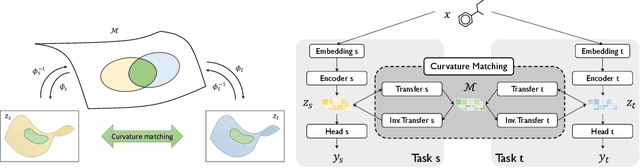

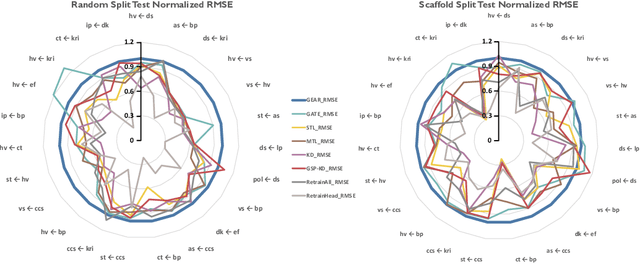
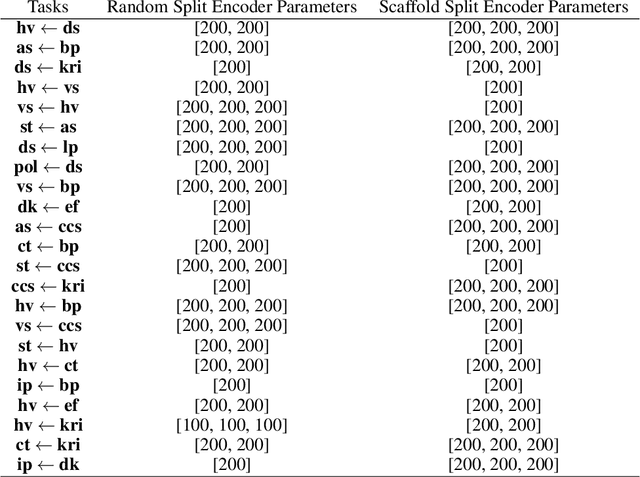
Geometrical interpretations of deep learning models offer insightful perspectives into their underlying mathematical structures. In this work, we introduce a novel approach that leverages differential geometry, particularly concepts from Riemannian geometry, to integrate multiple models into a unified transfer learning framework. By aligning the Ricci curvature of latent space of individual models, we construct an interrelated architecture, namely Geometric Embedding Alignment via cuRvature matching in transfer learning (GEAR), which ensures comprehensive geometric representation across datapoints. This framework enables the effective aggregation of knowledge from diverse sources, thereby improving performance on target tasks. We evaluate our model on 23 molecular task pairs sourced from various domains and demonstrate significant performance gains over existing benchmark model under both random (14.4%) and scaffold (8.3%) data splits.
MolMole: Molecule Mining from Scientific Literature
May 08, 2025The extraction of molecular structures and reaction data from scientific documents is challenging due to their varied, unstructured chemical formats and complex document layouts. To address this, we introduce MolMole, a vision-based deep learning framework that unifies molecule detection, reaction diagram parsing, and optical chemical structure recognition (OCSR) into a single pipeline for automating the extraction of chemical data directly from page-level documents. Recognizing the lack of a standard page-level benchmark and evaluation metric, we also present a testset of 550 pages annotated with molecule bounding boxes, reaction labels, and MOLfiles, along with a novel evaluation metric. Experimental results demonstrate that MolMole outperforms existing toolkits on both our benchmark and public datasets. The benchmark testset will be publicly available, and the MolMole toolkit will be accessible soon through an interactive demo on the LG AI Research website. For commercial inquiries, please contact us at \href{mailto:contact_ddu@lgresearch.ai}{contact\_ddu@lgresearch.ai}.
Mol-LLM: Generalist Molecular LLM with Improved Graph Utilization
Feb 05, 2025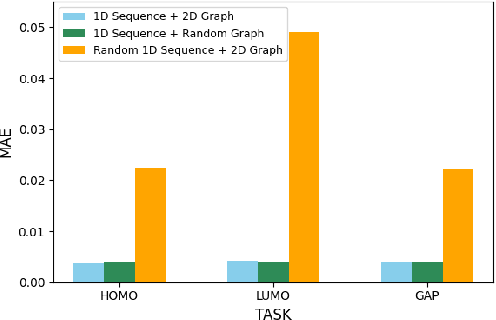
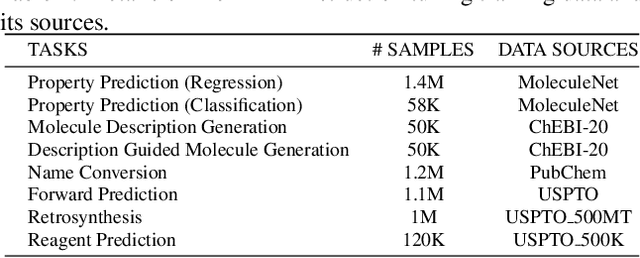

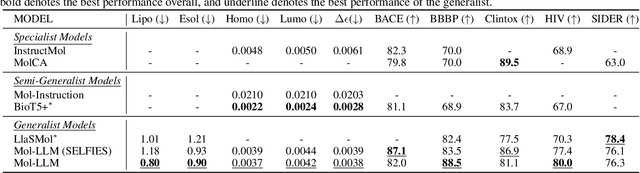
Recent advances in Large Language Models (LLMs) have motivated the development of general LLMs for molecular tasks. While several studies have demonstrated that fine-tuned LLMs can achieve impressive benchmark performances, they are far from genuine generalist molecular LLMs due to a lack of fundamental understanding of molecular structure. Specifically, when given molecular task instructions, LLMs trained with naive next-token prediction training assign similar likelihood scores to both original and negatively corrupted molecules, revealing their lack of molecular structure understanding that is crucial for reliable and general molecular LLMs. To overcome this limitation and obtain a true generalist molecular LLM, we introduce a novel multi-modal training method based on a thorough multi-modal instruction tuning as well as a molecular structure preference optimization between chosen and rejected graphs. On various molecular benchmarks, the proposed generalist molecular LLM, called Mol-LLM, achieves state-of-the-art performances among generalist LLMs on most tasks, at the same time, surpassing or comparable to state-of-the-art specialist LLMs. Moreover, Mol-LLM also shows superior generalization performances in reaction prediction tasks, demonstrating the effect of the molecular structure understanding for generalization perspective.
Scalable Multi-Task Transfer Learning for Molecular Property Prediction
Oct 01, 2024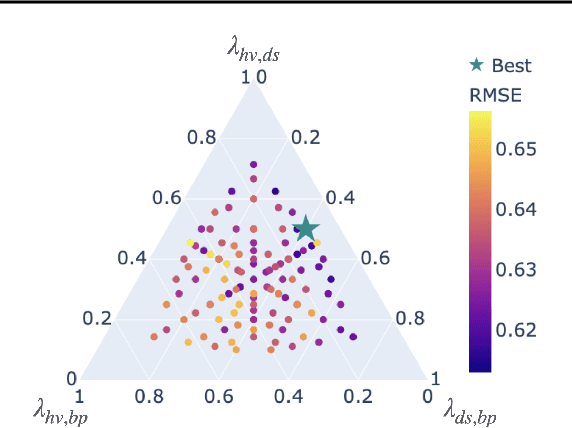

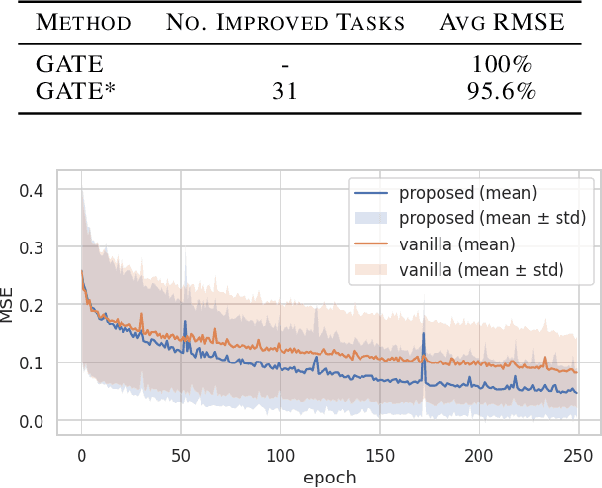
Molecules have a number of distinct properties whose importance and application vary. Often, in reality, labels for some properties are hard to achieve despite their practical importance. A common solution to such data scarcity is to use models of good generalization with transfer learning. This involves domain experts for designing source and target tasks whose features are shared. However, this approach has limitations: i). Difficulty in accurate design of source-target task pairs due to the large number of tasks, and ii). corresponding computational burden verifying many trials and errors of transfer learning design, thereby iii). constraining the potential of foundation modeling of multi-task molecular property prediction. We address the limitations of the manual design of transfer learning via data-driven bi-level optimization. The proposed method enables scalable multi-task transfer learning for molecular property prediction by automatically obtaining the optimal transfer ratios. Empirically, the proposed method improved the prediction performance of 40 molecular properties and accelerated training convergence.
Task Addition in Multi-Task Learning by Geometrical Alignment
Sep 25, 2024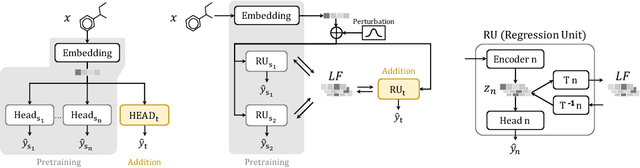


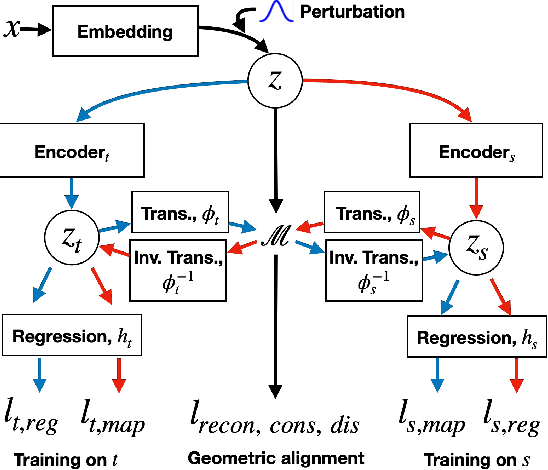
Training deep learning models on limited data while maintaining generalization is one of the fundamental challenges in molecular property prediction. One effective solution is transferring knowledge extracted from abundant datasets to those with scarce data. Recently, a novel algorithm called Geometrically Aligned Transfer Encoder (GATE) has been introduced, which uses soft parameter sharing by aligning the geometrical shapes of task-specific latent spaces. However, GATE faces limitations in scaling to multiple tasks due to computational costs. In this study, we propose a task addition approach for GATE to improve performance on target tasks with limited data while minimizing computational complexity. It is achieved through supervised multi-task pre-training on a large dataset, followed by the addition and training of task-specific modules for each target task. Our experiments demonstrate the superior performance of the task addition strategy for GATE over conventional multi-task methods, with comparable computational costs.
Multitask Extension of Geometrically Aligned Transfer Encoder
May 03, 2024


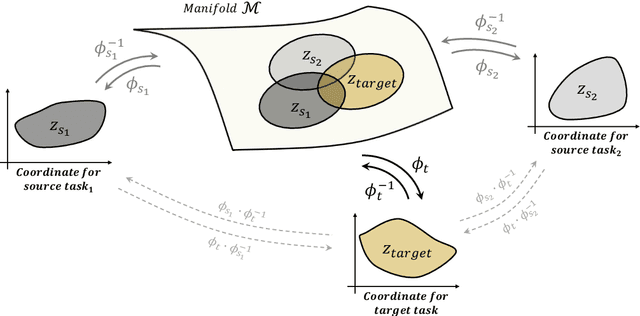
Molecular datasets often suffer from a lack of data. It is well-known that gathering data is difficult due to the complexity of experimentation or simulation involved. Here, we leverage mutual information across different tasks in molecular data to address this issue. We extend an algorithm that utilizes the geometric characteristics of the encoding space, known as the Geometrically Aligned Transfer Encoder (GATE), to a multi-task setup. Thus, we connect multiple molecular tasks by aligning the curved coordinates onto locally flat coordinates, ensuring the flow of information from source tasks to support performance on target data.
Geometrically Aligned Transfer Encoder for Inductive Transfer in Regression Tasks
Oct 10, 2023


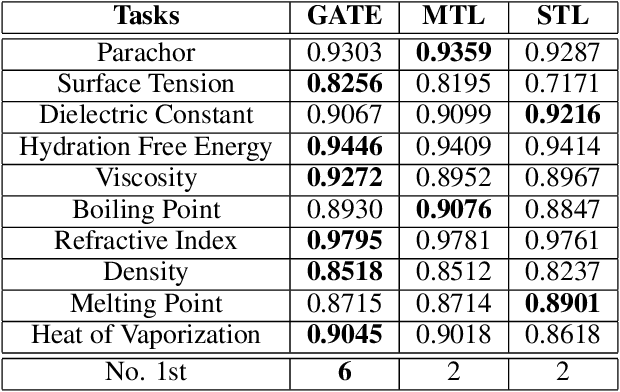
Transfer learning is a crucial technique for handling a small amount of data that is potentially related to other abundant data. However, most of the existing methods are focused on classification tasks using images and language datasets. Therefore, in order to expand the transfer learning scheme to regression tasks, we propose a novel transfer technique based on differential geometry, namely the Geometrically Aligned Transfer Encoder (GATE). In this method, we interpret the latent vectors from the model to exist on a Riemannian curved manifold. We find a proper diffeomorphism between pairs of tasks to ensure that every arbitrary point maps to a locally flat coordinate in the overlapping region, allowing the transfer of knowledge from the source to the target data. This also serves as an effective regularizer for the model to behave in extrapolation regions. In this article, we demonstrate that GATE outperforms conventional methods and exhibits stable behavior in both the latent space and extrapolation regions for various molecular graph datasets.