 Add to Chrome
 Add to Firefox
 Add to Edge
RetroReasoner: A Reasoning LLM for Strategic Retrosynthesis Prediction
Mar 13, 2026
Retrosynthesis prediction is a core task in organic synthesis that aims to predict reactants for a given product molecule. Traditionally, chemists select a plausible bond disconnection and derive corresponding reactants, which is time-consuming and requires substantial expertise. While recent advancements in molecular large language models (LLMs) have made progress, many methods either predict reactants without strategic reasoning or conduct only a generic product analysis, rather than reason explicitly about bond-disconnection strategies that logically lead to the choice of specific reactants. To overcome these limitations, we propose RetroReasoner, a retrosynthetic reasoning model that leverages chemists' strategic thinking. RetroReasoner is trained using both supervised fine-tuning (SFT) and reinforcement learning (RL). For SFT, we introduce SyntheticRetro, a framework that generates structured disconnection rationales alongside reactant predictions. In the case of RL, we apply a round-trip accuracy as reward, where predicted reactants are passed through a forward synthesis model, and predictions are rewarded when the forward-predicted product matches the original input product. Experimental results show that RetroReasoner not only outperforms prior baselines but also generates a broader range of feasible reactant proposals, particularly in handling more challenging reaction instances.

MolHIT: Advancing Molecular-Graph Generation with Hierarchical Discrete Diffusion Models
Feb 19, 2026Molecular generation with diffusion models has emerged as a promising direction for AI-driven drug discovery and materials science. While graph diffusion models have been widely adopted due to the discrete nature of 2D molecular graphs, existing models suffer from low chemical validity and struggle to meet the desired properties compared to 1D modeling. In this work, we introduce MolHIT, a powerful molecular graph generation framework that overcomes long-standing performance limitations in existing methods. MolHIT is based on the Hierarchical Discrete Diffusion Model, which generalizes discrete diffusion to additional categories that encode chemical priors, and decoupled atom encoding that splits the atom types according to their chemical roles. Overall, MolHIT achieves new state-of-the-art performance on the MOSES dataset with near-perfect validity for the first time in graph diffusion, surpassing strong 1D baselines across multiple metrics. We further demonstrate strong performance in downstream tasks, including multi-property guided generation and scaffold extension.
Mol-LLM: Generalist Molecular LLM with Improved Graph Utilization
Feb 05, 2025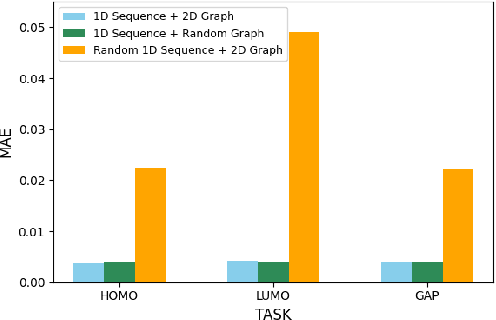
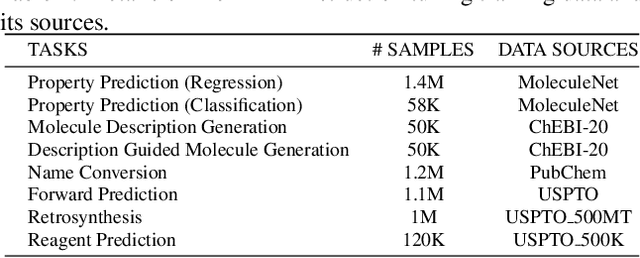

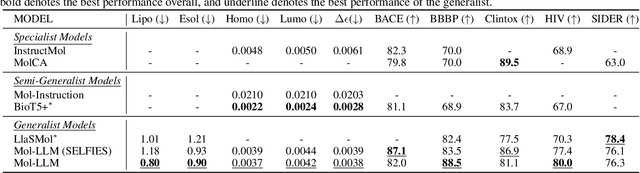
Recent advances in Large Language Models (LLMs) have motivated the development of general LLMs for molecular tasks. While several studies have demonstrated that fine-tuned LLMs can achieve impressive benchmark performances, they are far from genuine generalist molecular LLMs due to a lack of fundamental understanding of molecular structure. Specifically, when given molecular task instructions, LLMs trained with naive next-token prediction training assign similar likelihood scores to both original and negatively corrupted molecules, revealing their lack of molecular structure understanding that is crucial for reliable and general molecular LLMs. To overcome this limitation and obtain a true generalist molecular LLM, we introduce a novel multi-modal training method based on a thorough multi-modal instruction tuning as well as a molecular structure preference optimization between chosen and rejected graphs. On various molecular benchmarks, the proposed generalist molecular LLM, called Mol-LLM, achieves state-of-the-art performances among generalist LLMs on most tasks, at the same time, surpassing or comparable to state-of-the-art specialist LLMs. Moreover, Mol-LLM also shows superior generalization performances in reaction prediction tasks, demonstrating the effect of the molecular structure understanding for generalization perspective.