 Add to Chrome
 Add to Firefox
 Add to Edge
Towards Efficient and Evidence-grounded Mobility Prediction with LLM-Driven Agent
Jun 03, 2026
Individual-level mobility prediction is central to urban simulation, transportation planning, and policy analysis. Supervised sequence models achieve strong accuracy but require task-specific training and offer limited decision-level transparency. Recent LLM-based methods improve interpretability, yet mostly rely on static prompts and single-pass inference, limiting their ability to seek additional evidence when mobility signals are weak or conflicting. We propose \method{}, a training-free LLM-driven agent framework that formulates next-location prediction as adaptive evidence-controlled decision making. \method{} resolves routine cases through a fast path based on historical regularity, while ambiguous cases trigger iterative tool use over recent trajectories, historical behavior, stay-move likelihood, and geographical evidence. Across three mobility datasets, AgentMob achieves the strongest overall performance among training-free LLM-based methods, with GPT-5.4 reaching 71.42\% Acc@1 on BW, 33.14\% on YJMob100K, and 33.50\% on Shanghai ISP. On BW non-fast-path cases, the LLM controller improves Acc@1 from 30.65\% to 48.62\% over a same-tool statistical baseline, showing that its main benefit lies in resolving ambiguous predictions through adaptive evidence gathering. Our code is available at https://github.com/Unknown-zoo/AgentMob.

Agentization of Digital Assets for the Agentic Web: Concepts, Techniques, and Benchmark
Apr 05, 2026Agentic Web, as a new paradigm that redefines the internet through autonomous, goal-driven interactions, plays an important role in group intelligence. As the foundational semantic primitives of the Agentic Web, digital assets encapsulate interactive web elements into agents, which expand the capacities and coverage of agents in agentic web. The lack of automated methodologies for agent generation limits the wider usage of digital assets and the advancement of the Agentic Web. In this paper, we first formalize these challenges by strictly defining the A2A-Agentization process, decomposing it into critical stages and identifying key technical hurdles on top of the A2A protocol. Based on this framework, we develop an Agentization Agent to agentize digital assets for the Agentic Web. To rigorously evaluate this capability, we propose A2A-Agentization Bench, the first benchmark explicitly designed to evaluate agentization quality in terms of fidelity and interoperability. Our experiments demonstrate that our approach effectively activates the functional capabilities of digital assets and enables interoperable A2A multi-agent collaboration. We believe this work will further facilitate scalable and standardized integration of digital assets into the Agentic Web ecosystem.
MemDA: Forecasting Urban Time Series with Memory-based Drift Adaptation
Sep 25, 2023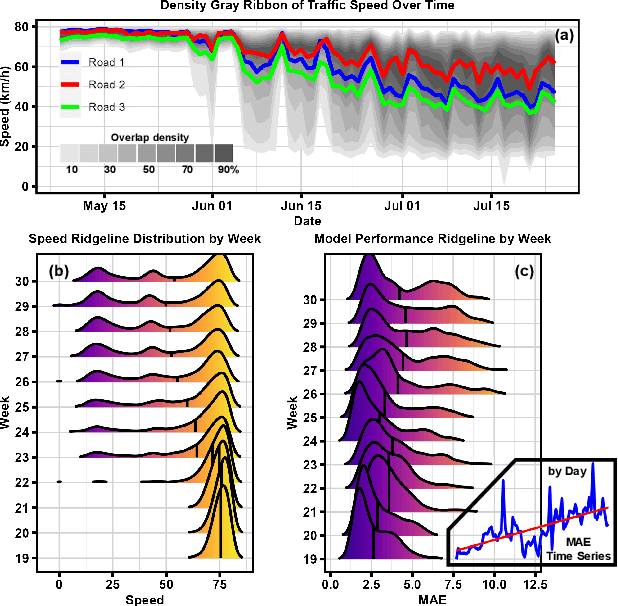
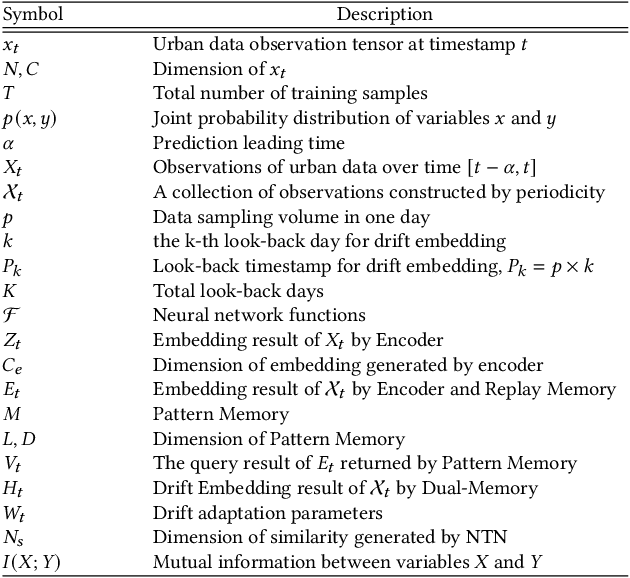
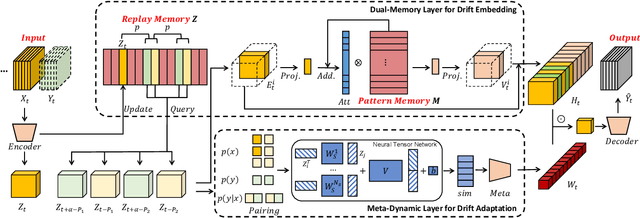

Urban time series data forecasting featuring significant contributions to sustainable development is widely studied as an essential task of the smart city. However, with the dramatic and rapid changes in the world environment, the assumption that data obey Independent Identically Distribution is undermined by the subsequent changes in data distribution, known as concept drift, leading to weak replicability and transferability of the model over unseen data. To address the issue, previous approaches typically retrain the model, forcing it to fit the most recent observed data. However, retraining is problematic in that it leads to model lag, consumption of resources, and model re-invalidation, causing the drift problem to be not well solved in realistic scenarios. In this study, we propose a new urban time series prediction model for the concept drift problem, which encodes the drift by considering the periodicity in the data and makes on-the-fly adjustments to the model based on the drift using a meta-dynamic network. Experiments on real-world datasets show that our design significantly outperforms state-of-the-art methods and can be well generalized to existing prediction backbones by reducing their sensitivity to distribution changes.
mdx: A Cloud Platform for Supporting Data Science and Cross-Disciplinary Research Collaborations
Mar 27, 2022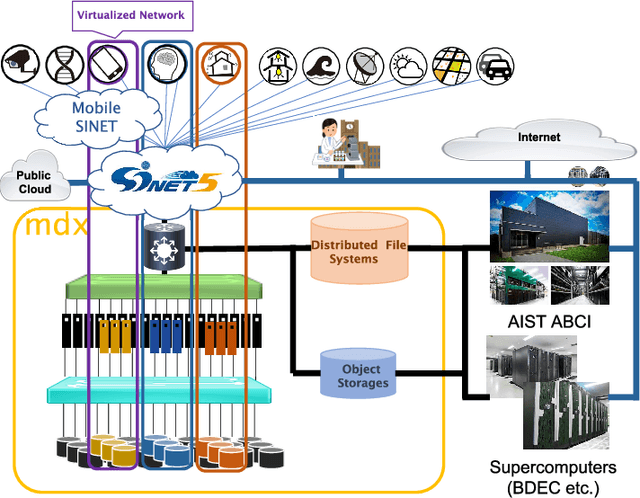
The growing amount of data and advances in data science have created a need for a new kind of cloud platform that provides users with flexibility, strong security, and the ability to couple with supercomputers and edge devices through high-performance networks. We have built such a nation-wide cloud platform, called "mdx" to meet this need. The mdx platform's virtualization service, jointly operated by 9 national universities and 2 national research institutes in Japan, launched in 2021, and more features are in development. Currently mdx is used by researchers in a wide variety of domains, including materials informatics, geo-spatial information science, life science, astronomical science, economics, social science, and computer science. This paper provides an the overview of the mdx platform, details the motivation for its development, reports its current status, and outlines its future plans.