 Add to Chrome
 Add to Firefox
 Add to Edge
MiMo-V2-Flash Technical Report
Jan 08, 2026
We present MiMo-V2-Flash, a Mixture-of-Experts (MoE) model with 309B total parameters and 15B active parameters, designed for fast, strong reasoning and agentic capabilities. MiMo-V2-Flash adopts a hybrid attention architecture that interleaves Sliding Window Attention (SWA) with global attention, with a 128-token sliding window under a 5:1 hybrid ratio. The model is pre-trained on 27 trillion tokens with Multi-Token Prediction (MTP), employing a native 32k context length and subsequently extended to 256k. To efficiently scale post-training compute, MiMo-V2-Flash introduces a novel Multi-Teacher On-Policy Distillation (MOPD) paradigm. In this framework, domain-specialized teachers (e.g., trained via large-scale reinforcement learning) provide dense and token-level reward, enabling the student model to perfectly master teacher expertise. MiMo-V2-Flash rivals top-tier open-weight models such as DeepSeek-V3.2 and Kimi-K2, despite using only 1/2 and 1/3 of their total parameters, respectively. During inference, by repurposing MTP as a draft model for speculative decoding, MiMo-V2-Flash achieves up to 3.6 acceptance length and 2.6x decoding speedup with three MTP layers. We open-source both the model weights and the three-layer MTP weights to foster open research and community collaboration.

MiMo-Audio: Audio Language Models are Few-Shot Learners
Dec 29, 2025Existing audio language models typically rely on task-specific fine-tuning to accomplish particular audio tasks. In contrast, humans are able to generalize to new audio tasks with only a few examples or simple instructions. GPT-3 has shown that scaling next-token prediction pretraining enables strong generalization capabilities in text, and we believe this paradigm is equally applicable to the audio domain. By scaling MiMo-Audio's pretraining data to over one hundred million of hours, we observe the emergence of few-shot learning capabilities across a diverse set of audio tasks. We develop a systematic evaluation of these capabilities and find that MiMo-Audio-7B-Base achieves SOTA performance on both speech intelligence and audio understanding benchmarks among open-source models. Beyond standard metrics, MiMo-Audio-7B-Base generalizes to tasks absent from its training data, such as voice conversion, style transfer, and speech editing. MiMo-Audio-7B-Base also demonstrates powerful speech continuation capabilities, capable of generating highly realistic talk shows, recitations, livestreaming and debates. At the post-training stage, we curate a diverse instruction-tuning corpus and introduce thinking mechanisms into both audio understanding and generation. MiMo-Audio-7B-Instruct achieves open-source SOTA on audio understanding benchmarks (MMSU, MMAU, MMAR, MMAU-Pro), spoken dialogue benchmarks (Big Bench Audio, MultiChallenge Audio) and instruct-TTS evaluations, approaching or surpassing closed-source models. Model checkpoints and full evaluation suite are available at https://github.com/XiaomiMiMo/MiMo-Audio.
Enhance Image Classification via Inter-Class Image Mixup with Diffusion Model
Mar 28, 2024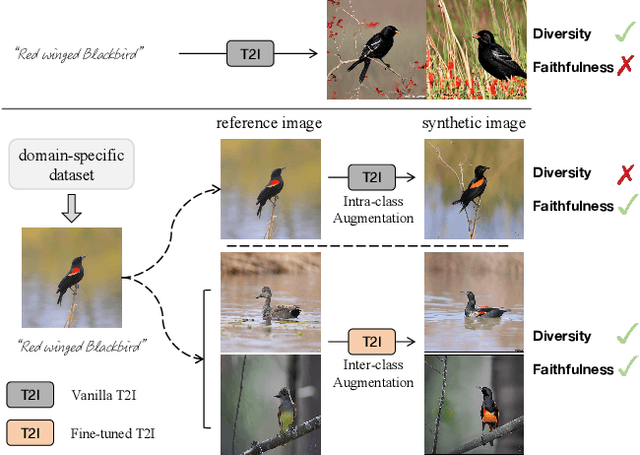

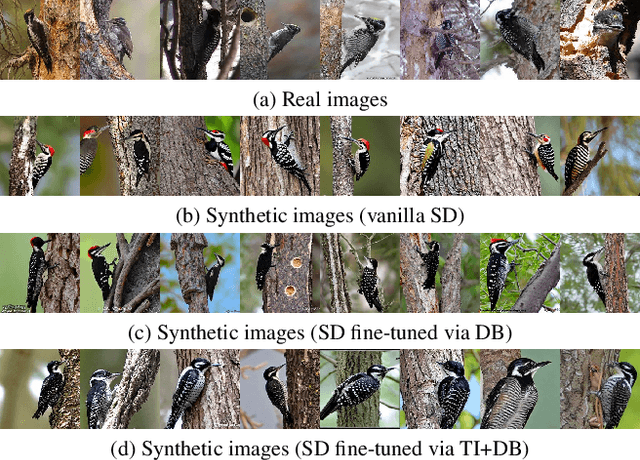
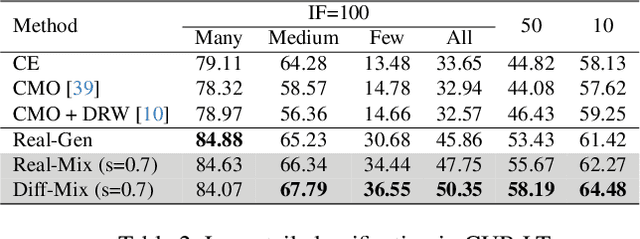
Text-to-image (T2I) generative models have recently emerged as a powerful tool, enabling the creation of photo-realistic images and giving rise to a multitude of applications. However, the effective integration of T2I models into fundamental image classification tasks remains an open question. A prevalent strategy to bolster image classification performance is through augmenting the training set with synthetic images generated by T2I models. In this study, we scrutinize the shortcomings of both current generative and conventional data augmentation techniques. Our analysis reveals that these methods struggle to produce images that are both faithful (in terms of foreground objects) and diverse (in terms of background contexts) for domain-specific concepts. To tackle this challenge, we introduce an innovative inter-class data augmentation method known as Diff-Mix (https://github.com/Zhicaiwww/Diff-Mix), which enriches the dataset by performing image translations between classes. Our empirical results demonstrate that Diff-Mix achieves a better balance between faithfulness and diversity, leading to a marked improvement in performance across diverse image classification scenarios, including few-shot, conventional, and long-tail classifications for domain-specific datasets.
An End-to-End Network for Upright Adjustment of Panoramic Images
Apr 12, 2023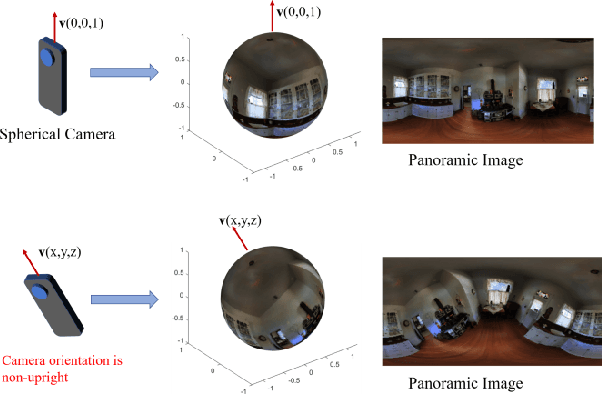
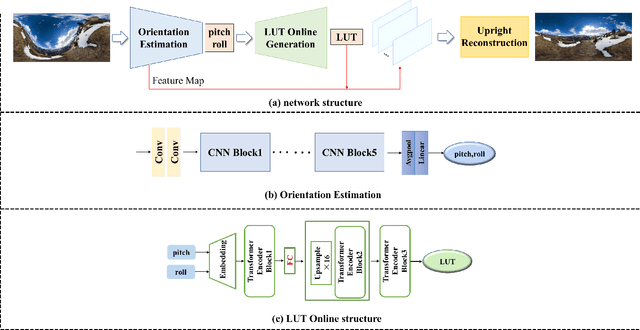
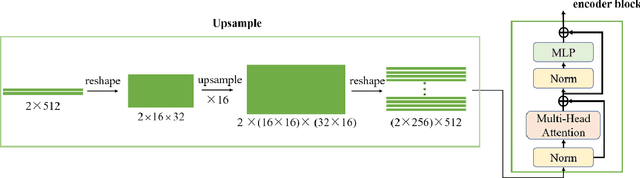

Nowadays, panoramic images can be easily obtained by panoramic cameras. However, when the panoramic camera orientation is tilted, a non-upright panoramic image will be captured. Existing upright adjustment models focus on how to estimate more accurate camera orientation, and attribute image reconstruction to offline or post-processing tasks. To this end, we propose an online end-to-end network for upright adjustment. Our network is designed to reconstruct the image while finding the angle. Our network consists of three modules: orientation estimation, LUT online generation, and upright reconstruction. Direction estimation estimates the tilt angle of the panoramic image. Then, a converter block with upsampling function is designed to generate angle to LUT. This module can output corresponding online LUT for different input angles. Finally, a lightweight generative adversarial network (GAN) aims to generate upright images from shallow features. The experimental results show that in terms of angles, we have improved the accuracy of small angle errors. In terms of image reconstruction, In image reconstruction, we have achieved the first real-time online upright reconstruction of panoramic images using deep learning networks.