 Add to Chrome
 Add to Firefox
 Add to Edge
TRACE: A Unified Rollout Budget Allocation Framework for Efficient Agentic Reinforcement Learning
Jun 09, 2026
Reinforcement learning with verifiable rewards (RLVR) is a promising approach for enhancing reasoning and agentic behavior in large language models. However, rollout-intensive policy optimization is often limited by insufficient reward contrast, arising when overly simple or complex prompts generate low-variance feedback and when outcome-only rewards assign the same terminal assessment to every decision in a multi-turn rollout. Past efforts have focused on allocating available rollout resources to promising prompts, yet they only leverage sample informativeness at the prompt level and neglect variation in prefix-level informativeness across turns within the same rollout. This work targets multi-turn agentic RL by modeling each ReAct-style thought-action-observation turn as a semantically distinct node, allowing budget allocation to extend from prompt roots to turn-level prefixes with further continuations, which naturally forms tree-structured rollouts. We introduce Tree Rollout Allocation for Contrastive Exploration (TRACE), a unified rollout allocation framework that enhances reward contrast within a fixed sampling budget. Technically, TRACE allocates rollout budget to both prompt roots and intermediate prefixes that are most likely to yield mixed terminal rewards. A shared generalizable predictor estimates conditional success probability at these anchors from prefix histories to guide this allocation. The resulting adaptive tree structure enriches outcome-only feedback and amplifies the policy-update signal. Empirically, TRACE achieves competitive performance and efficiency gains on typical agentic benchmarks, e.g., improving Qwen3-14B Multi-Hop QA average accuracy by 2.8 points over competitive baselines at equal sampling cost.

RLVR without Ineffective Samples: Group Prioritized Off-Policy Optimization for LLM Reasoning
May 31, 2026Reinforcement learning with verifiable rewards (RLVR) has emerged as a powerful paradigm for enhancing the reasoning capabilities of large language models (LLMs). However, its effectiveness is substantially hindered by the prevalence of ineffective training data: many sampled prompts yield response groups that are either entirely correct or entirely incorrect, resulting in zero-variance rewards and limited learning signals. Recent state-of-the-art methods address this issue through extensive LLM rollouts to filter ineffective samples, but at the cost of considerable computational overhead. Alternative approaches, including predictive sampling and trajectory replay, aim to improve data efficiency but often remain insufficient and may introduce additional issues such as systematic bias or suboptimal constraints. To address these limitations, we propose Group Prioritized Off-Policy Optimization (POPO), a simple yet effective framework that fully exploits effective training batches without additional rollout overhead. POPO comprises two key components: prioritized group replay and decoupled off-policy optimization. The former replaces ineffective on-policy groups with effective off-policy groups via a recency-based replay mechanism that jointly considers sample quality and the degree of off-policiness. To further mitigate the off-policy gap, POPO employs decoupled importance sampling to correct off-policy bias while maintaining stable policy updates under consistent trust-region constraints. Empirical evaluations across diverse reasoning tasks, including mathematics, planning, and visual geometry, demonstrate that POPO substantially accelerates RL finetuning and achieves strong reasoning performance with significantly fewer rollouts.
Listwise Policy Optimization: Group-based RLVR as Target-Projection on the LLM Response Simplex
May 07, 2026Reinforcement learning with verifiable rewards (RLVR) has become a standard approach for large language models (LLMs) post-training to incentivize reasoning capacity. Among existing recipes, group-based policy gradient is prevalent, which samples a group of responses per prompt and updates the policy via group-relative advantage signals. This work reveals that these optimization strategies share a common geometric structure: each implicitly defines a target distribution on the response simplex and projects toward it via first-order approximation. Building on this insight, we propose Listwise Policy Optimization (LPO) to explicitly conduct the target-projection, which demystifies the implicit target by restricting the proximal RL objective to the response simplex, and then projects the policy via exact divergence minimization. This framework provides (i) monotonic improvement on the listwise objective with bounded, zero-sum, and self-correcting projection gradients, and (ii) flexibility in divergence selection with distinct structural properties through the decoupled projection step. On diverse reasoning tasks and LLM backbones, LPO consistently improves training performance over typical policy gradient baselines under matched targets, while intrinsically preserving optimization stability and response diversity.
Enhancing Pretrained Model-based Continual Representation Learning via Guided Random Projection
Mar 19, 2026Recent paradigms in Random Projection Layer (RPL)-based continual representation learning have demonstrated superior performance when building upon a pre-trained model (PTM). These methods insert a randomly initialized RPL after a PTM to enhance feature representation in the initial stage. Subsequently, a linear classification head is used for analytic updates in the continual learning stage. However, under severe domain gaps between pre-trained representations and target domains, a randomly initialized RPL exhibits limited expressivity under large domain shifts. While largely scaling up the RPL dimension can improve expressivity, it also induces an ill-conditioned feature matrix, thereby destabilizing the recursive analytic updates of the linear head. To this end, we propose the Stochastic Continual Learner with MemoryGuard Supervisory Mechanism (SCL-MGSM). Unlike random initialization, MGSM constructs the projection layer via a principled, data-guided mechanism that progressively selects target-aligned random bases to adapt the PTM representation to downstream tasks. This facilitates the construction of a compact yet expressive RPL while improving the numerical stability of analytic updates. Extensive experiments on multiple exemplar-free Class Incremental Learning (CIL) benchmarks demonstrate that SCL-MGSM achieves superior performance compared to state-of-the-art methods.
Dynamics-Predictive Sampling for Active RL Finetuning of Large Reasoning Models
Mar 11, 2026Reinforcement learning (RL) finetuning has become a key technique for enhancing the reasoning abilities of large language models (LLMs). However, its effectiveness critically depends on the selection of training data. Recent advances underscore the importance of online prompt selection methods, which typically concentrate training on partially solved or moderately challenging examples under the current policy, thereby yielding more effective model updates. While significantly accelerating RL finetuning in terms of training steps, they also incur substantial computational overhead by requiring extensive LLM rollouts over large candidate batches to identify informative samples, an expense that can outweigh the finetuning process itself. To address this challenge, this work proposes Dynamics-Predictive Sampling (DPS), which online predicts and selects informative prompts by inferring their learning dynamics prior to costly rollouts. Specifically, we introduce a new perspective by modeling each prompt's solving progress during RL finetuning as a dynamical system, where the extent of solving is represented as the state and the transition is characterized by a hidden Markov model. Using historical rollout reward signals, we perform online Bayesian inference to estimate evolving state distributions, and the inference outcome provides a predictive prior for efficient prompt selection without rollout-intensive filtering. Empirical results across diverse reasoning tasks, including mathematics, planning, and visual geometry, demonstrate that DPS substantially reduces redundant rollouts, accelerates the training process, and achieves superior reasoning performance.
Small Generalizable Prompt Predictive Models Can Steer Efficient RL Post-Training of Large Reasoning Models
Feb 02, 2026Reinforcement learning enhances the reasoning capabilities of large language models but often involves high computational costs due to rollout-intensive optimization. Online prompt selection presents a plausible solution by prioritizing informative prompts to improve training efficiency. However, current methods either depend on costly, exact evaluations or construct prompt-specific predictive models lacking generalization across prompts. This study introduces Generalizable Predictive Prompt Selection (GPS), which performs Bayesian inference towards prompt difficulty using a lightweight generative model trained on the shared optimization history. Intermediate-difficulty prioritization and history-anchored diversity are incorporated into the batch acquisition principle to select informative prompt batches. The small predictive model also generalizes at test-time for efficient computational allocation. Experiments across varied reasoning benchmarks indicate GPS's substantial improvements in training efficiency, final performance, and test-time efficiency over superior baseline methods.
Structural features of the fly olfactory circuit mitigate the stability-plasticity dilemma in continual learning
Feb 03, 2025Artificial neural networks face the stability-plasticity dilemma in continual learning, while the brain can maintain memories and remain adaptable. However, the biological strategies for continual learning and their potential to inspire learning algorithms in neural networks are poorly understood. This study presents a minimal model of the fly olfactory circuit to investigate the biological strategies that support continual odor learning. We introduce the fly olfactory circuit as a plug-and-play component, termed the Fly Model, which can integrate with modern machine learning methods to address this dilemma. Our findings demonstrate that the Fly Model enhances both memory stability and learning plasticity, overcoming the limitations of current continual learning strategies. We validated its effectiveness across various challenging continual learning scenarios using commonly used datasets. The fly olfactory system serves as an elegant biological circuit for lifelong learning, offering a module that enhances continual learning with minimal additional computational cost for machine learning.
Energy-based Automated Model Evaluation
Jan 25, 2024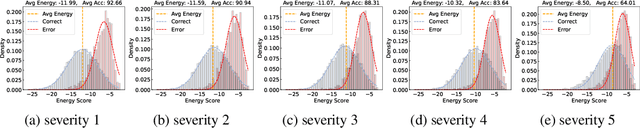
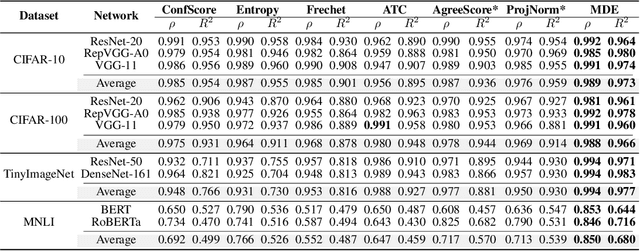
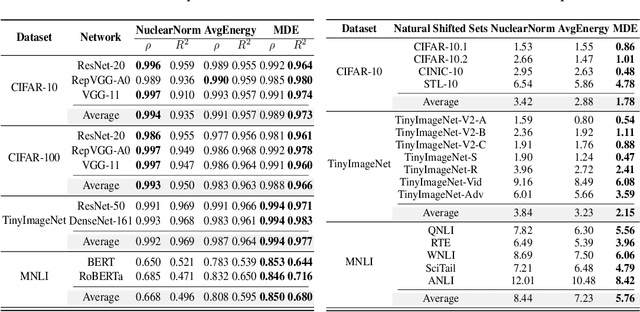
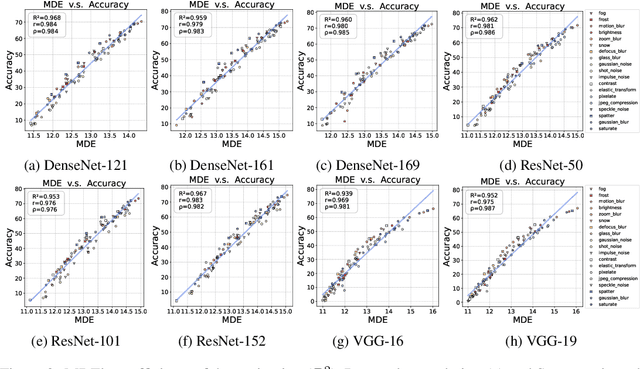
The conventional evaluation protocols on machine learning models rely heavily on a labeled, i.i.d-assumed testing dataset, which is not often present in real world applications. The Automated Model Evaluation (AutoEval) shows an alternative to this traditional workflow, by forming a proximal prediction pipeline of the testing performance without the presence of ground-truth labels. Despite its recent successes, the AutoEval frameworks still suffer from an overconfidence issue, substantial storage and computational cost. In that regard, we propose a novel measure -- Meta-Distribution Energy (MDE) -- that allows the AutoEval framework to be both more efficient and effective. The core of the MDE is to establish a meta-distribution statistic, on the information (energy) associated with individual samples, then offer a smoother representation enabled by energy-based learning. We further provide our theoretical insights by connecting the MDE with the classification loss. We provide extensive experiments across modalities, datasets and different architectural backbones to validate MDE's validity, together with its superiority compared with prior approaches. We also prove MDE's versatility by showing its seamless integration with large-scale models, and easy adaption to learning scenarios with noisy- or imbalanced- labels. Code and data are available: https://github.com/pengr/Energy_AutoEval