 Add to Chrome
 Add to Firefox
 Add to Edge
Unifying Active Learning and Semi-Supervised Learning for Medical Image Segmentation
Jul 27, 2026
In practical settings, medical image segmentation models are often developed with limited annotated data rather than fully labeled datasets. Training frequently begins in ultra-low labeled regimes where only a small number of volumes are annotated. In such scenarios, practitioners must simultaneously decide which cases to annotate and how to best use the remaining unlabeled data. Although active learning (AL) and semi-supervised learning (SSL) both target annotation scarcity, they are typically designed and optimized independently, resulting in objective mismatch and unstable training during early-stage "cold start" conditions. We propose RegAL, a unified active semi-supervised framework governed by a shared topology-aware Pareto optimization that couples sample acquisition with unlabeled data utilization. RegAL evaluates images along three complementary axes, voxel-wise uncertainty, feature diversity, and a novel topological consistency metric, to select anatomically informative edge cases for annotation. On the other hand, the same criteria are used to identify geometrically stable atlas candidates for diffeomorphic registration-guided augmentation to train a self-supervised Mean Teacher segmentation network. Across BraTS 2021, dHCP, and ProstateX, RegAL remains stable with few labeled volumes and consistently outperforms state-of-the-art AL, SSL, and active semi-supervised baselines across Dice and boundary-distance (ASD, HD95) metrics under extreme annotation scarcity.

MAdam: Metric-Aware Multi-Objective Adam
Jun 02, 2026Multi-objective optimization (MOO) underlies many machine learning problems, yet MOO solvers across the loss-balancing, gradient-balancing, and Pareto-based families almost universally hand their reconciled directions to Adam~\cite{kingma2015adam}. We show this coupling introduces two systematic gaps between the solver's intent and the optimizer's execution. The first is a \emph{weighting mismatch}: Adam's second-moment denominator entangles the time-varying preference vector with gradient statistics, marginalizing the preference into a history average and collapsing distinct Pareto trade-offs toward a near-uniform mixture. The second is a \emph{geometric mismatch}: Adam's adaptive metric distorts the Euclidean geometry MOO solvers assume, turning aligned objectives into apparent conflicts. To resolve both jointly, we introduce \textbf{MAdam} (Metric-Aware Multi-Objective Adam), a drop-in wrapper that leaves both solver and optimizer unchanged. MAdam preconditions the reconciled direction by the preference-conditioned curvature of the scalarized objective; on this whitened input, Adam's second moment collapses to identity, so the realized update is governed by the preference-conditioned metric. Across multi-task learning, Pareto-front recovery, physics-informed neural networks, and medical imaging, MAdam consistently improves over Adam for every solver family.
Spectral Vision Transformer for Efficient Tokenization with Limited Data
May 12, 2026We propose a novel spectral vision transformer architecture for efficient tokenization in limited data, with an emphasis on medical imaging. We outline convenient theoretical properties arising from the choice of basis including spatial invariance and optimal signal-to-noise ratio. We show reduced complexity arising from the spectral projection compared to spatial vision transformers. We show equitable or superior performance with a reduced number of parameters as compared to a variety of models including compact and standard vision transformers, convolutional neural networks with attention, shifted window transformers, multi-layer perceptrons, and logistic regression. We include simulated, public, and clinical data in our analysis and release our code at: \verb+github.com/agr78/spectralViT+.
Single-Subject Multi-View MRI Super-Resolution via Implicit Neural Representations
Mar 23, 2026Clinical MRI frequently acquires anisotropic volumes with high in-plane resolution and low through-plane resolution to reduce acquisition time. Multiple orientations are therefore acquired to provide complementary anatomical information. Conventional integration of these views relies on registration followed by interpolation, which can degrade fine structural details. Recent deep learning-based super-resolution (SR) approaches have demonstrated strong performance in enhancing single-view images. However, their clinical reliability is often limited by the need for large-scale training datasets, resulting in increased dependence on cohort-level priors. Self-supervised strategies offer an alternative by learning directly from the target scans. Prior work either neglects the existence of multi-view information or assumes that in-plane information can supervise through-plane reconstruction under the assumption of pre-alignment between images. However, this assumption is rarely satisfied in clinical settings. In this work, we introduce Single-Subject Implicit Multi-View Super-Resolution for MRI (SIMS-MRI), a framework that operates solely on anisotropic multi-view scans from a single patient without requiring pre- or post-processing. Our method combines a multi-resolution hash-encoded implicit representation with learned inter-view alignment to generate a spatially consistent isotropic reconstruction. We validate the SIMS-MRI pipeline on both simulated brain and clinical prostate MRI datasets. Code will be made publicly available for reproducibility: https://github.com/abhshkt/SIMS-MRI
AI-Based Detection of In-Treatment Changes from Prostate MR-Linac Images
Feb 04, 2026Purpose: To investigate whether routinely acquired longitudinal MR-Linac images can be leveraged to characterize treatment-induced changes during radiotherapy, particularly subtle inter-fraction changes over short intervals (average of 2 days). Materials and Methods: This retrospective study included a series of 0.35T MR-Linac images from 761 patients. An artificial intelligence (deep learning) model was used to characterize treatment-induced changes by predicting the temporal order of paired images. The model was first trained with the images from the first and the last fractions (F1-FL), then with all pairs (All-pairs). Model performance was assessed using quantitative metrics (accuracy and AUC), compared to a radiologist's performance, and qualitative analyses - the saliency map evaluation to investigate affected anatomical regions. Input ablation experiments were performed to identify the anatomical regions altered by radiotherapy. The radiologist conducted an additional task on partial images reconstructed by saliency map regions, reporting observations as well. Quantitative image analysis was conducted to investigate the results from the model and the radiologist. Results: The F1-FL model yielded near-perfect performance (AUC of 0.99), significantly outperforming the radiologist. The All-pairs model yielded an AUC of 0.97. This performance reflects therapy-induced changes, supported by the performance correlation to fraction intervals, ablation tests and expert's interpretation. Primary regions driving the predictions were prostate, bladder, and pubic symphysis. Conclusion: The model accurately predicts temporal order of MR-Linac fractions and detects radiation-induced changes over one or a few days, including prostate and adjacent organ alterations confirmed by experts. This underscores MR-Linac's potential for advanced image analysis beyond image guidance.
Effective Segmentation of Post-Treatment Gliomas Using Simple Approaches: Artificial Sequence Generation and Ensemble Models
Sep 12, 2024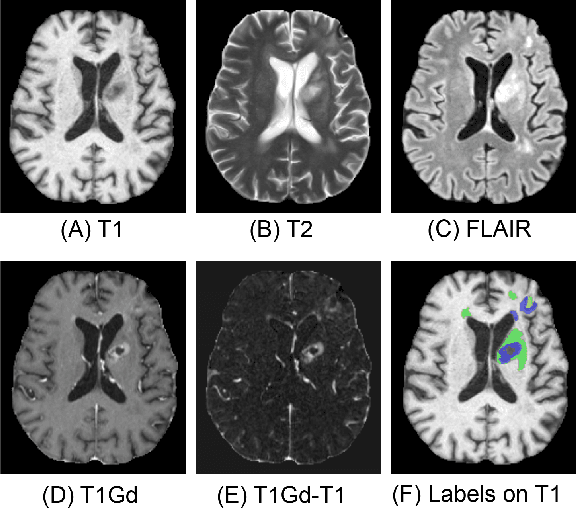

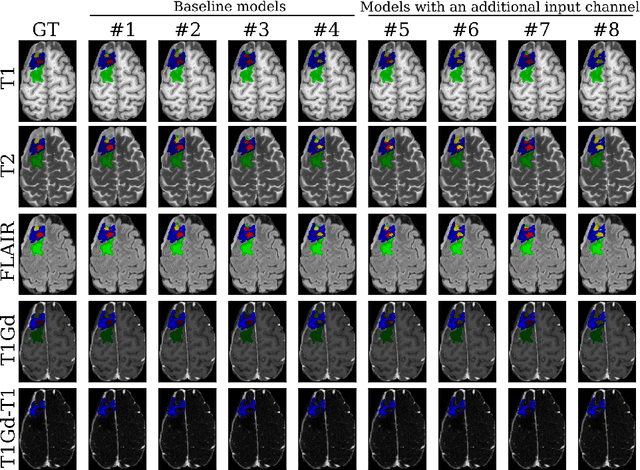
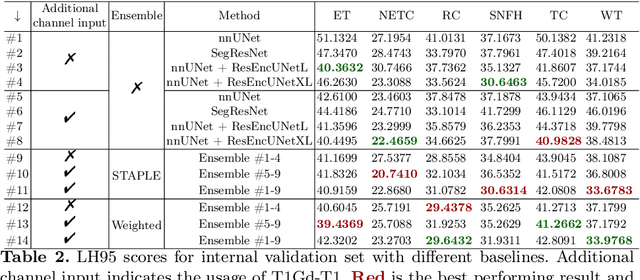
Segmentation is a crucial task in the medical imaging field and is often an important primary step or even a prerequisite to the analysis of medical volumes. Yet treatments such as surgery complicate the accurate delineation of regions of interest. The BraTS Post-Treatment 2024 Challenge published the first public dataset for post-surgery glioma segmentation and addresses the aforementioned issue by fostering the development of automated segmentation tools for glioma in MRI data. In this effort, we propose two straightforward approaches to enhance the segmentation performances of deep learning-based methodologies. First, we incorporate an additional input based on a simple linear combination of the available MRI sequences input, which highlights enhancing tumors. Second, we employ various ensembling methods to weigh the contribution of a battery of models. Our results demonstrate that these approaches significantly improve segmentation performance compared to baseline models, underscoring the effectiveness of these simple approaches in improving medical image segmentation tasks.
Adapting to Shifting Correlations with Unlabeled Data Calibration
Sep 09, 2024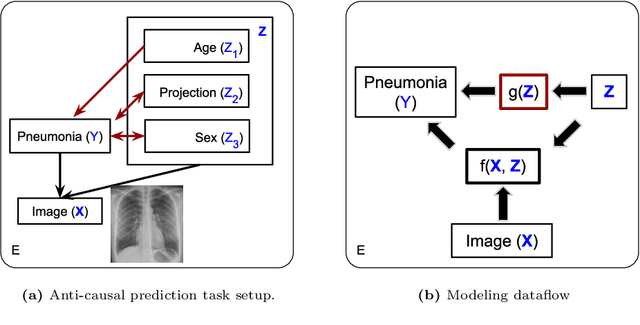
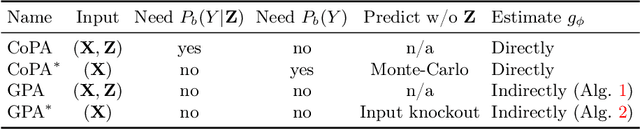
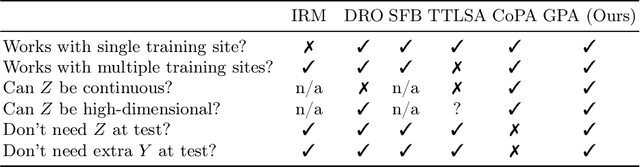
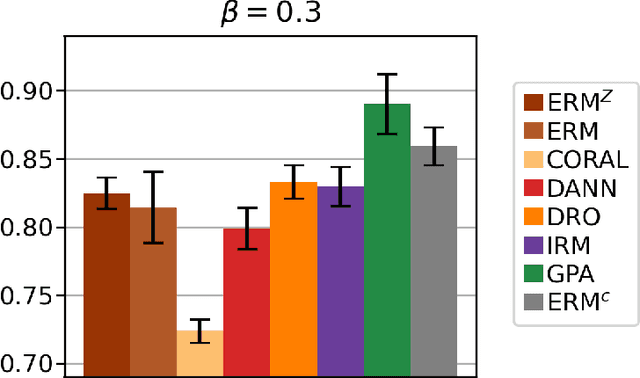
Distribution shifts between sites can seriously degrade model performance since models are prone to exploiting unstable correlations. Thus, many methods try to find features that are stable across sites and discard unstable features. However, unstable features might have complementary information that, if used appropriately, could increase accuracy. More recent methods try to adapt to unstable features at the new sites to achieve higher accuracy. However, they make unrealistic assumptions or fail to scale to multiple confounding features. We propose Generalized Prevalence Adjustment (GPA for short), a flexible method that adjusts model predictions to the shifting correlations between prediction target and confounders to safely exploit unstable features. GPA can infer the interaction between target and confounders in new sites using unlabeled samples from those sites. We evaluate GPA on several real and synthetic datasets, and show that it outperforms competitive baselines.
Knockout: A simple way to handle missing inputs
Jun 03, 2024



Deep learning models can extract predictive and actionable information from complex inputs. The richer the inputs, the better these models usually perform. However, models that leverage rich inputs (e.g., multi-modality) can be difficult to deploy widely, because some inputs may be missing at inference. Current popular solutions to this problem include marginalization, imputation, and training multiple models. Marginalization can obtain calibrated predictions but it is computationally costly and therefore only feasible for low dimensional inputs. Imputation may result in inaccurate predictions because it employs point estimates for missing variables and does not work well for high dimensional inputs (e.g., images). Training multiple models whereby each model takes different subsets of inputs can work well but requires knowing missing input patterns in advance. Furthermore, training and retaining multiple models can be costly. We propose an efficient way to learn both the conditional distribution using full inputs and the marginal distributions. Our method, Knockout, randomly replaces input features with appropriate placeholder values during training. We provide a theoretical justification of Knockout and show that it can be viewed as an implicit marginalization strategy. We evaluate Knockout in a wide range of simulations and real-world datasets and show that it can offer strong empirical performance.
BrainMorph: A Foundational Keypoint Model for Robust and Flexible Brain MRI Registration
May 22, 2024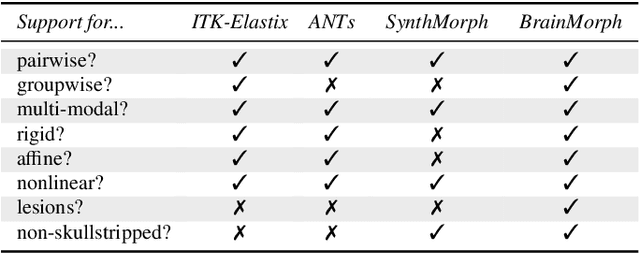
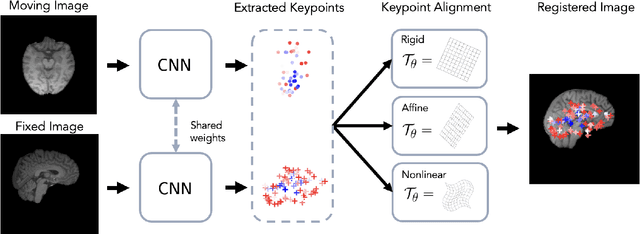
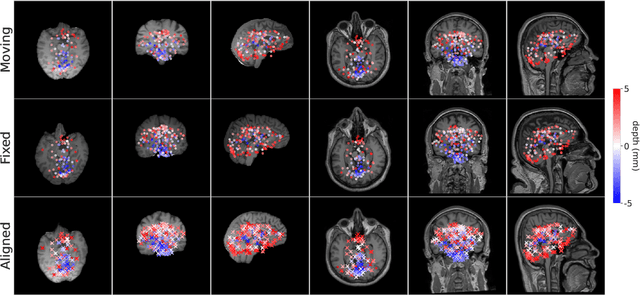
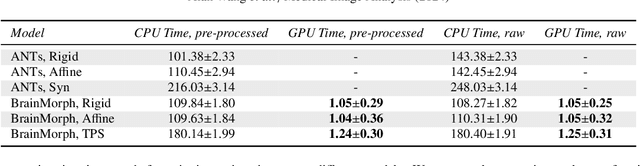
We present a keypoint-based foundation model for general purpose brain MRI registration, based on the recently-proposed KeyMorph framework. Our model, called BrainMorph, serves as a tool that supports multi-modal, pairwise, and scalable groupwise registration. BrainMorph is trained on a massive dataset of over 100,000 3D volumes, skull-stripped and non-skull-stripped, from nearly 16,000 unique healthy and diseased subjects. BrainMorph is robust to large misalignments, interpretable via interrogating automatically-extracted keypoints, and enables rapid and controllable generation of many plausible transformations with different alignment types and different degrees of nonlinearity at test-time. We demonstrate the superiority of BrainMorph in solving 3D rigid, affine, and nonlinear registration on a variety of multi-modal brain MRI scans of healthy and diseased subjects, in both the pairwise and groupwise setting. In particular, we show registration accuracy and speeds that surpass current state-of-the-art methods, especially in the context of large initial misalignments and large group settings. All code and models are available at https://github.com/alanqrwang/brainmorph.
Robust Learning via Conditional Prevalence Adjustment
Oct 24, 2023Healthcare data often come from multiple sites in which the correlations between confounding variables can vary widely. If deep learning models exploit these unstable correlations, they might fail catastrophically in unseen sites. Although many methods have been proposed to tackle unstable correlations, each has its limitations. For example, adversarial training forces models to completely ignore unstable correlations, but doing so may lead to poor predictive performance. Other methods (e.g. Invariant risk minimization [4]) try to learn domain-invariant representations that rely only on stable associations by assuming a causal data-generating process (input X causes class label Y ). Thus, they may be ineffective for anti-causal tasks (Y causes X), which are common in computer vision. We propose a method called CoPA (Conditional Prevalence-Adjustment) for anti-causal tasks. CoPA assumes that (1) generation mechanism is stable, i.e. label Y and confounding variable(s) Z generate X, and (2) the unstable conditional prevalence in each site E fully accounts for the unstable correlations between X and Y . Our crucial observation is that confounding variables are routinely recorded in healthcare settings and the prevalence can be readily estimated, for example, from a set of (Y, Z) samples (no need for corresponding samples of X). CoPA can work even if there is a single training site, a scenario which is often overlooked by existing methods. Our experiments on synthetic and real data show CoPA beating competitive baselines.