 Add to Chrome
 Add to Firefox
 Add to Edge
Single-Subject Multi-View MRI Super-Resolution via Implicit Neural Representations
Mar 23, 2026
Clinical MRI frequently acquires anisotropic volumes with high in-plane resolution and low through-plane resolution to reduce acquisition time. Multiple orientations are therefore acquired to provide complementary anatomical information. Conventional integration of these views relies on registration followed by interpolation, which can degrade fine structural details. Recent deep learning-based super-resolution (SR) approaches have demonstrated strong performance in enhancing single-view images. However, their clinical reliability is often limited by the need for large-scale training datasets, resulting in increased dependence on cohort-level priors. Self-supervised strategies offer an alternative by learning directly from the target scans. Prior work either neglects the existence of multi-view information or assumes that in-plane information can supervise through-plane reconstruction under the assumption of pre-alignment between images. However, this assumption is rarely satisfied in clinical settings. In this work, we introduce Single-Subject Implicit Multi-View Super-Resolution for MRI (SIMS-MRI), a framework that operates solely on anisotropic multi-view scans from a single patient without requiring pre- or post-processing. Our method combines a multi-resolution hash-encoded implicit representation with learned inter-view alignment to generate a spatially consistent isotropic reconstruction. We validate the SIMS-MRI pipeline on both simulated brain and clinical prostate MRI datasets. Code will be made publicly available for reproducibility: https://github.com/abhshkt/SIMS-MRI

Modality-agnostic, patient-specific digital twins modeling temporally varying digestive motion
Jul 03, 2025Objective: Clinical implementation of deformable image registration (DIR) requires voxel-based spatial accuracy metrics such as manually identified landmarks, which are challenging to implement for highly mobile gastrointestinal (GI) organs. To address this, patient-specific digital twins (DT) modeling temporally varying motion were created to assess the accuracy of DIR methods. Approach: 21 motion phases simulating digestive GI motion as 4D sequences were generated from static 3D patient scans using published analytical GI motion models through a semi-automated pipeline. Eleven datasets, including six T2w FSE MRI (T2w MRI), two T1w 4D golden-angle stack-of-stars, and three contrast-enhanced CT scans. The motion amplitudes of the DTs were assessed against real patient stomach motion amplitudes extracted from independent 4D MRI datasets. The generated DTs were then used to assess six different DIR methods using target registration error, Dice similarity coefficient, and the 95th percentile Hausdorff distance using summary metrics and voxel-level granular visualizations. Finally, for a subset of T2w MRI scans from patients treated with MR-guided radiation therapy, dose distributions were warped and accumulated to assess dose warping errors, including evaluations of DIR performance in both low- and high-dose regions for patient-specific error estimation. Main results: Our proposed pipeline synthesized DTs modeling realistic GI motion, achieving mean and maximum motion amplitudes and a mean log Jacobian determinant within 0.8 mm and 0.01, respectively, similar to published real-patient gastric motion data. It also enables the extraction of detailed quantitative DIR performance metrics and rigorous validation of dose mapping accuracy. Significance: The pipeline enables rigorously testing DIR tools for dynamic, anatomically complex regions enabling granular spatial and dosimetric accuracies.
Effective Segmentation of Post-Treatment Gliomas Using Simple Approaches: Artificial Sequence Generation and Ensemble Models
Sep 12, 2024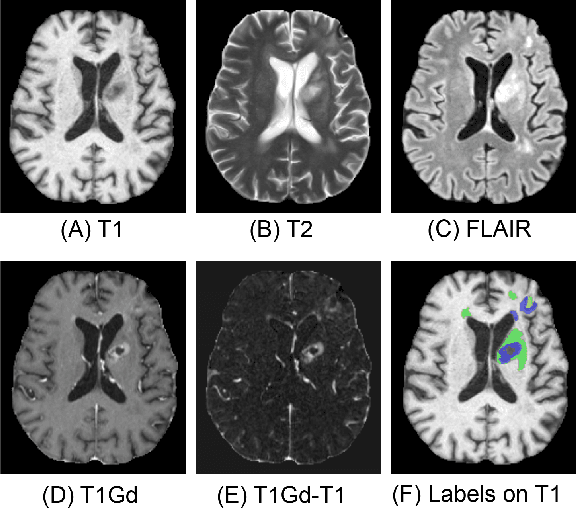

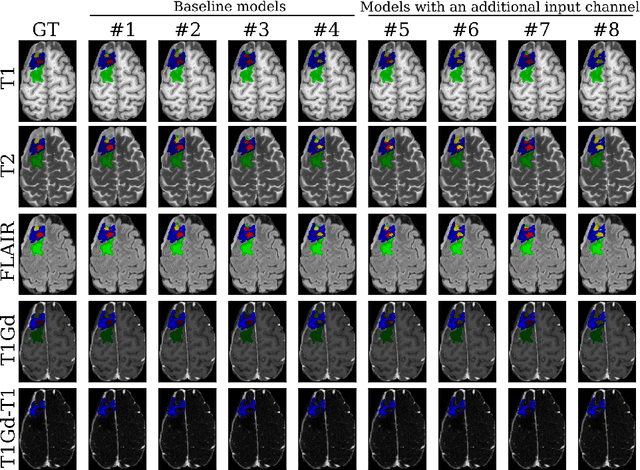
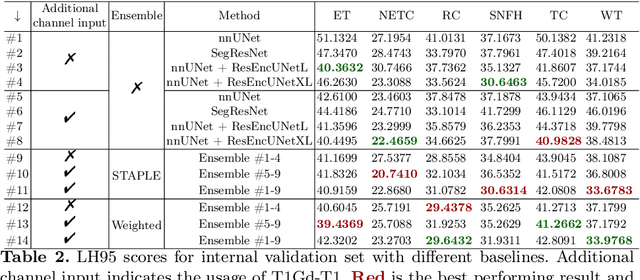
Segmentation is a crucial task in the medical imaging field and is often an important primary step or even a prerequisite to the analysis of medical volumes. Yet treatments such as surgery complicate the accurate delineation of regions of interest. The BraTS Post-Treatment 2024 Challenge published the first public dataset for post-surgery glioma segmentation and addresses the aforementioned issue by fostering the development of automated segmentation tools for glioma in MRI data. In this effort, we propose two straightforward approaches to enhance the segmentation performances of deep learning-based methodologies. First, we incorporate an additional input based on a simple linear combination of the available MRI sequences input, which highlights enhancing tumors. Second, we employ various ensembling methods to weigh the contribution of a battery of models. Our results demonstrate that these approaches significantly improve segmentation performance compared to baseline models, underscoring the effectiveness of these simple approaches in improving medical image segmentation tasks.