 Add to Chrome
 Add to Firefox
 Add to Edge
Ling and Ring 2.6 Technical Report: Efficient and Instant Agentic Intelligence at Trillion-Parameter Scale
Jun 13, 2026
Efficient and scalable agentic intelligence requires models that can deliver both low-latency responses and strong reasoning capabilities while remaining practical to train, serve, and deploy. In this report, we present Ling-2.6 and Ring-2.6, a family of models designed to address this challenge at scale. Ling-2.6 is optimized for instant response generation and high capability per output token, whereas Ring-2.6 is tailored for deeper reasoning and more advanced agentic workflows. Instead of training from scratch, we upgrade the Ling-2.0 base model through architectural migration pre-training and large-scale post-training. This upgrade is guided by a unified co-design of model architecture, optimization objectives, serving systems, and agent training environments, enabling improvements in both model capability and deployment efficiency. At the architectural level, we introduce a hybrid linear attention design that integrates Lightning Attention with MLA, improving the efficiency of long-context training and decoding. To further enhance token efficiency, we optimize capability per output token through Evolutionary Chain-of-Thought, Linguistic Unit Policy Optimization, bidirectional preference alignment, and shortest-correct-response distillation. For agentic capabilities, we propose KPop, a reinforcement learning framework designed to support stable training of Ring-2.6-1T on large-scale environment-grounded data. KPop improves training efficiency through asynchronous scheduling across coding, search, tool use, and workflow execution, enabling scalable learning from complex agent-environment interactions. Together, Ling-2.6 and Ring-2.6 provide a practical pathway toward efficient, scalable, and open agentic systems. We open-source all checkpoints in the 2.6 family to support further research and development in practical agentic intelligence.

Mathesis: Towards Formal Theorem Proving from Natural Languages
Jun 08, 2025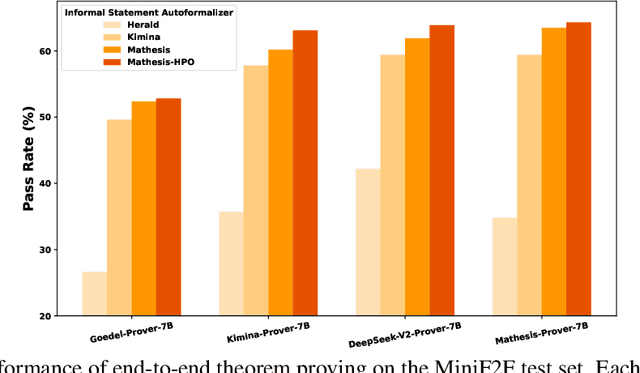
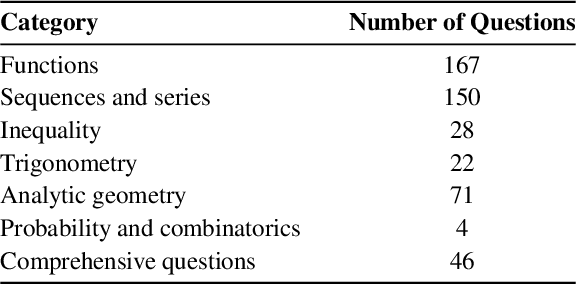
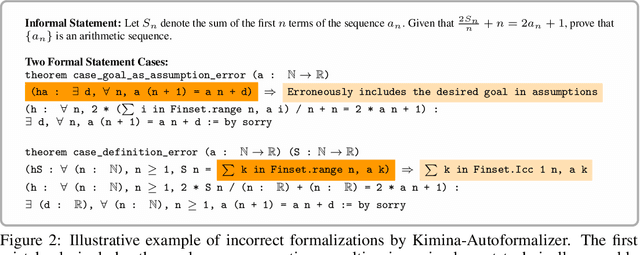
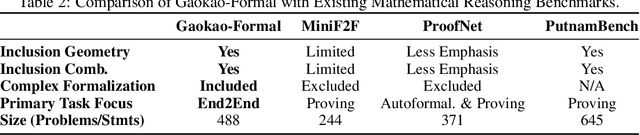
Recent advances in large language models show strong promise for formal reasoning. However, most LLM-based theorem provers have long been constrained by the need for expert-written formal statements as inputs, limiting their applicability to real-world problems expressed in natural language. We tackle this gap with Mathesis, the first end-to-end theorem proving pipeline processing informal problem statements. It contributes Mathesis-Autoformalizer, the first autoformalizer using reinforcement learning to enhance the formalization ability of natural language problems, aided by our novel LeanScorer framework for nuanced formalization quality assessment. It also proposes a Mathesis-Prover, which generates formal proofs from the formalized statements. To evaluate the real-world applicability of end-to-end formal theorem proving, we introduce Gaokao-Formal, a benchmark of 488 complex problems from China's national college entrance exam. Our approach is carefully designed, with a thorough study of each component. Experiments demonstrate Mathesis's effectiveness, with the autoformalizer outperforming the best baseline by 22% in pass-rate on Gaokao-Formal. The full system surpasses other model combinations, achieving 64% accuracy on MiniF2F with pass@32 and a state-of-the-art 18% on Gaokao-Formal.
Efficient Neural Theorem Proving via Fine-grained Proof Structure Analysis
Jan 30, 2025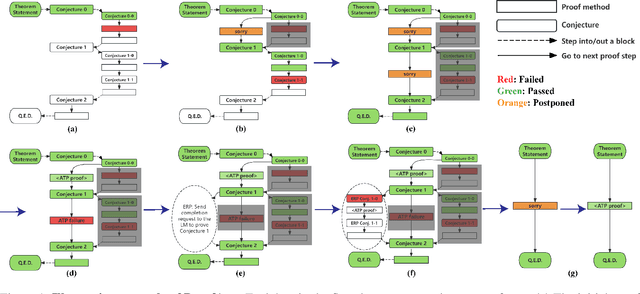
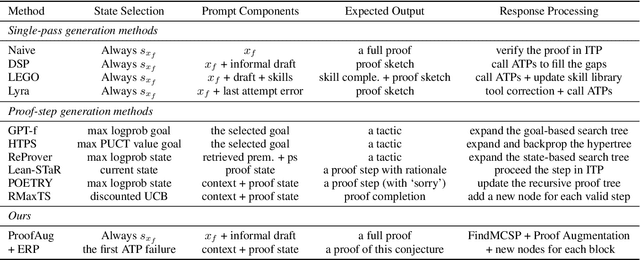
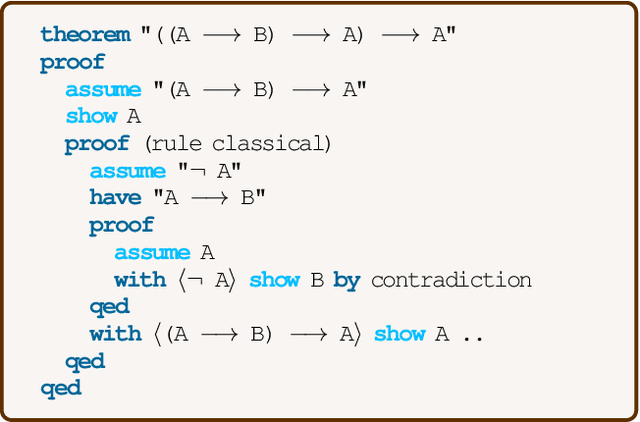

The synergy between deep learning models and traditional automation tools plays a pivotal role in developing robust neural theorem provers (NTPs). However, for proof synthesis with LLMs, previous work applies automation tools either only when the model explicitly calls the method, or only at a single granularity level, failing to fully exploit the power of built-in tactics and off-the-shelf automated theorem provers. In this work, we propose ProofAug, a novel theorem proving method that enjoys superior sample efficiency through equipping proof-generation LLMs with automation methods in different granularities via fine-grained structure analysis of model-generated proof proposals. Furthermore, ProofAug serves as a versatile plug-and-play module that seamlessly integrates with any tree-search algorithm, enabling our construction of an efficient recursive proving (ERP) module to further enhance performance. The superiority of our method is validated on the miniF2F-test benchmark using the open-source deepseek-math-7b-base model and the Isabelle proof assistant. Notably, by additionally employing a mixed prompting strategy, we achieve a cumulative pass rate of 66.0% after curation of the dataset (61.9% for the original version), setting a new SOTA across all proof languages with a total sample budget of only 2100. Our code is available at https://github.com/haoxiongliu/ProofAug.
Augmenting Math Word Problems via Iterative Question Composing
Jan 30, 2024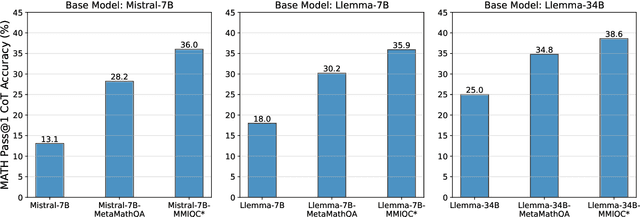
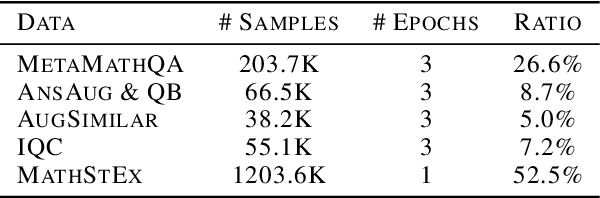
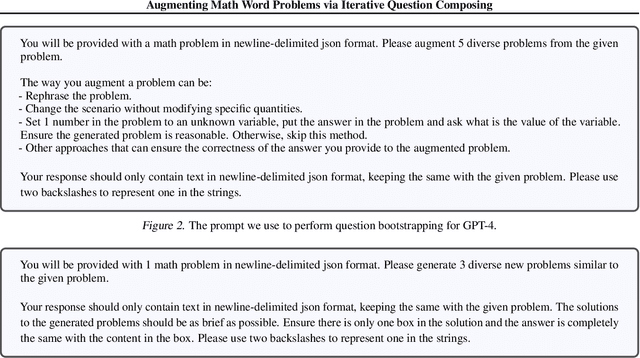
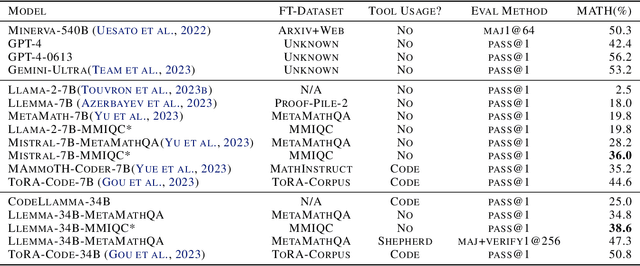
Despite the advancements in large language models (LLMs) for mathematical reasoning, solving competition-level math problems remains a significant challenge, especially for open-source LLMs without external tools. We introduce the MMIQC dataset, comprising a mixture of processed web data and synthetic question-response pairs, aimed at enhancing the mathematical reasoning capabilities of base language models. Models fine-tuned on MMIQC consistently surpass their counterparts in performance on the MATH benchmark across various model sizes. Notably, Qwen-72B-MMIQC achieves a 45.0% accuracy, exceeding the previous open-source state-of-the-art by 8.2% and outperforming the initial version GPT-4 released in 2023. Extensive evaluation results on Hungarian high school finals suggest that such improvement can generalize to unseen data. Our ablation study on MMIQC reveals that a large part of the improvement can be attributed to our novel augmentation method, Iterative Question Composing (IQC), which involves iteratively composing new questions from seed problems using an LLM and applying rejection sampling through another LLM. The MMIQC dataset is available on the HuggingFace hub at https://huggingface.co/datasets/Vivacem/MMIQC. Our code is available at https://github.com/iiis-ai/IterativeQuestionComposing.
Quantifying the Variability Collapse of Neural Networks
Jun 06, 2023Recent studies empirically demonstrate the positive relationship between the transferability of neural networks and the within-class variation of the last layer features. The recently discovered Neural Collapse (NC) phenomenon provides a new perspective of understanding such last layer geometry of neural networks. In this paper, we propose a novel metric, named Variability Collapse Index (VCI), to quantify the variability collapse phenomenon in the NC paradigm. The VCI metric is well-motivated and intrinsically related to the linear probing loss on the last layer features. Moreover, it enjoys desired theoretical and empirical properties, including invariance under invertible linear transformations and numerical stability, that distinguishes it from previous metrics. Our experiments verify that VCI is indicative of the variability collapse and the transferability of pretrained neural networks.