 Add to Chrome
 Add to Firefox
 Add to Edge
Coupled-cluster molecular properties across the main group that extrapolate beyond training size
Aug 18, 2026
Coupled-cluster theory defines the accuracy standard for molecular electronic-structure properties but scales too steeply for routine application, whereas density-functional theory is affordable yet systematically biased. We resolve this trade-off with a single equivariant network, MEHnet-MG, that predicts an effective one-electron Hamiltonian from one inexpensive B3LYP/def2-SVP calculation and derives a broad suite of properties from it (energy, optical gap, dipole, quadrupole, polarizability, Mulliken atomic charges, and Mayer bond orders) at coupled-cluster accuracy across nine main-group elements, including the under-served phosphorus, sulfur, and chlorine chemistries. The model is trained on a new in-house dataset of multi-property labels computed at the CCSD(T) level for all nine elements. On a held-out test set, it reduces the error of every property by a factor of 3.8 to 230 relative to semi-local, hybrid, and double-hybrid DFT (referenced to composite CCSD(T)/cc-pVTZ; Methods), while adding only ~25 ms wall time per molecule, delivering coupled-cluster-quality predictions at the cost of a single DFT calculation. Critically, deriving every property from a predicted Hamiltonian rather than pooling per-atom features builds the correct size-scaling into the model architecture: on pi-conjugated oligothiophenes it matches finite-field CCSD polarizability and the EOM-CCSD optical gap to ~2% at the largest sizes where those references remain affordable (44 and 37 atoms, where a single CCSD field point already costs ~500x the model's entire inference) and extrapolates the corrected trends to 58-atom chains, a regime where pooling-based architectures fail by construction. Accurate extrapolation is therefore set by the model's inductive bias rather than by the training data.

Stochastic Parrots or ICU Experts? Large Language Models in Critical Care Medicine: A Scoping Review
Jul 27, 2024With the rapid development of artificial intelligence (AI), large language models (LLMs) have shown strong capabilities in natural language understanding, reasoning, and generation, attracting amounts of research interest in applying LLMs to health and medicine. Critical care medicine (CCM) provides diagnosis and treatment for critically ill patients who often require intensive monitoring and interventions in intensive care units (ICUs). Can LLMs be applied to CCM? Are LLMs just like stochastic parrots or ICU experts in assisting clinical decision-making? This scoping review aims to provide a panoramic portrait of the application of LLMs in CCM. Literature in seven databases, including PubMed, Embase, Scopus, Web of Science, CINAHL, IEEE Xplore, and ACM Digital Library, were searched from January 1, 2019, to June 10, 2024. Peer-reviewed journal and conference articles that discussed the application of LLMs in critical care settings were included. From an initial 619 articles, 24 were selected for final review. This review grouped applications of LLMs in CCM into three categories: clinical decision support, medical documentation and reporting, and medical education and doctor-patient communication. LLMs have advantages in handling unstructured data and do not require manual feature engineering. Meanwhile, applying LLMs to CCM faces challenges, including hallucinations, poor interpretability, bias and alignment challenges, and privacy and ethics issues. Future research should enhance model reliability and interpretability, integrate up-to-date medical knowledge, and strengthen privacy and ethical guidelines. As LLMs evolve, they could become key tools in CCM to help improve patient outcomes and optimize healthcare delivery. This study is the first review of LLMs in CCM, aiding researchers, clinicians, and policymakers to understand the current status and future potentials of LLMs in CCM.
Blind quantum machine learning with quantum bipartite correlator
Oct 19, 2023

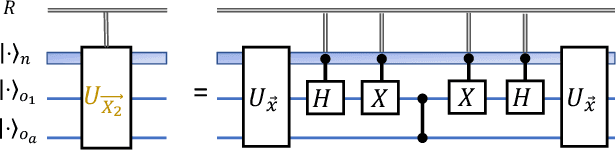

Distributed quantum computing is a promising computational paradigm for performing computations that are beyond the reach of individual quantum devices. Privacy in distributed quantum computing is critical for maintaining confidentiality and protecting the data in the presence of untrusted computing nodes. In this work, we introduce novel blind quantum machine learning protocols based on the quantum bipartite correlator algorithm. Our protocols have reduced communication overhead while preserving the privacy of data from untrusted parties. We introduce robust algorithm-specific privacy-preserving mechanisms with low computational overhead that do not require complex cryptographic techniques. We then validate the effectiveness of the proposed protocols through complexity and privacy analysis. Our findings pave the way for advancements in distributed quantum computing, opening up new possibilities for privacy-aware machine learning applications in the era of quantum technologies.
Can ChatGPT be used to generate scientific hypotheses?
Mar 30, 2023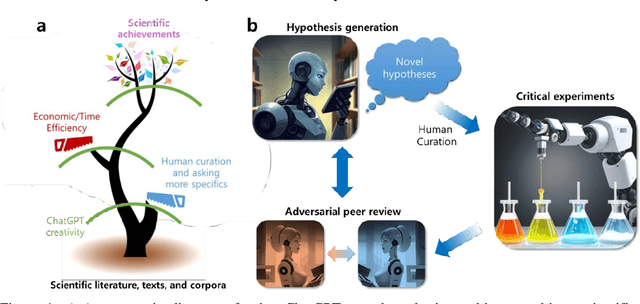
We investigate whether large language models can perform the creative hypothesis generation that human researchers regularly do. While the error rate is high, generative AI seems to be able to effectively structure vast amounts of scientific knowledge and provide interesting and testable hypotheses. The future scientific enterprise may include synergistic efforts with a swarm of "hypothesis machines", challenged by automated experimentation and adversarial peer reviews.