 Add to Chrome
 Add to Firefox
 Add to Edge
ICM Out! Better Tournament Strategy from Computed Continuations, vs. Solvers and LLMs
Aug 10, 2026
The Independent Chip Model (ICM) converts tournament chips into reference prize equity, and policies are routinely constructed against those values. Because ICM reads only stack sizes, it omits action order, blind obligations, and seat rotation, and it does not price the elimination pressure a big stack puts on the short stacks it can bust. Those omissions can alter the successor-state contrasts that determine a move. We introduce Strategic-Continuation Optimization (SCO), a policy-construction method that enumerates current-hand outcomes, maps them to successor states, prices those states with continuation values computed from the finite tournament model, and optimizes and freezes the resulting current-hand policy. The fixed-ICM comparison policy changes one thing only: the same optimizer solves the same game with successor states priced by analytic ICM, so the two policies differ only through that pricing. We evaluate the resulting policies in a three-player jam/fold tournament with a \$1M prize pool. Relative to the frozen strategic-continuation benchmark, analytic ICM has \$9{,}036 mean absolute value error across all 2,838 state--seat entries. That value error rewrites the ranges it prices: measured against each decision point's own fixed-ICM jam range, SCO moves the jam frequency by an average of 14.08\%. To price those different moves, we compare all 946 states and three policy owners while changing only the focal policy and holding both opponents and the continuation evaluator fixed. The policy produced by SCO earns \$214.33 more prize equity per hand on average and is favored in 2,433 of 2,838 matched units. The ordering survives replacing the solver-built opponent with two LLMs and with a family of non-modeling threshold players. This value-to-policy-to-cost chain shows directly when ICM becomes an inadequate objective for tournament strategy construction.

Solver-Guided Reasoning for Mixed-Equilibrium Strategies
Aug 07, 2026Reasoning in large language models (LLMs) is often grounded in human text, human demonstrations, and human-generated rationales. For equilibrium reasoning in complex games, however, relying on human data can be suboptimal. In fact, human play is often guided by intuition and heuristics and can deviate substantially from game equilibrium. This discrepancy is amplified in games with mixed-strategy equilibria, where human data is heavily biased toward pure strategies. Consequently, conditioning LLMs on this data yields weak game strategies. To grant LLMs the reasoning capacity in games, in this work, we study how to elicit equilibrium play using solver output. We propose Mixed-Strategy Decision Tree (MDT), which articulates the silent optimality of the equilibrium into sparse strategic rules that both humans and LLMs could understand. Using solver output rather than human annotation allows us to extend the input to arbitrarily new states and continuations. We instantiate this study on No-Limit Texas Hold'em by querying a solver oracle for over \textbf{250 million mixed-strategy decisions}; MDT together with other techniques \textbf{reduces the $\ell_1$ distance to the equilibrium by $52.6\%$} across $8$ different LLM configurations. A Route-only ablation tests the incremental contribution of the shadow-based contrast, while complete River-endgame and Liar's Dice experiments evaluate strategic fidelity and portability beyond the original NLH communication setting.
AV-AIVAT: 74x Cheaper Agent Evaluation with Certified Anytime-Valid Stopping in Imperfect-Information Games
Aug 06, 2026Deciding which of two agents is stronger means playing games until skill outweighs luck, and every game costs money, model inference, or expert time. Since the number of games needed is unknown, fixed-budget evaluations either keep paying after the result is settled or stop before the agents can be told apart, while naive optional stopping with an ordinary confidence interval invalidates the stated level. We make such an evaluation stop as soon as its evidence suffices, with the guarantee intact. The Action-Informed Value Assessment Tool (AIVAT) reduces variance in imperfect-information games through conditional mean-zero corrections, by a median $54\times$ across 15 LLM agent configurations spanning 71,439 paired Heads-Up No-Limit Hold'em (HUNL) hands, but does not say when to stop. We combine AIVAT with continuously monitored Confidence Sequences (CSs) into anytime-valid AIVAT (AV-AIVAT), whose online value model learns only from past games so that no game scores its own correction. At the nominal 95\% level and a target precision of $\pm1$ Big Blind, raw outcomes need a median $74\times$ as many hands as AIVAT-corrected outcomes to stop under the Asymptotic CS (AsympCS). Exact finite-sample certification uses the Empirical-Bernstein CS (EB-CS), which needs an independently justified bound on corrected payoffs. We establish such a bound structurally for Leduc hold'em and characterize a width floor set by the CS's bet cap and that bound, which governs how much of a variance gain becomes earlier stopping; the descriptive HUNL EB-CS runs show a median $1.37\times$ stopping-time ratio. AV-AIVAT turns variance reduction into efficient, auditable early stopping while separating asymptotic screening from exact certification, so an evaluation can stop the moment its evidence suffices and hand a third party everything needed to recheck the verdict at that very stopping time.
Agents That Certify Their Own Exploits: Confidence-Scheduled Restricted Responses for Safe Opponent Exploitation
Jul 30, 2026An agent playing a Nash-equilibrium strategy in a two-player zero-sum imperfect-information game secures the game value but forfeits the additional value offered by a flawed opponent. Diffuse deviations pose a particular challenge: binary release rules may gather too little evidence to act, while a full best response to an incomplete opponent model can be highly exploitable. We introduce \emph{budget-constrained confidence-scheduled restricted responses} (CS-RNR), the first opponent-exploitation method whose safety guarantee is a certificate the agent computes on the strategy it actually deploys, so that every exploit it commits to is one it has audited itself. The method tracks pooled action frequencies with anytime-valid confidence sequences and treats a frequency as exploitable only once its interval separates from an equilibrium reference. The confirmed deviations define a conservative opponent model, which a restricted-response solve turns into candidate counter-strategies over a grid of pin levels. Before deployment, each complete candidate is evaluated by a full-tree best response. The resulting certificate is compared with a user-specified budget and committed atomically with the strategy. Because this check is performed on the played strategy, model quality determines the exploitation achieved while the certificate controls reference-relative expected loss. In Leduc hold'em, CS-RNR obtains $6.2\times$ the steady-state gain of a money-verified binary gate while keeping every deployed strategy within budget. A trajectory mixture using the same estimator reaches $13.6\times$ the budget. Across Leduc, Liar's Dice, and 5-rank Leduc, all $36{,}000$ audited hands satisfy the reported certificate tolerance.
PokerSkill: LLMs Can Play Expert-Level Poker without Training or Solvers
May 28, 2026Poker is a landmark challenge for artificial intelligence. The dominant approach relies on equilibrium solvers built on counterfactual regret minimization, requiring millions of core-hours of training. Large Language Models (LLMs) possess extensive poker knowledge but perform far below solver-based agents when asked to play directly. Traditional rule-based poker agents are interpretable and training-free, but their strategic ceiling remains far below equilibrium play. We introduce \textbf{PokerSkill}, a training-free and solver-free framework that bridges this gap by using detailed rule-based poker skills as a structured action-grounding interface for LLMs. A deterministic context engine analyzes the current state and retrieves only the relevant fragments from a layered skill library, which is entirely designed by human poker experts, constraining the LLM's choice to reasonable actions. Against GTOWizard, a state-of-the-art GTO benchmark, GPT-5.5 XHigh with PokerSkill achieves $-57 \pm 21$ mbb/hand, Claude Opus 4.6 achieves $-80 \pm 29$ mbb/hand and Claude Opus 4.7 achieves $-87\pm 64$ mbb/hand, reducing losses by 49--61\% compared to default-prompt baselines and outperforming the strong bot Slumbot. Our key finding is that rule-based skills alone do not constitute a strong strategy, and LLMs alone cannot play well, but their combination yields an agent that requires neither training nor solver access yet competes with systems built on millions of core-hours of computation. To our knowledge, this is the first demonstration of an LLM achieving competitive performance in a complex imperfect-information game without game-specific training or solver queries. Code is available at https://github.com/lbn187/PokerSkill.
Real-Time Parallel Counterfactual Regret Minimization
May 19, 2026Counterfactual Regret Minimization (CFR) is the dominant algorithmic family for solving large imperfect-information games, underpinning breakthroughs such as Libratus and Pluribus in No-Limit Texas Hold'em poker. In real-time game-playing systems, the solver must compute a near-equilibrium strategy within a strict time budget of only a few seconds per decision, and the number of CFR iterations completed in this window directly determines play strength. We present \textbf{Parallel CFR}, the first parallelization framework for real-time depth-limited CFR solving that seamlessly integrates pruning, abstraction, and advanced CFR variants. We decompose each CFR iteration into a pipeline of seven stages and identify two orthogonal dimensions of parallelism: \emph{by information set} and \emph{by tree node}. Leaf node evaluation is offloaded to GPUs via batched neural network inference, creating a heterogeneous CPU--GPU pipeline. Experiments on Heads-Up No-Limit Texas Hold'em demonstrate that Parallel CFR achieves $3.3$--$3.4\times$ speedup over the single-threaded baseline on postflop streets, with per-iteration time of ${\sim}47$--$54$~ms on a depth-limited game tree with over $1$ billion histories. All experiments run on a single desktop-class device (NVIDIA DGX Spark), enabling hundreds of CFR iterations within a typical real-time decision budget without requiring datacenter-scale infrastructure.
RL-CFR: Improving Action Abstraction for Imperfect Information Extensive-Form Games with Reinforcement Learning
Mar 07, 2024Effective action abstraction is crucial in tackling challenges associated with large action spaces in Imperfect Information Extensive-Form Games (IIEFGs). However, due to the vast state space and computational complexity in IIEFGs, existing methods often rely on fixed abstractions, resulting in sub-optimal performance. In response, we introduce RL-CFR, a novel reinforcement learning (RL) approach for dynamic action abstraction. RL-CFR builds upon our innovative Markov Decision Process (MDP) formulation, with states corresponding to public information and actions represented as feature vectors indicating specific action abstractions. The reward is defined as the expected payoff difference between the selected and default action abstractions. RL-CFR constructs a game tree with RL-guided action abstractions and utilizes counterfactual regret minimization (CFR) for strategy derivation. Impressively, it can be trained from scratch, achieving higher expected payoff without increased CFR solving time. In experiments on Heads-up No-limit Texas Hold'em, RL-CFR outperforms ReBeL's replication and Slumbot, demonstrating significant win-rate margins of $64\pm 11$ and $84\pm 17$ mbb/hand, respectively.
Blind quantum machine learning with quantum bipartite correlator
Oct 19, 2023

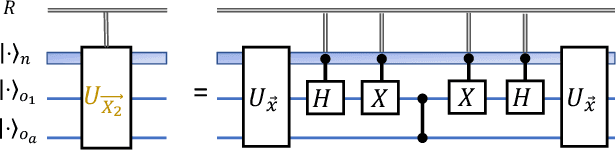

Distributed quantum computing is a promising computational paradigm for performing computations that are beyond the reach of individual quantum devices. Privacy in distributed quantum computing is critical for maintaining confidentiality and protecting the data in the presence of untrusted computing nodes. In this work, we introduce novel blind quantum machine learning protocols based on the quantum bipartite correlator algorithm. Our protocols have reduced communication overhead while preserving the privacy of data from untrusted parties. We introduce robust algorithm-specific privacy-preserving mechanisms with low computational overhead that do not require complex cryptographic techniques. We then validate the effectiveness of the proposed protocols through complexity and privacy analysis. Our findings pave the way for advancements in distributed quantum computing, opening up new possibilities for privacy-aware machine learning applications in the era of quantum technologies.
Deep Demixing: Reconstructing the Evolution of Network Epidemics
Jun 11, 2023We propose the deep demixing (DDmix) model, a graph autoencoder that can reconstruct epidemics evolving over networks from partial or aggregated temporal information. Assuming knowledge of the network topology but not of the epidemic model, our goal is to estimate the complete propagation path of a disease spread. A data-driven approach is leveraged to overcome the lack of model awareness. To solve this inverse problem, DDmix is proposed as a graph conditional variational autoencoder that is trained from past epidemic spreads. DDmix seeks to capture key aspects of the underlying (unknown) spreading dynamics in its latent space. Using epidemic spreads simulated in synthetic and real-world networks, we demonstrate the accuracy of DDmix by comparing it with multiple (non-graph-aware) learning algorithms. The generalizability of DDmix is highlighted across different types of networks. Finally, we showcase that a simple post-processing extension of our proposed method can help identify super-spreaders in the reconstructed propagation path.
Learnable Digital Twin for Efficient Wireless Network Evaluation
Jun 11, 2023Network digital twins (NDTs) facilitate the estimation of key performance indicators (KPIs) before physically implementing a network, thereby enabling efficient optimization of the network configuration. In this paper, we propose a learning-based NDT for network simulators. The proposed method offers a holistic representation of information flow in a wireless network by integrating node, edge, and path embeddings. Through this approach, the model is trained to map the network configuration to KPIs in a single forward pass. Hence, it offers a more efficient alternative to traditional simulation-based methods, thus allowing for rapid experimentation and optimization. Our proposed method has been extensively tested through comprehensive experimentation in various scenarios, including wired and wireless networks. Results show that it outperforms baseline learning models in terms of accuracy and robustness. Moreover, our approach achieves comparable performance to simulators but with significantly higher computational efficiency.