 Add to Chrome
 Add to Firefox
 Add to Edge
The yes-no bias of large language models reflects answer order and wording, not shifts in moral judgment
Jul 06, 2026
Large language models (LLMs) increasingly issue judgments read as binary verdicts, and a growing literature reports such judgments shifting under logically irrelevant changes of wording - among them an amplified yes-no bias on moral dilemmas, absent in humans. A single framing cannot say what such a shift is: in a yes/no question the word "no" is at once logical verdict, lexical token, and last-printed option. We introduce a psychometric battery that separates these: crossed symmetrization - every logically irrelevant factor flipped in balanced pairs - across a corpus of question forms. A graded rating across logically equivalent forms recovers a coherent internal moral scale: frontier models' stance $θ$ is nearly format-invariant (cross-form incoherence 0.12-0.21 on a $\pm 1$ axis); small open-weight models fail in model-specific ways. Forcing the verdict through yes/no overlays a decomposable artifact: an order bias toward the last-printed option - opposite to classic human primacy - plus a lexical pull toward the word "no"; the artifact is substantial only in the Claude models (story-averaged -0.32 to -0.86), $\approx 0$ for GPT-5.5 and Gemini, and shrinks under extended reasoning. The word and the verdict share one token; swapping the words for arbitrary labels separates them, and the verdict-attached logical bias proves $\approx 0$ for every frontier model, while model-specific label and order attachments remain: the models are not drawn toward rejecting - the pull follows the printed surface, not the verdict it carries. A minimal model, $P = σ((θ\pm m)/s)$, summarizes any such artifact by a framing susceptibility m and a moral decisiveness s, measurably distinct from sampling temperature. The battery applies unchanged to any dilemma set and binary format: measuring what a model values requires crossing the frames of the question, not asking once.

Grounded autonomous research: a fault-tolerant LLM pipeline from corpus to manuscript in frontier computational physics
Jul 02, 2026Autonomous-research agents have demonstrated end-to-end LLM automation in machine-learning sandboxes where execution provides calibration. Frontier physical science differs categorically: physical reasoning underlies every methodology choice, toolchains are often underdocumented, and calibration must come from external literature anchors - which unscaffolded agents cite but do not confront, hallucinating plausible, unverifiable results from internal priors. We present a pipeline that runs end-to-end from a corpus of 11,083 recent condensed-matter physics arXiv papers to a publication-grade manuscript with three substantive physics findings (here on altermagnetic piezomagnetism): the agent autonomously conceives a research direction by mapping the corpus, calibrates methodology by reproducing published references, conducts novel first-principles computations, and writes the manuscript - grounded in literature throughout, across 47 fresh-context sessions in six phases sharing only on-disk state, with 2,162 literature-consultation events. Fault tolerance emerges from redundancy: fresh-context isolation, distributed grounding, and adversarial review catch what any single session misses; pre- and post-pilot stages are fully autonomous, and pilot requires bounded human intervention only at reproduction failures - operational knowledge curation, not scientific direction. Two paired failure modes - a pre-architecture baseline and a no-pilot ablation - isolate structurally enforced numerical confrontation at calibration checkpoints as the operative grounding mechanism. The primitives, characterized failure modes, and quantified intervention pattern lay a foundation for autonomous research in high-stakes scientific domains beyond computational physics.
RPS: Information Elicitation with Reinforcement Prompt Selection
Apr 15, 2026Large language models (LLMs) have shown remarkable capabilities in dialogue generation and reasoning, yet their effectiveness in eliciting user-known but concealed information in open-ended conversations remains limited. In many interactive AI applications, such as personal assistants, tutoring systems, and legal or clinical support, users often withhold sensitive or uncertain information due to privacy concerns, ambiguity, or social hesitation. This makes it challenging for LLMs to gather complete and contextually relevant inputs. In this work, we define the problem of information elicitation in open-ended dialogue settings and propose Reinforcement Prompt Selection (RPS), a lightweight reinforcement learning framework that formulates prompt selection as a sequential decision-making problem. To analyze this problem in a controlled setting, we design a synthetic experiment, where a reinforcement learning agent outperforms a random query baseline, illustrating the potential of policy-based approaches for adaptive information elicitation. Building on this insight, RPS learns a policy over a pool of prompts to adaptively elicit concealed or incompletely expressed information from users through dialogue. We also introduce IELegal, a new benchmark dataset constructed from real legal case documents, which simulates dialogue-based information elicitation tasks aimed at uncovering case-relevant facts. In this setting, RPS outperforms static prompt baselines, demonstrating the effectiveness of adaptive prompt selection for eliciting critical information in LLM-driven dialogue systems.
Towards grounded autonomous research: an end-to-end LLM mini research loop on published computational physics
Apr 14, 2026Recent autonomous LLM agents have demonstrated end-to-end automation of machine-learning research. Real-world physical science is intrinsically harder, requiring deep reasoning bounded by physical truth and, because real systems are too complex to study in isolation, almost always built on existing literature. We focus on the smallest meaningful unit of such research, a mini research loop in which an agent reads a paper, reproduces it, critiques it, and extends it. We test this loop in two complementary regimes: scale and depth. At scale, across 111 open-access computational physics papers, an agent autonomously runs the read-plan-compute-compare loop and, without being asked to critique, raises substantive concerns on ~42% of papers - 97.7% of which require execution to surface. In depth, for one Nature Communications paper on multiscale simulation of a 2D-material MOSFET, the agent runs new calculations missing from the original and produces, unsupervised, a publishable Comment -- composed, figured, typeset, and PDF-iterated -- that revises the paper's headline conclusion.
From Experiments to Expertise: Scientific Knowledge Consolidation for AI-Driven Computational Research
Mar 13, 2026While large language models (LLMs) have transformed AI agents into proficient executors of computational materials science, performing a hundred simulations does not make a researcher. What distinguishes research from routine execution is the progressive accumulation of knowledge -- learning which approaches fail, recognizing patterns across systems, and applying understanding to new problems. However, the prevailing paradigm in AI-driven computational science treats each execution in isolation, largely discarding hard-won insights between runs. Here we present QMatSuite, an open-source platform closing this gap. Agents record findings with full provenance, retrieve knowledge before new calculations, and in dedicated reflection sessions correct erroneous findings and synthesize observations into cross-compound patterns. In benchmarks on a six-step quantum-mechanical simulation workflow, accumulated knowledge reduces reasoning overhead by 67% and improves accuracy from 47% to 3% deviation from literature -- and when transferred to an unfamiliar material, achieves 1% deviation with zero pipeline failures.
Polyp-E: Benchmarking the Robustness of Deep Segmentation Models via Polyp Editing
Oct 22, 2024


Automatic polyp segmentation is helpful to assist clinical diagnosis and treatment. In daily clinical practice, clinicians exhibit robustness in identifying polyps with both location and size variations. It is uncertain if deep segmentation models can achieve comparable robustness in automated colonoscopic analysis. To benchmark the model robustness, we focus on evaluating the robustness of segmentation models on the polyps with various attributes (e.g. location and size) and healthy samples. Based on the Latent Diffusion Model, we perform attribute editing on real polyps and build a new dataset named Polyp-E. Our synthetic dataset boasts exceptional realism, to the extent that clinical experts find it challenging to discern them from real data. We evaluate several existing polyp segmentation models on the proposed benchmark. The results reveal most of the models are highly sensitive to attribute variations. As a novel data augmentation technique, the proposed editing pipeline can improve both in-distribution and out-of-distribution generalization ability. The code and datasets will be released.
Multi-view Data Classification with a Label-driven Auto-weighted Strategy
Jan 03, 2022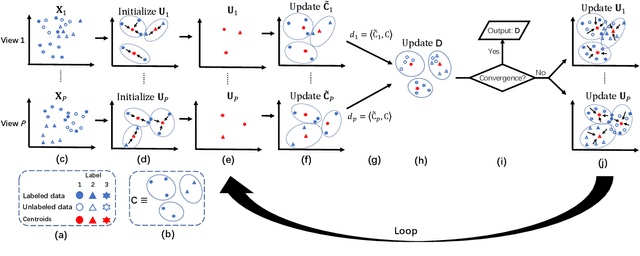
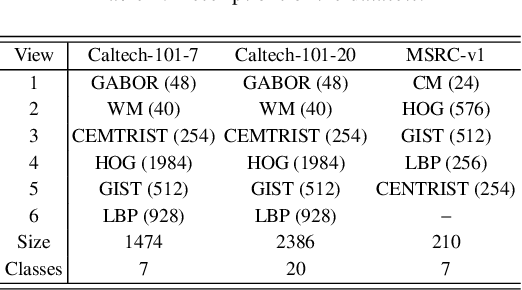
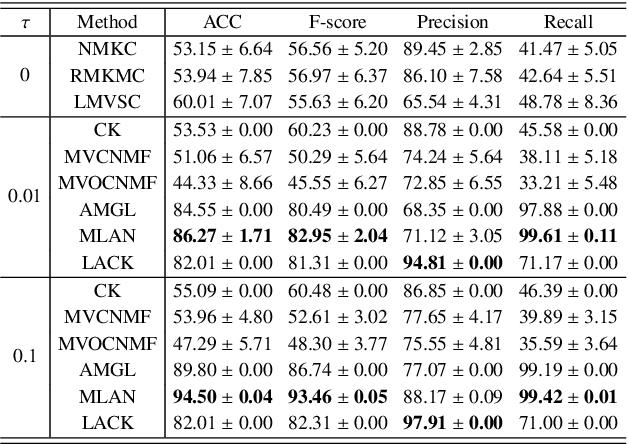
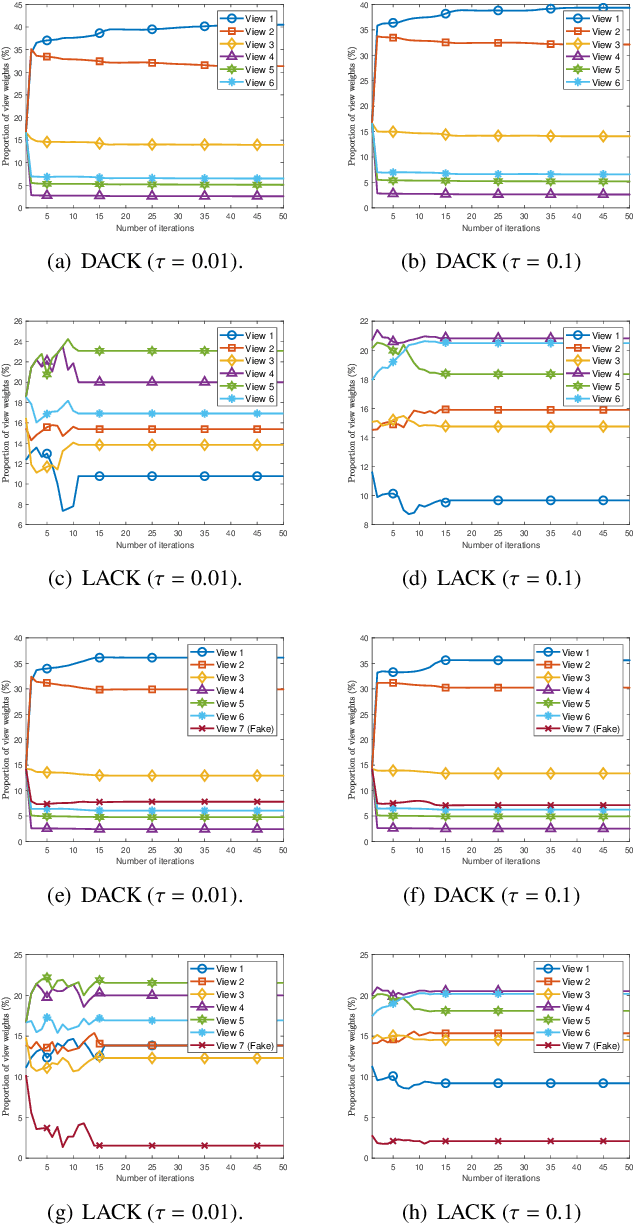
Distinguishing the importance of views has proven to be quite helpful for semi-supervised multi-view learning models. However, existing strategies cannot take advantage of semi-supervised information, only distinguishing the importance of views from a data feature perspective, which is often influenced by low-quality views then leading to poor performance. In this paper, by establishing a link between labeled data and the importance of different views, we propose an auto-weighted strategy to evaluate the importance of views from a label perspective to avoid the negative impact of unimportant or low-quality views. Based on this strategy, we propose a transductive semi-supervised auto-weighted multi-view classification model. The initialization of the proposed model can be effectively determined by labeled data, which is practical. The model is decoupled into three small-scale sub-problems that can efficiently be optimized with a local convergence guarantee. The experimental results on classification tasks show that the proposed method achieves optimal or sub-optimal classification accuracy at the lowest computational cost compared to other related methods, and the weight change experiments show that our proposed strategy can distinguish view importance more accurately than other related strategies on multi-view datasets with low-quality views.
Partially Shared Semi-supervised Deep Matrix Factorization with Multi-view Data
Dec 02, 2020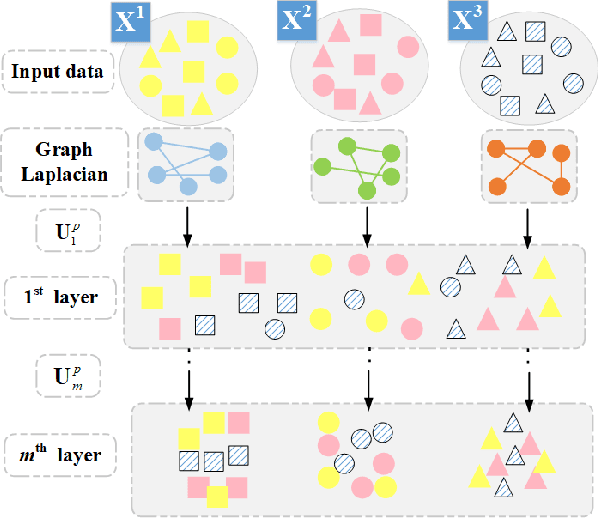
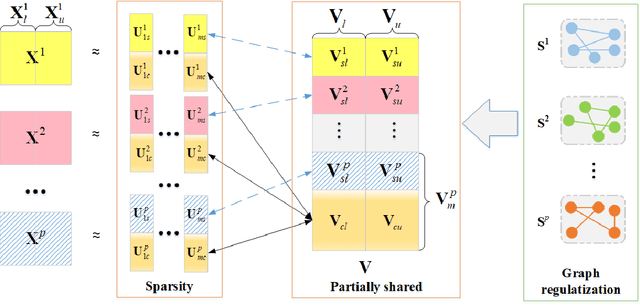
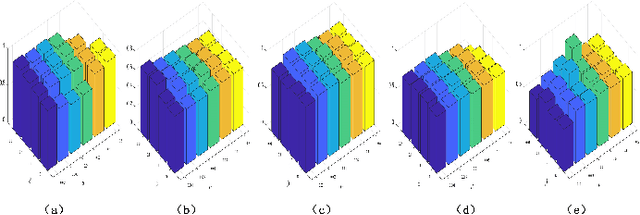
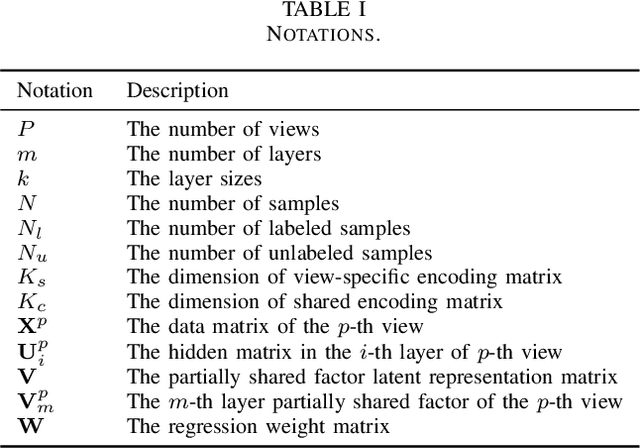
Since many real-world data can be described from multiple views, multi-view learning has attracted considerable attention. Various methods have been proposed and successfully applied to multi-view learning, typically based on matrix factorization models. Recently, it is extended to the deep structure to exploit the hierarchical information of multi-view data, but the view-specific features and the label information are seldom considered. To address these concerns, we present a partially shared semi-supervised deep matrix factorization model (PSDMF). By integrating the partially shared deep decomposition structure, graph regularization and the semi-supervised regression model, PSDMF can learn a compact and discriminative representation through eliminating the effects of uncorrelated information. In addition, we develop an efficient iterative updating algorithm for PSDMF. Extensive experiments on five benchmark datasets demonstrate that PSDMF can achieve better performance than the state-of-the-art multi-view learning approaches. The MATLAB source code is available at https://github.com/libertyhhn/PartiallySharedDMF.