 Add to Chrome
 Add to Firefox
 Add to Edge
A Simple Approximation to the Distribution of the Ridge Regression Estimator
Aug 03, 2026
We present a simple Gaussian approximation to the finite-sample distribution of the classical ridge regression estimator. Our approximation captures the fact that, in finite samples, the ridge regression estimator trades off bias and variance to reduce estimation and prediction error. Our approximation is based on nonstandard asymptotics where $i)$ we let the estimator's regularization parameter grow proportionally to the sample size; and $ii)$ we treat the population regression coefficients as \emph{local} to the reference vector that defines the estimator's direction of shrinkage. In contrast to other asymptotic approximations in the literature, we allow for general forms of heteroskedasticity and autocorrelation in the data generating process (at the cost of considering a low-dimensional model where the number of covariates is not allowed to grow with the sample size). We use our simple Gaussian approximation to propose two new strategies to select the regularization parameter for the ridge regression estimator. The suggested strategies select the regularization parameter to minimize either average or worst-case excess prediction risk, where risk is computed using our suggested Gaussian approximation.

Harnessing disorder to decouple extension and shear in kirigami metamaterials
Jul 18, 2026Kirigami turns stiff sheets into compliant, shape-morphing structures, but its reliance on periodic cut patterns comes at a cost: correlated panel rotations couple extension to shear, so stretching one axis drives a parasitic shear that cannot be suppressed, and also confine anisotropic stiffness to a narrow, discrete set of responses that cannot be tuned independently. Biological tissues overcome an analogous constraint through controlled disorder, such as graded fiber orientations in skin and hierarchical anisotropy in myocardium, achieving direction-dependent mechanics unavailable to regular architectures. Here, we show that engineered disorder is a design degree of freedom for kirigami, with stochastic kirigami accessing a continuous and far broader region of mechanical response than periodic patterns. This includes programmable anisotropy with near-complete elimination of extension-shear coupling. Because disordered patterns lack a simple parameterization, we navigate this design space with a geometry-aware graph neural network (GNN) that maps cut topology to the full nonlinear, bidirectional stress-strain response, coupled to a genetic algorithm that inverse-designs patterns reproducing target responses along two perpendicular axes. The GNN trains an order of magnitude faster and more accurately than image-based models. Fabricated elastomer samples reproduce the predicted nonlinear, anisotropic responses, closing the loop from design to physical component. By turning disorder into a variable to control directional stiffness, this work develops architected materials that stretch without parasitic shear, from soft actuators to tissue-interfacing devices matched to the anisotropy of living tissue.
RankGraph-2: Lifecycle Co-Design for Billion-Node Graph Learning in Recommendation
Jun 16, 2026Graph-based retrieval at billion-node scale requires jointly solving three tightly coupled problems -- graph construction, representation learning, and real-time serving -- yet existing work addresses each in isolation. We present RankGraph-2, a framework deployed at Meta that co-designs all three lifecycle stages for similarity-based retrieval (U2U2I and U2I2I), where each stage's requirements shape the others. Serving requires a co-learned cluster index to avoid expensive online KNN -- this pushes index co-training into the training objective. Training benefits from the observation that similarity-based retrieval tolerates pre-computed neighborhoods, eliminating online graph infrastructure -- this requires construction to produce self-contained data. Construction must also support hour-level refresh for item coverage. Acting on these cascading requirements, RankGraph-2 reduces hundreds of trillions of edges to hundreds of billions via subsampling with popularity bias correction, pre-computes multi-hop neighborhoods via personalized PageRank, and co-learns a residual-quantization cluster index that reduces serving computational cost by 83%. This lifecycle co-design enables a simple architecture to achieve 3.8 x higher recall than a GAT + Deep Graph Infomax model on a bipartite graph and 2.1 x higher than PyTorch-BigGraph on item retrieval. RankGraph-2 delivers up to +0.96% CTR and +2.75% CVR, and has powered 20+ retrieval launches across major surfaces.
SculptDrug : A Spatial Condition-Aware Bayesian Flow Model for Structure-based Drug Design
Nov 16, 2025Structure-Based drug design (SBDD) has emerged as a popular approach in drug discovery, leveraging three-dimensional protein structures to generate drug ligands. However, existing generative models encounter several key challenges: (1) incorporating boundary condition constraints, (2) integrating hierarchical structural conditions, and (3) ensuring spatial modeling fidelity. To address these limitations, we propose SculptDrug, a spatial condition-aware generative model based on Bayesian flow networks (BFNs). First, SculptDrug follows a BFN-based framework and employs a progressive denoising strategy to ensure spatial modeling fidelity, iteratively refining atom positions while enhancing local interactions for precise spatial alignment. Second, we introduce a Boundary Awareness Block that incorporates protein surface constraints into the generative process to ensure that generated ligands are geometrically compatible with the target protein. Third, we design a Hierarchical Encoder that captures global structural context while preserving fine-grained molecular interactions, ensuring overall consistency and accurate ligand-protein conformations. We evaluate SculptDrug on the CrossDocked dataset, and experimental results demonstrate that SculptDrug outperforms state-of-the-art baselines, highlighting the effectiveness of spatial condition-aware modeling.
A Crystal-Specific Pre-Training Framework for Crystal Material Property Prediction
Jun 09, 2023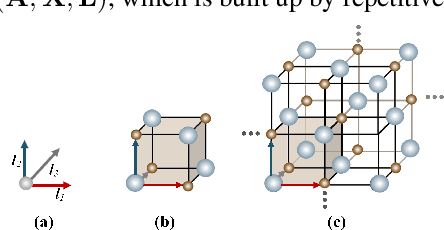

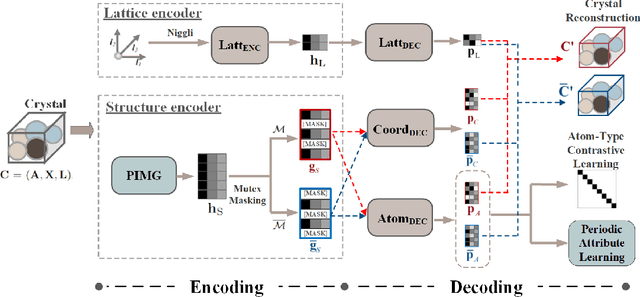
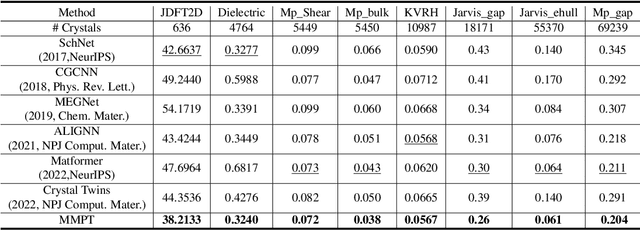
Crystal property prediction is a crucial aspect of developing novel materials. However, there are two technical challenges to be addressed for speeding up the investigation of crystals. First, labeling crystal properties is intrinsically difficult due to the high cost and time involved in physical simulations or lab experiments. Second, crystals adhere to a specific quantum chemical principle known as periodic invariance, which is often not captured by existing machine learning methods. To overcome these challenges, we propose the crystal-specific pre-training framework for learning crystal representations with self-supervision. The framework designs a mutex mask strategy for enhancing representation learning so as to alleviate the limited labels available for crystal property prediction. Moreover, we take into account the specific periodic invariance in crystal structures by developing a periodic invariance multi-graph module and periodic attribute learning within our framework. This framework has been tested on eight different tasks. The experimental results on these tasks show that the framework achieves promising prediction performance and is able to outperform recent strong baselines.
MTNet: A Multi-Task Neural Network for On-Field Calibration of Low-Cost Air Monitoring Sensors
May 10, 2021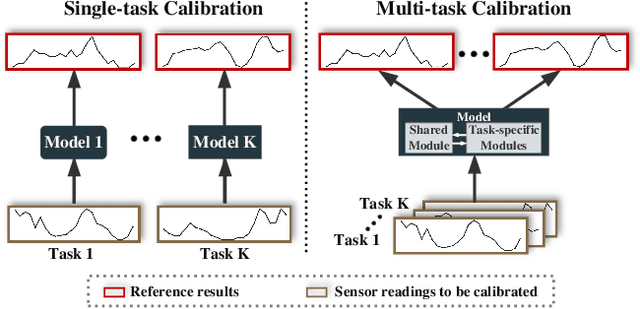
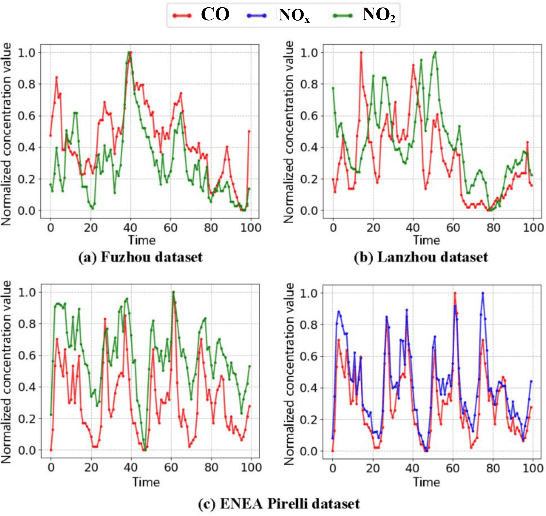
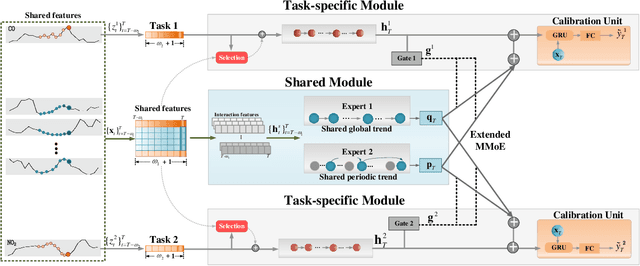
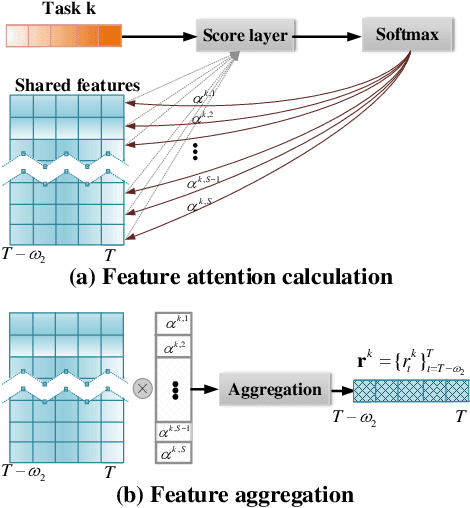
The advances of sensor technology enable people to monitor air quality through widely distributed low-cost sensors. However, measurements from these sensors usually encounter high biases and require a calibration step to reach an acceptable performance in down-streaming analytical tasks. Most existing calibration methods calibrate one type of sensor at a time, which we call single-task calibration. Despite the popularity of this single-task schema, it may neglect interactions among calibration tasks of different sensors, which encompass underlying information to promote calibration performance. In this paper, we propose a multi-task calibration network (MTNet) to calibrate multiple sensors (e.g., carbon monoxide and nitrogen oxide sensors) simultaneously, modeling the interactions among tasks. MTNet consists of a single shared module, and several task-specific modules. Specifically, in the shared module, we extend the multi-gate mixture-of-experts structure to harmonize the task conflicts and correlations among different tasks; in each task-specific module, we introduce a feature selection strategy to customize the input for the specific task. These improvements allow MTNet to learn interaction information shared across different tasks, and task-specific information for each calibration task as well. We evaluate MTNet on three real-world datasets and compare it with several established baselines. The experimental results demonstrate that MTNet achieves the state-of-the-art performance.