 Add to Chrome
 Add to Firefox
 Add to Edge
HyFAD: Hybrid Time-Frequency Diffusion with Frequency-Aware Embedding for Time Series Imputation
Jun 03, 2026
Diffusion models have demonstrated strong performance in time series modeling due to their ability to progressively capture complex data distributions through iterative denoising. However, existing approaches struggle with frequency-sensitive denoising, high-frequency reconstruction and balancing global trends with local dynamics. To address these limitations, we propose \textbf{HyFAD}, a \textbf{Hy}brid time-frequency \textbf{D}iffusion model with \textbf{F}requency-\textbf{A}ware embedding for time series imputation. Built upon the DDPM paradigm, HyFAD adopts a coupled time-frequency diffusion framework, in which the reverse denoising proceeds sequentially from the time domain to the frequency domain, enabling coarse-to-fine generation. Specifically, the time-domain diffusion process captures low-frequency global trends, while the frequency-domain diffusion process refines high-frequency spectral components. We further introduce a frequency-aware step embedding that exploits the relationship between diffusion steps and spectral components, providing step-dependent spectral guidance and facilitates more accurate band-wise reconstruction. Extensive experiments on multiple benchmark datasets demonstrate that HyFAD achieves state-of-the-art performance. Our source code is available at https://github.com/hongfangao/HyFAD.

SculptDrug : A Spatial Condition-Aware Bayesian Flow Model for Structure-based Drug Design
Nov 16, 2025Structure-Based drug design (SBDD) has emerged as a popular approach in drug discovery, leveraging three-dimensional protein structures to generate drug ligands. However, existing generative models encounter several key challenges: (1) incorporating boundary condition constraints, (2) integrating hierarchical structural conditions, and (3) ensuring spatial modeling fidelity. To address these limitations, we propose SculptDrug, a spatial condition-aware generative model based on Bayesian flow networks (BFNs). First, SculptDrug follows a BFN-based framework and employs a progressive denoising strategy to ensure spatial modeling fidelity, iteratively refining atom positions while enhancing local interactions for precise spatial alignment. Second, we introduce a Boundary Awareness Block that incorporates protein surface constraints into the generative process to ensure that generated ligands are geometrically compatible with the target protein. Third, we design a Hierarchical Encoder that captures global structural context while preserving fine-grained molecular interactions, ensuring overall consistency and accurate ligand-protein conformations. We evaluate SculptDrug on the CrossDocked dataset, and experimental results demonstrate that SculptDrug outperforms state-of-the-art baselines, highlighting the effectiveness of spatial condition-aware modeling.
DiffImp: Efficient Diffusion Model for Probabilistic Time Series Imputation with Bidirectional Mamba Backbone
Oct 17, 2024
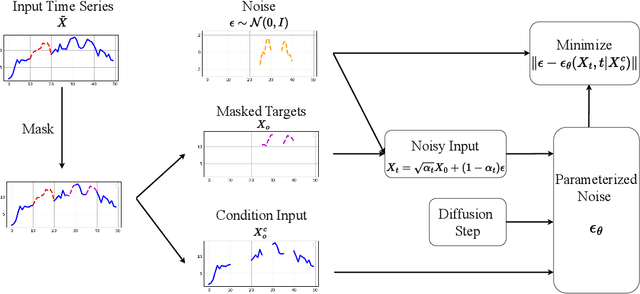


Probabilistic time series imputation has been widely applied in real-world scenarios due to its ability to estimate uncertainty of imputation results. Meanwhile, denoising diffusion probabilistic models (DDPMs) have achieved great success in probabilistic time series imputation tasks with its power to model complex distributions. However, current DDPM-based probabilistic time series imputation methodologies are confronted with two types of challenges: 1)~\textit{~The backbone modules of the denoising parts are not capable of achieving sequence modeling with low time complexity.} 2)~\textit{The architecture of denoising modules can not handle the inter-variable and bidirectional dependencies in the time series imputation problem effectively.} To address the first challenge, we integrate the computational efficient state space model, namely Mamba, as the backbone denosing module for DDPMs. To tackle the second challenge, we carefully devise several SSM-based blocks for bidirectional modeling and inter-variable relation understanding. Experimental results demonstrate that our approach can achieve state-of-the-art time series imputation results on multiple datasets, different missing scenarios and missing ratios.