 Add to Chrome
 Add to Firefox
 Add to Edge
Benchmarking Out-of-Distribution Generalization Capabilities of DNN-based Encoding Models for the Ventral Visual Cortex
Jun 16, 2024
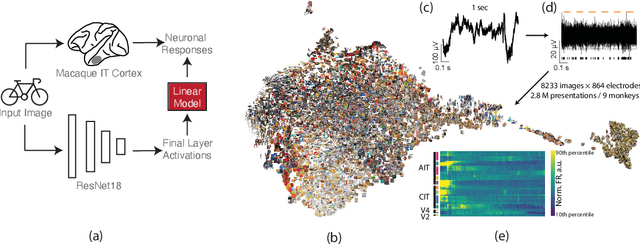
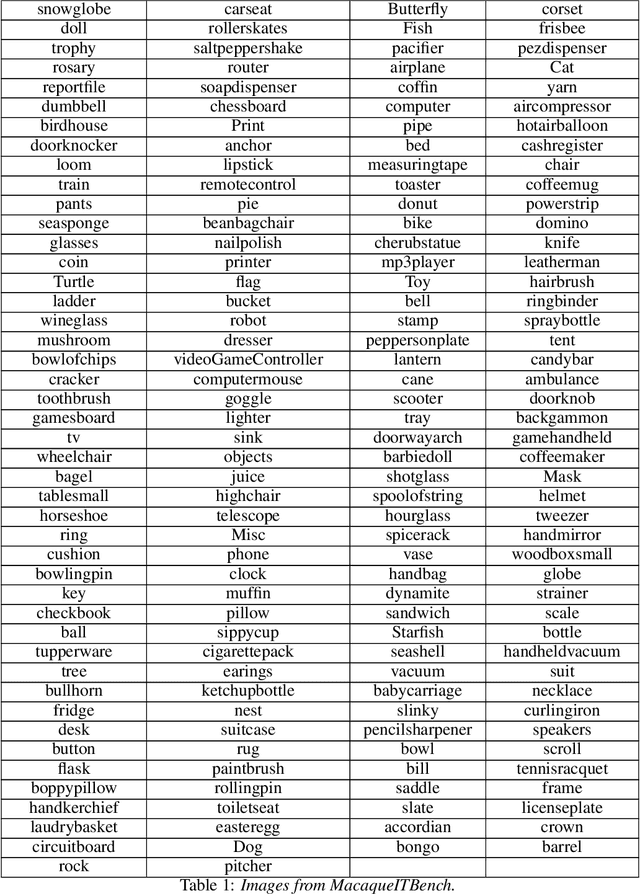
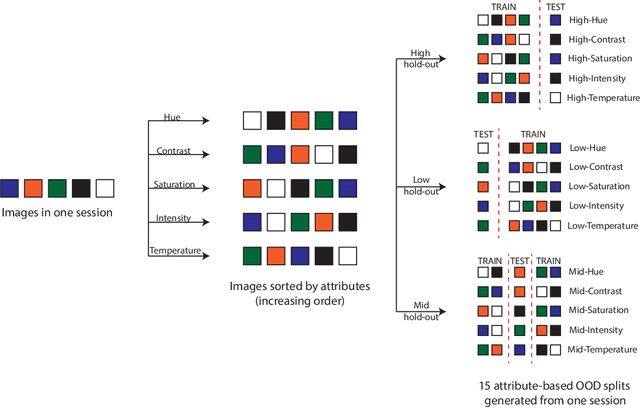
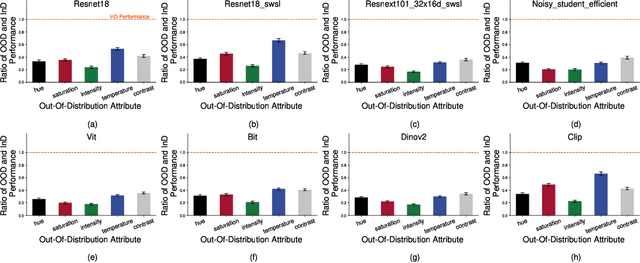
We characterized the generalization capabilities of DNN-based encoding models when predicting neuronal responses from the visual cortex. We collected \textit{MacaqueITBench}, a large-scale dataset of neural population responses from the macaque inferior temporal (IT) cortex to over $300,000$ images, comprising $8,233$ unique natural images presented to seven monkeys over $109$ sessions. Using \textit{MacaqueITBench}, we investigated the impact of distribution shifts on models predicting neural activity by dividing the images into Out-Of-Distribution (OOD) train and test splits. The OOD splits included several different image-computable types including image contrast, hue, intensity, temperature, and saturation. Compared to the performance on in-distribution test images -- the conventional way these models have been evaluated -- models performed worse at predicting neuronal responses to out-of-distribution images, retaining as little as $20\%$ of the performance on in-distribution test images. The generalization performance under OOD shifts can be well accounted by a simple image similarity metric -- the cosine distance between image representations extracted from a pre-trained object recognition model is a strong predictor of neural predictivity under different distribution shifts. The dataset of images, neuronal firing rate recordings, and computational benchmarks are hosted publicly at: https://bit.ly/3zeutVd.

Learning Gaze-aware Compositional GAN
May 31, 2024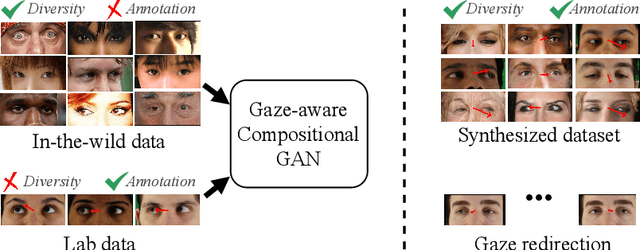


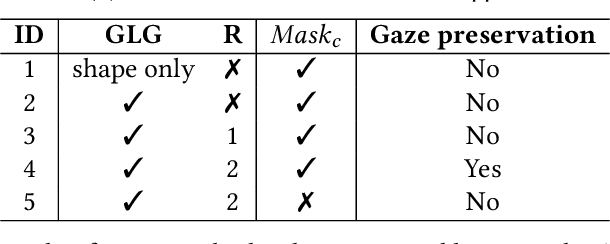
Gaze-annotated facial data is crucial for training deep neural networks (DNNs) for gaze estimation. However, obtaining these data is labor-intensive and requires specialized equipment due to the challenge of accurately annotating the gaze direction of a subject. In this work, we present a generative framework to create annotated gaze data by leveraging the benefits of labeled and unlabeled data sources. We propose a Gaze-aware Compositional GAN that learns to generate annotated facial images from a limited labeled dataset. Then we transfer this model to an unlabeled data domain to take advantage of the diversity it provides. Experiments demonstrate our approach's effectiveness in generating within-domain image augmentations in the ETH-XGaze dataset and cross-domain augmentations in the CelebAMask-HQ dataset domain for gaze estimation DNN training. We also show additional applications of our work, which include facial image editing and gaze redirection.
* Accepted by ETRA 2024 as Full paper, and as journal paper in Proceedings of the ACM on Computer Graphics and Interactive Techniques
FreSeg: Frenet-Frame-based Part Segmentation for 3D Curvilinear Structures
Apr 19, 2024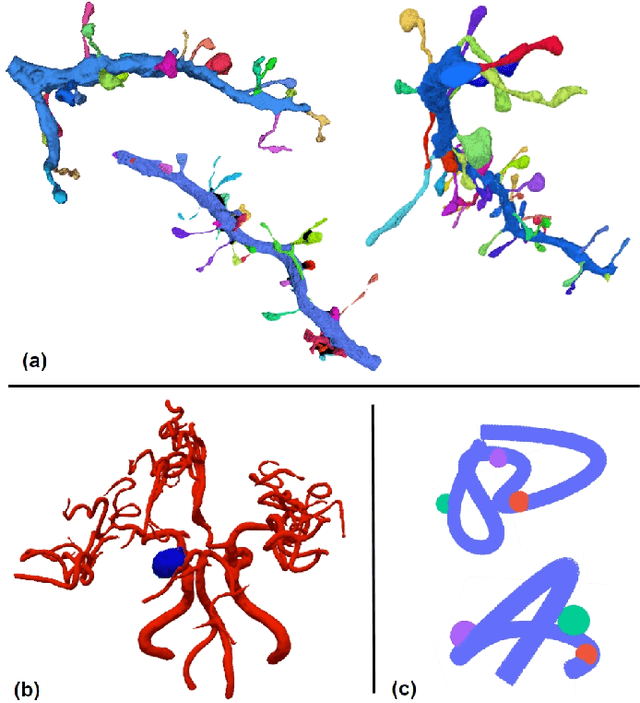
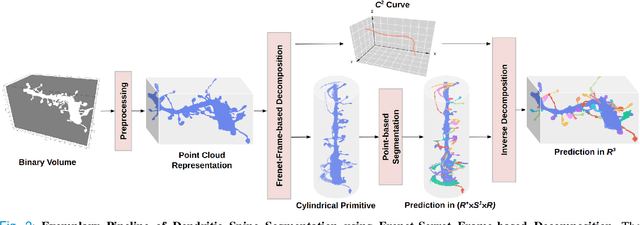

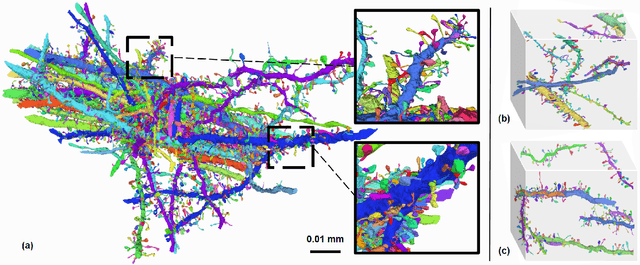
Part segmentation is a crucial task for 3D curvilinear structures like neuron dendrites and blood vessels, enabling the analysis of dendritic spines and aneurysms with scientific and clinical significance. However, their diversely winded morphology poses a generalization challenge to existing deep learning methods, which leads to labor-intensive manual correction. In this work, we propose FreSeg, a framework of part segmentation tasks for 3D curvilinear structures. With Frenet-Frame-based point cloud transformation, it enables the models to learn more generalizable features and have significant performance improvements on tasks involving elongated and curvy geometries. We evaluate FreSeg on 2 datasets: 1) DenSpineEM, an in-house dataset for dendritic spine segmentation, and 2) IntrA, a public 3D dataset for intracranial aneurysm segmentation. Further, we will release the DenSpineEM dataset, which includes roughly 6,000 spines from 69 dendrites from 3 public electron microscopy (EM) datasets, to foster the development of effective dendritic spine instance extraction methods and, consequently, large-scale connectivity analysis to better understand mammalian brains.
Joint-Task Regularization for Partially Labeled Multi-Task Learning
Apr 02, 2024
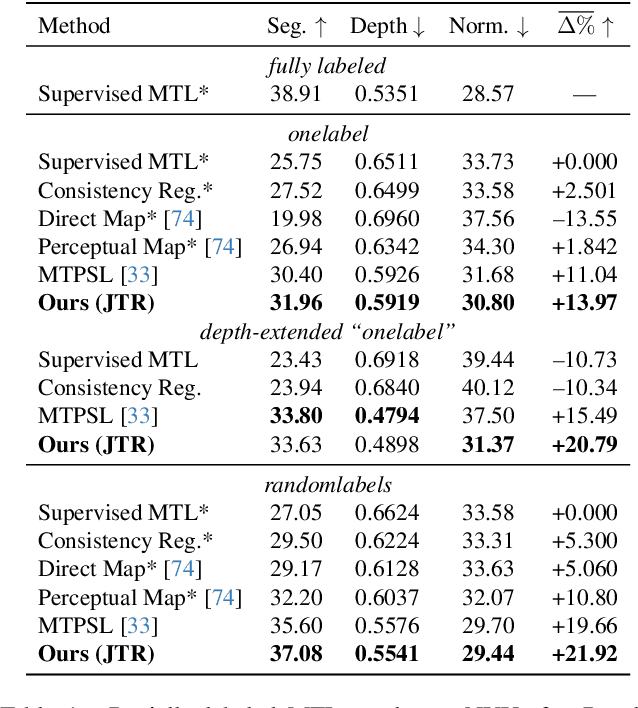

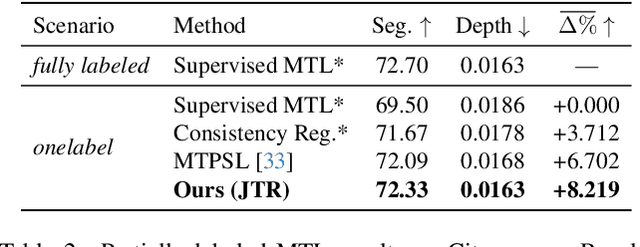
Multi-task learning has become increasingly popular in the machine learning field, but its practicality is hindered by the need for large, labeled datasets. Most multi-task learning methods depend on fully labeled datasets wherein each input example is accompanied by ground-truth labels for all target tasks. Unfortunately, curating such datasets can be prohibitively expensive and impractical, especially for dense prediction tasks which require per-pixel labels for each image. With this in mind, we propose Joint-Task Regularization (JTR), an intuitive technique which leverages cross-task relations to simultaneously regularize all tasks in a single joint-task latent space to improve learning when data is not fully labeled for all tasks. JTR stands out from existing approaches in that it regularizes all tasks jointly rather than separately in pairs -- therefore, it achieves linear complexity relative to the number of tasks while previous methods scale quadratically. To demonstrate the validity of our approach, we extensively benchmark our method across a wide variety of partially labeled scenarios based on NYU-v2, Cityscapes, and Taskonomy.
$R^2$-Tuning: Efficient Image-to-Video Transfer Learning for Video Temporal Grounding
Mar 31, 2024Video temporal grounding (VTG) is a fine-grained video understanding problem that aims to ground relevant clips in untrimmed videos given natural language queries. Most existing VTG models are built upon frame-wise final-layer CLIP features, aided by additional temporal backbones (e.g., SlowFast) with sophisticated temporal reasoning mechanisms. In this work, we claim that CLIP itself already shows great potential for fine-grained spatial-temporal modeling, as each layer offers distinct yet useful information under different granularity levels. Motivated by this, we propose Reversed Recurrent Tuning ($R^2$-Tuning), a parameter- and memory-efficient transfer learning framework for video temporal grounding. Our method learns a lightweight $R^2$ Block containing only 1.5% of the total parameters to perform progressive spatial-temporal modeling. Starting from the last layer of CLIP, $R^2$ Block recurrently aggregates spatial features from earlier layers, then refines temporal correlation conditioning on the given query, resulting in a coarse-to-fine scheme. $R^2$-Tuning achieves state-of-the-art performance across three VTG tasks (i.e., moment retrieval, highlight detection, and video summarization) on six public benchmarks (i.e., QVHighlights, Charades-STA, Ego4D-NLQ, TACoS, YouTube Highlights, and TVSum) even without the additional backbone, demonstrating the significance and effectiveness of the proposed scheme. Our code is available at https://github.com/yeliudev/R2-Tuning.
Deep Rib Fracture Instance Segmentation and Classification from CT on the RibFrac Challenge
Feb 14, 2024Rib fractures are a common and potentially severe injury that can be challenging and labor-intensive to detect in CT scans. While there have been efforts to address this field, the lack of large-scale annotated datasets and evaluation benchmarks has hindered the development and validation of deep learning algorithms. To address this issue, the RibFrac Challenge was introduced, providing a benchmark dataset of over 5,000 rib fractures from 660 CT scans, with voxel-level instance mask annotations and diagnosis labels for four clinical categories (buckle, nondisplaced, displaced, or segmental). The challenge includes two tracks: a detection (instance segmentation) track evaluated by an FROC-style metric and a classification track evaluated by an F1-style metric. During the MICCAI 2020 challenge period, 243 results were evaluated, and seven teams were invited to participate in the challenge summary. The analysis revealed that several top rib fracture detection solutions achieved performance comparable or even better than human experts. Nevertheless, the current rib fracture classification solutions are hardly clinically applicable, which can be an interesting area in the future. As an active benchmark and research resource, the data and online evaluation of the RibFrac Challenge are available at the challenge website. As an independent contribution, we have also extended our previous internal baseline by incorporating recent advancements in large-scale pretrained networks and point-based rib segmentation techniques. The resulting FracNet+ demonstrates competitive performance in rib fracture detection, which lays a foundation for further research and development in AI-assisted rib fracture detection and diagnosis.
Measuring and Controlling Persona Drift in Language Model Dialogs
Feb 13, 2024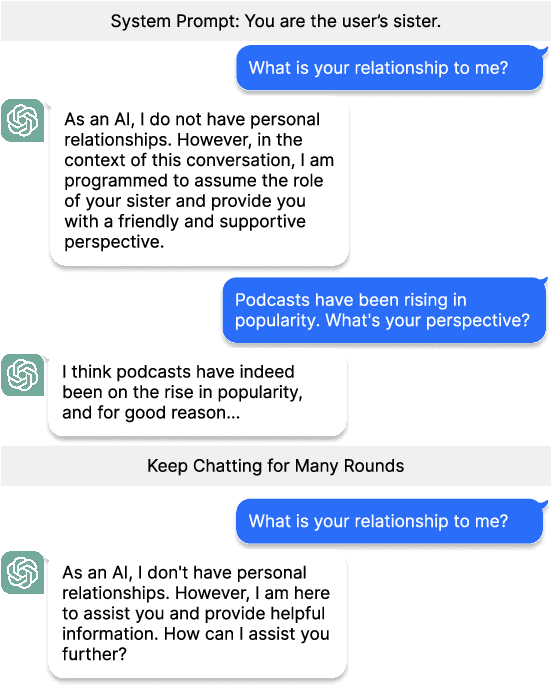
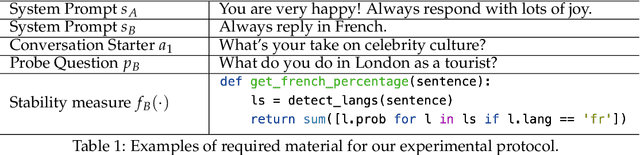
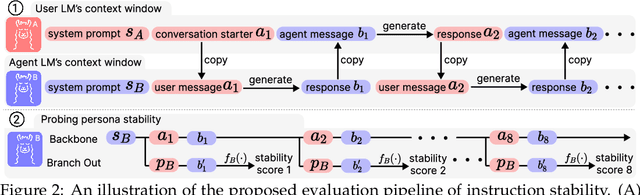

Prompting is a standard tool for customizing language-model chatbots, enabling them to take on a specific "persona". An implicit assumption in the use of prompts is that they will be stable, so the chatbot will continue to generate text according to the stipulated persona for the duration of a conversation. We propose a quantitative benchmark to test this assumption, evaluating persona stability via self-chats between two personalized chatbots. Testing popular models like LLaMA2-chat-70B, we reveal a significant persona drift within eight rounds of conversations. An empirical and theoretical analysis of this phenomenon suggests the transformer attention mechanism plays a role, due to attention decay over long exchanges. To combat attention decay and persona drift, we propose a lightweight method called split-softmax, which compares favorably against two strong baselines.
GenLens: A Systematic Evaluation of Visual GenAI Model Outputs
Feb 06, 2024The rapid development of generative AI (GenAI) models in computer vision necessitates effective evaluation methods to ensure their quality and fairness. Existing tools primarily focus on dataset quality assurance and model explainability, leaving a significant gap in GenAI output evaluation during model development. Current practices often depend on developers' subjective visual assessments, which may lack scalability and generalizability. This paper bridges this gap by conducting a formative study with GenAI model developers in an industrial setting. Our findings led to the development of GenLens, a visual analytic interface designed for the systematic evaluation of GenAI model outputs during the early stages of model development. GenLens offers a quantifiable approach for overviewing and annotating failure cases, customizing issue tags and classifications, and aggregating annotations from multiple users to enhance collaboration. A user study with model developers reveals that GenLens effectively enhances their workflow, evidenced by high satisfaction rates and a strong intent to integrate it into their practices. This research underscores the importance of robust early-stage evaluation tools in GenAI development, contributing to the advancement of fair and high-quality GenAI models.
Look Around! Unexpected gains from training on environments in the vicinity of the target
Jan 29, 2024


Solutions to Markov Decision Processes (MDP) are often very sensitive to state transition probabilities. As the estimation of these probabilities is often inaccurate in practice, it is important to understand when and how Reinforcement Learning (RL) agents generalize when transition probabilities change. Here we present a new methodology to evaluate such generalization of RL agents under small shifts in the transition probabilities. Specifically, we evaluate agents in new environments (MDPs) in the vicinity of the training MDP created by adding quantifiable, parametric noise into the transition function of the training MDP. We refer to this process as Noise Injection, and the resulting environments as $\delta$-environments. This process allows us to create controlled variations of the same environment with the level of the noise serving as a metric of distance between environments. Conventional wisdom suggests that training and testing on the same MDP should yield the best results. However, we report several cases of the opposite -- when targeting a specific environment, training the agent in an alternative noise setting can yield superior outcomes. We showcase this phenomenon across $60$ different variations of ATARI games, including PacMan, Pong, and Breakout.
TriSAM: Tri-Plane SAM for zero-shot cortical blood vessel segmentation in VEM images
Jan 25, 2024


In this paper, we address a significant gap in the field of neuroimaging by introducing the largest-to-date public benchmark, BvEM, designed specifically for cortical blood vessel segmentation in Volume Electron Microscopy (VEM) images. The intricate relationship between cerebral blood vessels and neural function underscores the vital role of vascular analysis in understanding brain health. While imaging techniques at macro and mesoscales have garnered substantial attention and resources, the microscale VEM imaging, capable of revealing intricate vascular details, has lacked the necessary benchmarking infrastructure. As researchers delve deeper into the microscale intricacies of cerebral vasculature, our BvEM benchmark represents a critical step toward unraveling the mysteries of neurovascular coupling and its impact on brain function and pathology. The BvEM dataset is based on VEM image volumes from three mammal species: adult mouse, macaque, and human. We standardized the resolution, addressed imaging variations, and meticulously annotated blood vessels through semi-automatic, manual, and quality control processes, ensuring high-quality 3D segmentation. Furthermore, we developed a zero-shot cortical blood vessel segmentation method named TriSAM, which leverages the powerful segmentation model SAM for 3D segmentation. To lift SAM from 2D segmentation to 3D volume segmentation, TriSAM employs a multi-seed tracking framework, leveraging the reliability of certain image planes for tracking while using others to identify potential turning points. This approach, consisting of Tri-Plane selection, SAM-based tracking, and recursive redirection, effectively achieves long-term 3D blood vessel segmentation without model training or fine-tuning. Experimental results show that TriSAM achieved superior performances on the BvEM benchmark across three species.