 Add to Chrome
 Add to Firefox
 Add to Edge
CompanionCast: A Multi-Agent Conversational AI Framework with Spatial Audio for Social Co-Viewing Experiences
Dec 11, 2025
Social presence is central to the enjoyment of watching content together, yet modern media consumption is increasingly solitary. We investigate whether multi-agent conversational AI systems can recreate the dynamics of shared viewing experiences across diverse content types. We present CompanionCast, a general framework for orchestrating multiple role-specialized AI agents that respond to video content using multimodal inputs, speech synthesis, and spatial audio. Distinctly, CompanionCast integrates an LLM-as-a-Judge module that iteratively scores and refines conversations across five dimensions (relevance, authenticity, engagement, diversity, personality consistency). We validate this framework through sports viewing, a domain with rich dynamics and strong social traditions, where a pilot study with soccer fans suggests that multi-agent interaction improves perceived social presence compared to solo viewing. We contribute: (1) a generalizable framework for orchestrating multi-agent conversations around multimodal video content, (2) a novel evaluator-agent pipeline for conversation quality control, and (3) exploratory evidence of increased social presence in AI-mediated co-viewing. We discuss challenges and future directions for applying this approach to diverse viewing contexts including entertainment, education, and collaborative watching experiences.

GenLens: A Systematic Evaluation of Visual GenAI Model Outputs
Feb 06, 2024The rapid development of generative AI (GenAI) models in computer vision necessitates effective evaluation methods to ensure their quality and fairness. Existing tools primarily focus on dataset quality assurance and model explainability, leaving a significant gap in GenAI output evaluation during model development. Current practices often depend on developers' subjective visual assessments, which may lack scalability and generalizability. This paper bridges this gap by conducting a formative study with GenAI model developers in an industrial setting. Our findings led to the development of GenLens, a visual analytic interface designed for the systematic evaluation of GenAI model outputs during the early stages of model development. GenLens offers a quantifiable approach for overviewing and annotating failure cases, customizing issue tags and classifications, and aggregating annotations from multiple users to enhance collaboration. A user study with model developers reveals that GenLens effectively enhances their workflow, evidenced by high satisfaction rates and a strong intent to integrate it into their practices. This research underscores the importance of robust early-stage evaluation tools in GenAI development, contributing to the advancement of fair and high-quality GenAI models.
AtomXR: Streamlined XR Prototyping with Natural Language and Immersive Physical Interaction
Nov 19, 2023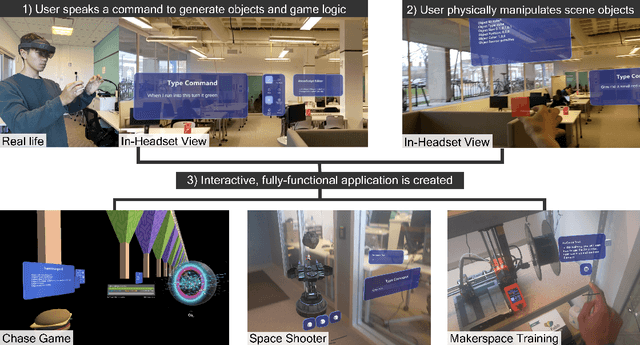
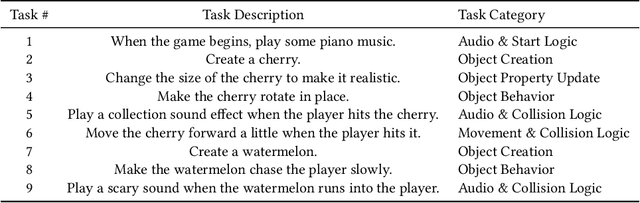
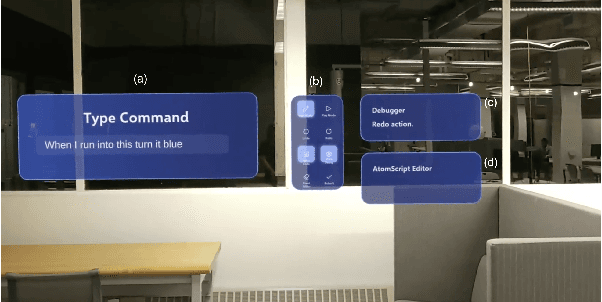
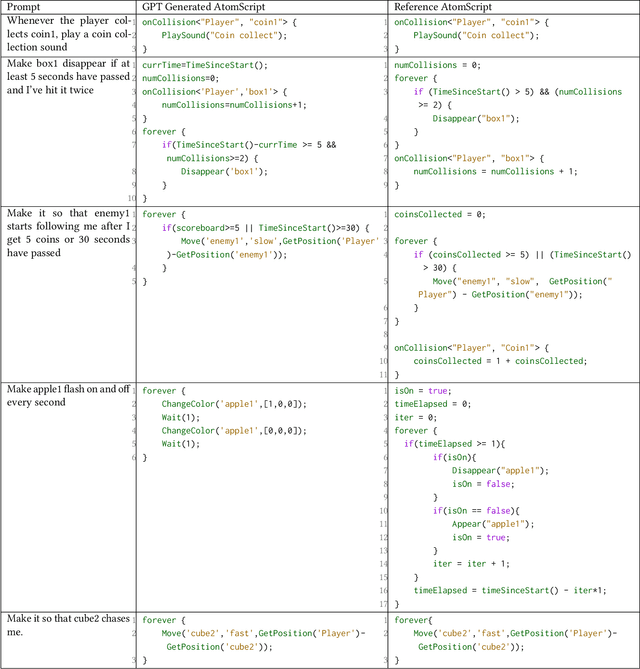
As technological advancements in extended reality (XR) amplify the demand for more XR content, traditional development processes face several challenges: 1) a steep learning curve for inexperienced developers, 2) a disconnect between 2D development environments and 3D user experiences inside headsets, and 3) slow iteration cycles due to context switching between development and testing environments. To address these challenges, we introduce AtomXR, a streamlined, immersive, no-code XR prototyping tool designed to empower both experienced and inexperienced developers in creating applications using natural language, eye-gaze, and touch interactions. AtomXR consists of: 1) AtomScript, a high-level human-interpretable scripting language for rapid prototyping, 2) a natural language interface that integrates LLMs and multimodal inputs for AtomScript generation, and 3) an immersive in-headset authoring environment. Empirical evaluation through two user studies offers insights into natural language-based and immersive prototyping, and shows AtomXR provides significant improvements in speed and user experience compared to traditional systems.