 Add to Chrome
 Add to Firefox
 Add to Edge
Motion Capture is Not the Target Domain: Scaling Synthetic Data for Learning Motion Representations
Feb 11, 2026
Synthetic data offers a compelling path to scalable pretraining when real-world data is scarce, but models pretrained on synthetic data often fail to transfer reliably to deployment settings. We study this problem in full-body human motion, where large-scale data collection is infeasible but essential for wearable-based Human Activity Recognition (HAR), and where synthetic motion can be generated from motion-capture-derived representations. We pretrain motion time-series models using such synthetic data and evaluate their transfer across diverse downstream HAR tasks. Our results show that synthetic pretraining improves generalisation when mixed with real data or scaled sufficiently. We also demonstrate that large-scale motion-capture pretraining yields only marginal gains due to domain mismatch with wearable signals, clarifying key sim-to-real challenges and the limits and opportunities of synthetic motion data for transferable HAR representations.

Uncertainty Quantification for Machine Learning in Healthcare: A Survey
May 04, 2025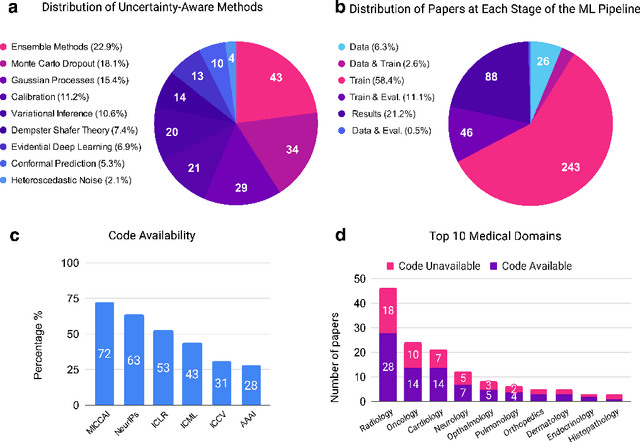
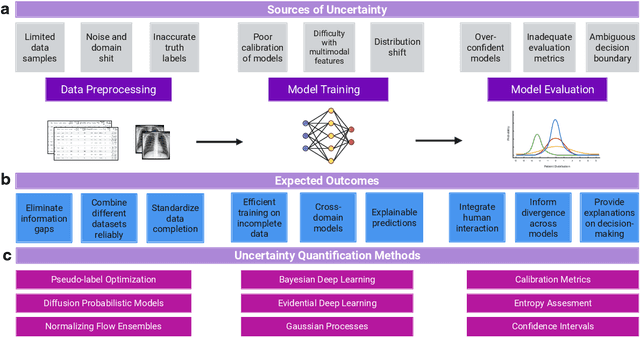
Uncertainty Quantification (UQ) is pivotal in enhancing the robustness, reliability, and interpretability of Machine Learning (ML) systems for healthcare, optimizing resources and improving patient care. Despite the emergence of ML-based clinical decision support tools, the lack of principled quantification of uncertainty in ML models remains a major challenge. Current reviews have a narrow focus on analyzing the state-of-the-art UQ in specific healthcare domains without systematically evaluating method efficacy across different stages of model development, and despite a growing body of research, its implementation in healthcare applications remains limited. Therefore, in this survey, we provide a comprehensive analysis of current UQ in healthcare, offering an informed framework that highlights how different methods can be integrated into each stage of the ML pipeline including data processing, training and evaluation. We also highlight the most popular methods used in healthcare and novel approaches from other domains that hold potential for future adoption in the medical context. We expect this study will provide a clear overview of the challenges and opportunities of implementing UQ in the ML pipeline for healthcare, guiding researchers and practitioners in selecting suitable techniques to enhance the reliability, safety and trust from patients and clinicians on ML-driven healthcare solutions.