 Add to Chrome
 Add to Firefox
 Add to Edge
UniLab: A Heterogeneous Architecture for Robot RL Beyond GPU-Dominant Paradigms
Jun 02, 2026
Simulation-based RL for contemporary robot control is increasingly organized around GPU-resident simulation: physics, rollout collection, and learning are placed on a single GPU-centric execution path. This paradigm has greatly improved training speed, but it has also encouraged a default assumption that efficient training requires physics to reside on the GPU. We revisit this assumption. Our view is that, in simulation-dominated robot control, the essential question is not which processor runs physics, but whether simulation throughput, policy learning, and runtime synchronization form an efficient end-to-end loop. We present UniLab, a heterogeneous CPU-simulation / GPU-learning architecture that decouples CPU-parallel simulation from GPU policy updates through a unified runtime for data movement, buffering, and synchronization. UniLab is implemented as a complete and extensible training system using MuJoCoUni and MotrixSim CPU-batched physics backends, supporting PPO, FastSAC, FlashSAC, and APPO. On representative simulation-based robot control tasks, UniLab improves end-to-end training efficiency by 3--10$\times$ under the same hardware configuration, while reducing dependence on the NVIDIA CUDA-based software stack and supporting cross-platform execution on the Apple macOS platform and the AMD ROCm and Intel XPU accelerator backends. These results show that GPU simulation is an effective path to efficient training, but not a necessary one, broadening the practical system choices available for robot RL training. Project page: https://unilabsim.github.io.

A Heterogeneous Architecture for Robot RL Beyond GPU-Dominant Paradigms
May 28, 2026Simulation-based RL for contemporary robot control is increasingly organized around GPU-resident simulation: physics, rollout collection, and learning are placed on a single GPU-centric execution path. This paradigm has greatly improved training speed, but it has also encouraged a default assumption that efficient training requires physics to reside on the GPU. We revisit this assumption. Our view is that, in simulation-dominated robot control, the essential question is not which processor runs physics, but whether simulation throughput, policy learning, and runtime synchronization form an efficient end-to-end loop. We present UniLab, a heterogeneous CPU-simulation / GPU-learning architecture that decouples CPU-parallel simulation from GPU policy updates through a unified runtime for data movement, buffering, and synchronization. UniLab is implemented as a complete and extensible training system using MuJoCoUni and MotrixSim CPU-batched physics backends, supporting PPO, SAC, FlashSAC, TD3, and APPO. On representative simulation-based robot control tasks, UniLab improves end-to-end training efficiency by 3--10$\times$ under the same hardware configuration, while reducing dependence on the NVIDIA CUDA-based software stack and supporting cross-platform execution on the Apple macOS platform and the AMD ROCm and Intel XPU accelerator backends. These results show that GPU simulation is an effective path to efficient training, but not a necessary one, broadening the practical system choices available for robot RL training. Project page: https://github.com/unilabsim/UniLab.
GS-Playground: A High-Throughput Photorealistic Simulator for Vision-Informed Robot Learning
Apr 28, 2026Embodied AI research is undergoing a shift toward vision-centric perceptual paradigms. While massively parallel simulators have catalyzed breakthroughs in proprioception-based locomotion, their potential remains largely untapped for vision-informed tasks due to the prohibitive computational overhead of large-scale photorealistic rendering. Furthermore, the creation of simulation-ready 3D assets heavily relies on labor-intensive manual modeling, while the significant sim-to-real physical gap hinders the transfer of contact-rich manipulation policies. To address these bottlenecks, we propose GS-Playground, a multi-modal simulation framework designed to accelerate end-to-end perceptual learning. We develop a novel high-performance parallel physics engine, specifically designed to integrate with a batch 3D Gaussian Splatting (3DGS) rendering pipeline to ensure high-fidelity synchronization. Our system achieves a breakthrough throughput of 10^4 FPS at 640x480 resolution, significantly lowering the barrier for large-scale visual RL. Additionally, we introduce an automated Real2Sim workflow that reconstructs photorealistic, physically consistent, and memory-efficient environments, streamlining the generation of complex simulation-ready scenes. Extensive experiments on locomotion, navigation, and manipulation demonstrate that GS-Playground effectively bridges the perceptual and physical gaps across diverse embodied tasks. Project homepage: https://gsplayground.github.io.
Relation-aware Hierarchical Attention Framework for Video Question Answering
May 14, 2021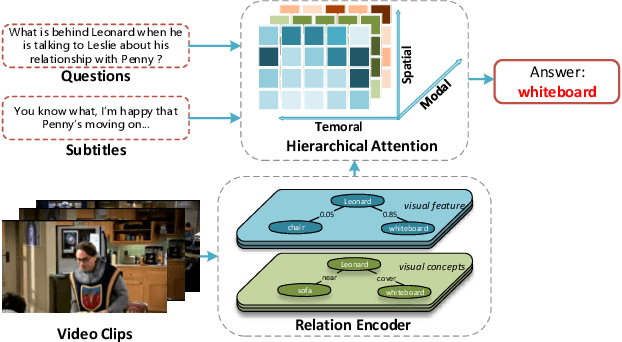
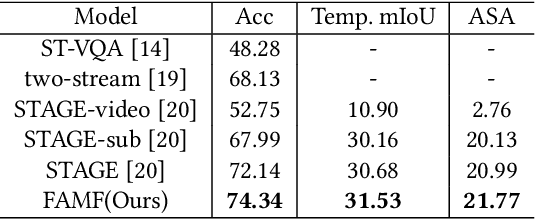
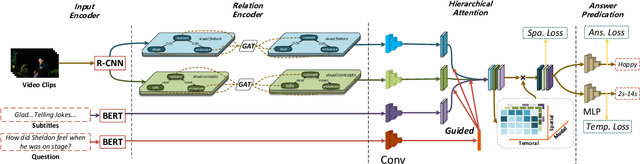
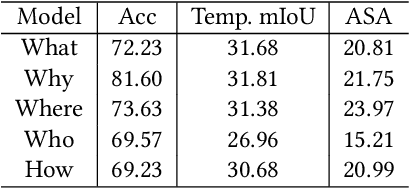
Video Question Answering (VideoQA) is a challenging video understanding task since it requires a deep understanding of both question and video. Previous studies mainly focus on extracting sophisticated visual and language embeddings, fusing them by delicate hand-crafted networks. However, the relevance of different frames, objects, and modalities to the question are varied along with the time, which is ignored in most of existing methods. Lacking understanding of the the dynamic relationships and interactions among objects brings a great challenge to VideoQA task. To address this problem, we propose a novel Relation-aware Hierarchical Attention (RHA) framework to learn both the static and dynamic relations of the objects in videos. In particular, videos and questions are embedded by pre-trained models firstly to obtain the visual and textual features. Then a graph-based relation encoder is utilized to extract the static relationship between visual objects. To capture the dynamic changes of multimodal objects in different video frames, we consider the temporal, spatial, and semantic relations, and fuse the multimodal features by hierarchical attention mechanism to predict the answer. We conduct extensive experiments on a large scale VideoQA dataset, and the experimental results demonstrate that our RHA outperforms the state-of-the-art methods.