 Add to Chrome
 Add to Firefox
 Add to Edge
Learning to Rotate: Temporal and Semantic Rotary Encoding for Sequential Modeling
Apr 27, 2026
Every Transformer architecture dedicates enormous capacity to learning rich representations in semantic embedding space -- yet the rotation manifold acted upon by Rotary Positional Embeddings (RoPE) has been treated as a fixed, hand-crafted structure, populated only by discrete ordinal indices. We argue that this rotation space is a largely overlooked second dimension of expressivity in the attention mechanism, one whose systematic exploration may open a new door for attention-based architectures. The analogy to complex numbers is instructive: just as introducing the imaginary axis -- orthogonal to and independent of the real line -- unlocked new algebraic structure once believed impossible, treating the rotation manifold as a learnable, signal-conditioned space opens an orthogonal degree of freedom in attention. In this framing, the token embedding encodes the semantic (real) component of a representation -- what a token means -- while the rotation encodes its dynamic (imaginary) component -- how it relates to every other token across time, position, and context. We introduce SIREN-RoPE, a concrete instantiation of this idea, which populates the rotation dimension with heterogeneous signals -- continuous timestamps, cyclical temporal patterns, and categorical metadata -- via a dual-branch Sinusoidal Representation Network (SIREN). As a proof of concept, we evaluate on a production-scale news feed dataset from a major social network using a generative recommender as the ranking model, demonstrating that activating this hidden dimension yields consistent improvements across calibration and ranking objectives with negligible computational overhead. We invite the community to view the rotation space not as a solved positional-encoding detail, but as an untapped axis whose rich structure may prove as consequential for attention as the imaginary unit proved for algebra.

Scalable Hyperparameter-Divergent Ensemble Training with Automatic Learning Rate Exploration for Large Models
Apr 27, 2026Training large neural networks with data-parallel stochastic gradient descent allocates N GPU replicas to compute effectively identical updates -- a practice that leaves the rich space of learning rate configurations entirely unexplored during training. We propose Hyperparameter-Divergent Ensemble Training (HDET), a method that repurposes these replicas for simultaneous learning rate exploration at negligible communication overhead. HDET operates in alternating phases: a fan-out stage in which replicas train independently under a structured, symmetric spread of learning rates, and a converge stage in which parameters are averaged across all replicas via AllReduce every T steps. Building on this ensemble substrate, we further propose an automatic learning rate (auto-LR) controller that treats the relative training loss across replicas as a performance signal, updating the shared base schedule toward higher-performing configurations via a momentum-based gradient-free meta-update. The combined method produces a self-adapting learning rate schedule that improves both optimization quality and generalization without additional hyperparameter sweeps or training budget. Crucially, the framework generalizes beyond learning rate: any scalar hyperparameter that does not alter model architecture -- such as dropout rate, attention scale temperature, or weight-decay coefficient -- can be explored across replicas using the same fan-out/converge protocol, with inter-replica loss differences serving as zero-order hypergradients that guide the search direction. HDET is implemented as a drop-in replacement for PyTorch's OneCycleLR scheduler, requiring no changes to model architecture, optimizer, or data pipeline.
Beyond Interleaving: Causal Attention Reformulations for Generative Recommender Systems
Mar 11, 2026Generative Recommender Systems (GR) increasingly model user behavior as a sequence generation task by interleaving item and action tokens. While effective, this formulation introduces significant structural and computational inefficiencies: it doubles sequence length, incurs quadratic overhead, and relies on implicit attention to recover the causal relationship between an item and its associated action. Furthermore, interleaving heterogeneous tokens forces the Transformer to disentangle semantically incompatible signals, leading to increased attention noise and reduced representation efficiency.In this work, we propose a principled reformulation of generative recommendation that aligns sequence modeling with underlying causal structures and attention theory. We demonstrate that current interleaving mechanisms act as inefficient proxies for similarity-weighted action pooling. To address this, we introduce two novel architectures that eliminate interleaved dependencies to reduce sequence complexity by 50%: Attention-based Late Fusion for Actions (AttnLFA) and Attention-based Mixed Value Pooling (AttnMVP). These models explicitly encode the $i_n \rightarrow a_n$ causal dependency while preserving the expressive power of Transformer-based sequence modeling.We evaluate our framework on large-scale product recommendation data from a major social network. Experimental results show that AttnLFA and AttnMVP consistently outperform interleaved baselines, achieving evaluation loss improvements of 0.29% and 0.80%, and significant gains in Normalized Entropy (NE). Crucially, these performance gains are accompanied by training time reductions of 23% and 12%, respectively. Our findings suggest that explicitly modeling item-action causality provides a superior design paradigm for scalable and efficient generative ranking.
An Industrial-Scale Sequential Recommender for LinkedIn Feed Ranking
Feb 12, 2026LinkedIn Feed enables professionals worldwide to discover relevant content, build connections, and share knowledge at scale. We present Feed Sequential Recommender (Feed-SR), a transformer-based sequential ranking model for LinkedIn Feed that replaces a DCNv2-based ranker and meets strict production constraints. We detail the modeling choices, training techniques, and serving optimizations that enable deployment at LinkedIn scale. Feed-SR is currently the primary member experience on LinkedIn's Feed and shows significant improvements in member engagement (+2.10% time spent) in online A/B tests compared to the existing production model. We also describe our deployment experience with alternative sequential and LLM-based ranking architectures and why Feed-SR provided the best combination of online metrics and production efficiency.
LiRank: Industrial Large Scale Ranking Models at LinkedIn
Feb 10, 2024

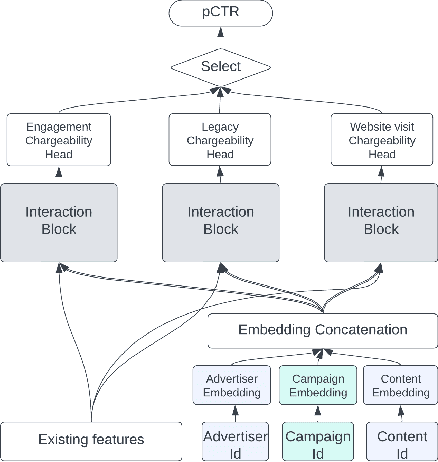

We present LiRank, a large-scale ranking framework at LinkedIn that brings to production state-of-the-art modeling architectures and optimization methods. We unveil several modeling improvements, including Residual DCN, which adds attention and residual connections to the famous DCNv2 architecture. We share insights into combining and tuning SOTA architectures to create a unified model, including Dense Gating, Transformers and Residual DCN. We also propose novel techniques for calibration and describe how we productionalized deep learning based explore/exploit methods. To enable effective, production-grade serving of large ranking models, we detail how to train and compress models using quantization and vocabulary compression. We provide details about the deployment setup for large-scale use cases of Feed ranking, Jobs Recommendations, and Ads click-through rate (CTR) prediction. We summarize our learnings from various A/B tests by elucidating the most effective technical approaches. These ideas have contributed to relative metrics improvements across the board at LinkedIn: +0.5% member sessions in the Feed, +1.76% qualified job applications for Jobs search and recommendations, and +4.3% for Ads CTR. We hope this work can provide practical insights and solutions for practitioners interested in leveraging large-scale deep ranking systems.