 Add to Chrome
 Add to Firefox
 Add to Edge
Melo: A Production LLM-Powered Music Recommendation Agent
Jul 26, 2026
We describe Melo, an LLM-powered music recommendation agent deployed on NetEase Cloud Music. Melo is structured as a deterministic five-node state graph over heterogeneous tools, with a prompt- and state-machine-driven orchestration policy rather than a fine-tuned controller. At industrial scale, the bottleneck is not how smart the brain is but how the system detects and recovers from the mistakes that brain makes. Two production failure modes drove the design: entity hallucination, where the agent commits to interpretations unsupported by the live catalog or user-behavior index, and long-tail degradation, where over-constrained requests collapse to generic popular fallbacks. We address them with two complementary mechanisms. Inference-time entity grounding repurposes the production search index as a verification primitive that gates entity decisions before they propagate downstream. Reflective retry verbalizes failure reasons from a broken tool chain and feeds them into the next planning step, so the system can relax or revise constraints rather than fall back blindly. A one-month online A/B test across NetEase Cloud Music's playlist surfaces reports an over 2 pp lift in a primary playlist retention metric and a lift of over one minute in a core playlist engagement metric. Offline ablation isolates a 7.8 pp reduction in entity misidentification from the three-layer grounding stack on our evaluation set, and a triggered-session analysis on our evaluation set shows reflective retry firing on 5.8% of sessions with 59% process-level recovery. Our deployment experience suggests that progress on LLM-powered music recommendation at this scale depends as much on the named, ablatable runtime machinery that catches and corrects the brain's mistakes as on the brain itself: a hypothesis we offer for the community to test.

PIANO: Personalized Reranking via Information Aggregation Node for Music Search Optimization
Jun 15, 2026Unlike short-video content, music tracks have long lifecycles and lasting value. Effective music search re-ranking must therefore align the user's current query with long-term preferences while jointly optimizing Click-Through Rate (CTR) and Conversion Rate (CVR). However, existing methods suffer from two limitations: (1) sequential methods rely on item-interaction history and therefore cannot use historical search queries to tell which past preferences match the user's current search intent; (2) most listwise models optimize a single objective (e.g., CTR only), and conventional multi-objective methods balance click and conversion at the item level, ignoring how these trade-offs play out across the whole ranked list. To address these limitations, we propose PIANO, a personalized listwise re-ranking framework with two key components: (i) the Query-Driven Interest Refiner (QDIR) uses cross-attention over historical queries to align past intents with the current one; (ii) the Information Aggregation Node (IAN), a learnable [CLS]-style token, aggregates the candidate list and predicts CTR/CVR at the list level. Extensive experiments on public and industrial datasets show consistent gains over strong baselines. In online A/B tests on NetEase Cloud Music, a leading music streaming platform, PIANO achieves statistically significant improvements in CTR (+0.62%) and CVR (+4.45%).
Climber-Pilot: A Non-Myopic Generative Recommendation Model Towards Better Instruction-Following
Feb 14, 2026Generative retrieval has emerged as a promising paradigm in recommender systems, offering superior sequence modeling capabilities over traditional dual-tower architectures. However, in large-scale industrial scenarios, such models often suffer from inherent myopia: due to single-step inference and strict latency constraints, they tend to collapse diverse user intents into locally optimal predictions, failing to capture long-horizon and multi-item consumption patterns. Moreover, real-world retrieval systems must follow explicit retrieval instructions, such as category-level control and policy constraints. Incorporating such instruction-following behavior into generative retrieval remains challenging, as existing conditioning or post-hoc filtering approaches often compromise relevance or efficiency. In this work, we present Climber-Pilot, a unified generative retrieval framework to address both limitations. First, we introduce Time-Aware Multi-Item Prediction (TAMIP), a novel training paradigm designed to mitigate inherent myopia in generative retrieval. By distilling long-horizon, multi-item foresight into model parameters through time-aware masking, TAMIP alleviates locally optimal predictions while preserving efficient single-step inference. Second, to support flexible instruction-following retrieval, we propose Condition-Guided Sparse Attention (CGSA), which incorporates business constraints directly into the generative process via sparse attention, without introducing additional inference steps. Extensive offline experiments and online A/B testing at NetEase Cloud Music, one of the largest music streaming platforms, demonstrate that Climber-Pilot significantly outperforms state-of-the-art baselines, achieving a 4.24\% lift of the core business metric.
LiRank: Industrial Large Scale Ranking Models at LinkedIn
Feb 10, 2024

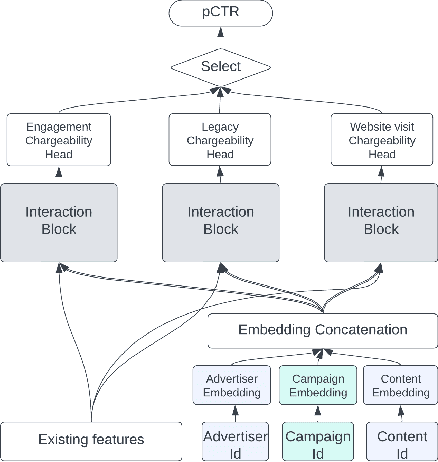

We present LiRank, a large-scale ranking framework at LinkedIn that brings to production state-of-the-art modeling architectures and optimization methods. We unveil several modeling improvements, including Residual DCN, which adds attention and residual connections to the famous DCNv2 architecture. We share insights into combining and tuning SOTA architectures to create a unified model, including Dense Gating, Transformers and Residual DCN. We also propose novel techniques for calibration and describe how we productionalized deep learning based explore/exploit methods. To enable effective, production-grade serving of large ranking models, we detail how to train and compress models using quantization and vocabulary compression. We provide details about the deployment setup for large-scale use cases of Feed ranking, Jobs Recommendations, and Ads click-through rate (CTR) prediction. We summarize our learnings from various A/B tests by elucidating the most effective technical approaches. These ideas have contributed to relative metrics improvements across the board at LinkedIn: +0.5% member sessions in the Feed, +1.76% qualified job applications for Jobs search and recommendations, and +4.3% for Ads CTR. We hope this work can provide practical insights and solutions for practitioners interested in leveraging large-scale deep ranking systems.
Bootstrapping Contrastive Learning Enhanced Music Cold-Start Matching
Aug 05, 2023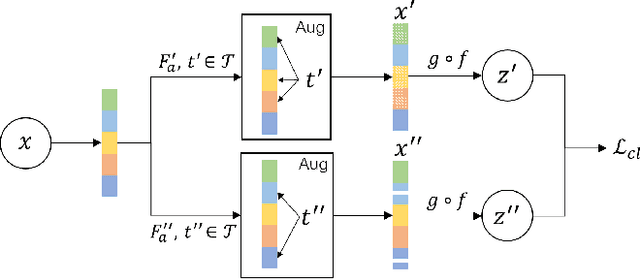

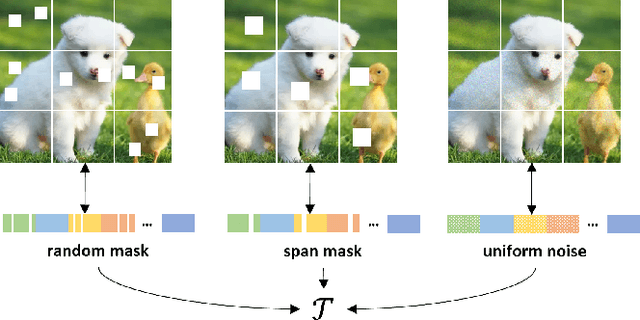
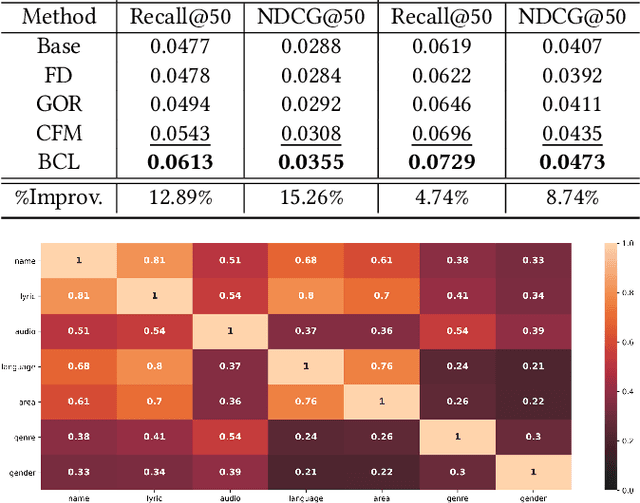
We study a particular matching task we call Music Cold-Start Matching. In short, given a cold-start song request, we expect to retrieve songs with similar audiences and then fastly push the cold-start song to the audiences of the retrieved songs to warm up it. However, there are hardly any studies done on this task. Therefore, in this paper, we will formalize the problem of Music Cold-Start Matching detailedly and give a scheme. During the offline training, we attempt to learn high-quality song representations based on song content features. But, we find supervision signals typically follow power-law distribution causing skewed representation learning. To address this issue, we propose a novel contrastive learning paradigm named Bootstrapping Contrastive Learning (BCL) to enhance the quality of learned representations by exerting contrastive regularization. During the online serving, to locate the target audiences more accurately, we propose Clustering-based Audience Targeting (CAT) that clusters audience representations to acquire a few cluster centroids and then locate the target audiences by measuring the relevance between the audience representations and the cluster centroids. Extensive experiments on the offline dataset and online system demonstrate the effectiveness and efficiency of our method. Currently, we have deployed it on NetEase Cloud Music, affecting millions of users. Code will be released in the future.
* Accepted by WWW'2023