 Add to Chrome
 Add to Firefox
 Add to Edge
Scalable Hyperparameter-Divergent Ensemble Training with Automatic Learning Rate Exploration for Large Models
Apr 27, 2026
Training large neural networks with data-parallel stochastic gradient descent allocates N GPU replicas to compute effectively identical updates -- a practice that leaves the rich space of learning rate configurations entirely unexplored during training. We propose Hyperparameter-Divergent Ensemble Training (HDET), a method that repurposes these replicas for simultaneous learning rate exploration at negligible communication overhead. HDET operates in alternating phases: a fan-out stage in which replicas train independently under a structured, symmetric spread of learning rates, and a converge stage in which parameters are averaged across all replicas via AllReduce every T steps. Building on this ensemble substrate, we further propose an automatic learning rate (auto-LR) controller that treats the relative training loss across replicas as a performance signal, updating the shared base schedule toward higher-performing configurations via a momentum-based gradient-free meta-update. The combined method produces a self-adapting learning rate schedule that improves both optimization quality and generalization without additional hyperparameter sweeps or training budget. Crucially, the framework generalizes beyond learning rate: any scalar hyperparameter that does not alter model architecture -- such as dropout rate, attention scale temperature, or weight-decay coefficient -- can be explored across replicas using the same fan-out/converge protocol, with inter-replica loss differences serving as zero-order hypergradients that guide the search direction. HDET is implemented as a drop-in replacement for PyTorch's OneCycleLR scheduler, requiring no changes to model architecture, optimizer, or data pipeline.

An Industrial-Scale Sequential Recommender for LinkedIn Feed Ranking
Feb 12, 2026LinkedIn Feed enables professionals worldwide to discover relevant content, build connections, and share knowledge at scale. We present Feed Sequential Recommender (Feed-SR), a transformer-based sequential ranking model for LinkedIn Feed that replaces a DCNv2-based ranker and meets strict production constraints. We detail the modeling choices, training techniques, and serving optimizations that enable deployment at LinkedIn scale. Feed-SR is currently the primary member experience on LinkedIn's Feed and shows significant improvements in member engagement (+2.10% time spent) in online A/B tests compared to the existing production model. We also describe our deployment experience with alternative sequential and LLM-based ranking architectures and why Feed-SR provided the best combination of online metrics and production efficiency.
Large Scale Retrieval for the LinkedIn Feed using Causal Language Models
Oct 16, 2025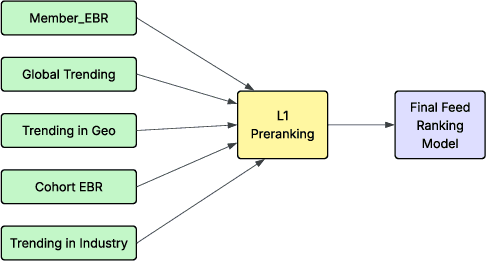
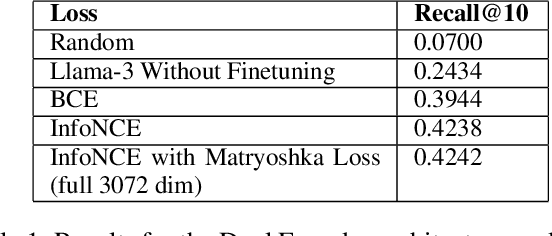
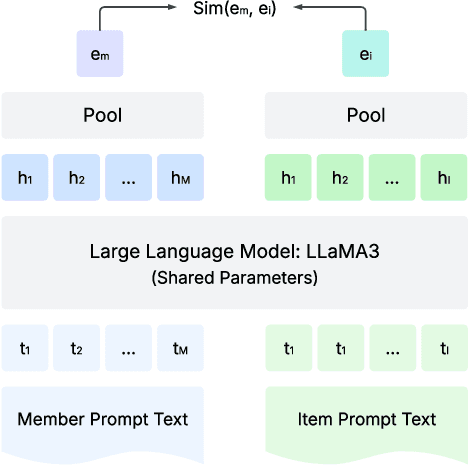
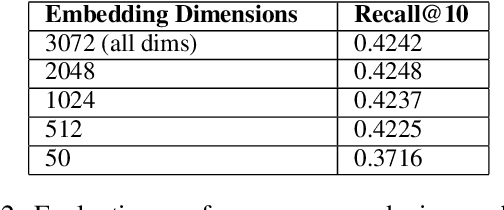
In large scale recommendation systems like the LinkedIn Feed, the retrieval stage is critical for narrowing hundreds of millions of potential candidates to a manageable subset for ranking. LinkedIn's Feed serves suggested content from outside of the member's network (based on the member's topical interests), where 2000 candidates are retrieved from a pool of hundreds of millions candidate with a latency budget of a few milliseconds and inbound QPS of several thousand per second. This paper presents a novel retrieval approach that fine-tunes a large causal language model (Meta's LLaMA 3) as a dual encoder to generate high quality embeddings for both users (members) and content (items), using only textual input. We describe the end to end pipeline, including prompt design for embedding generation, techniques for fine-tuning at LinkedIn's scale, and infrastructure for low latency, cost effective online serving. We share our findings on how quantizing numerical features in the prompt enables the information to get properly encoded in the embedding, facilitating greater alignment between the retrieval and ranking layer. The system was evaluated using offline metrics and an online A/B test, which showed substantial improvements in member engagement. We observed significant gains among newer members, who often lack strong network connections, indicating that high-quality suggested content aids retention. This work demonstrates how generative language models can be effectively adapted for real time, high throughput retrieval in industrial applications.