 Add to Chrome
 Add to Firefox
 Add to Edge
Learning to Rotate: Temporal and Semantic Rotary Encoding for Sequential Modeling
Apr 27, 2026
Every Transformer architecture dedicates enormous capacity to learning rich representations in semantic embedding space -- yet the rotation manifold acted upon by Rotary Positional Embeddings (RoPE) has been treated as a fixed, hand-crafted structure, populated only by discrete ordinal indices. We argue that this rotation space is a largely overlooked second dimension of expressivity in the attention mechanism, one whose systematic exploration may open a new door for attention-based architectures. The analogy to complex numbers is instructive: just as introducing the imaginary axis -- orthogonal to and independent of the real line -- unlocked new algebraic structure once believed impossible, treating the rotation manifold as a learnable, signal-conditioned space opens an orthogonal degree of freedom in attention. In this framing, the token embedding encodes the semantic (real) component of a representation -- what a token means -- while the rotation encodes its dynamic (imaginary) component -- how it relates to every other token across time, position, and context. We introduce SIREN-RoPE, a concrete instantiation of this idea, which populates the rotation dimension with heterogeneous signals -- continuous timestamps, cyclical temporal patterns, and categorical metadata -- via a dual-branch Sinusoidal Representation Network (SIREN). As a proof of concept, we evaluate on a production-scale news feed dataset from a major social network using a generative recommender as the ranking model, demonstrating that activating this hidden dimension yields consistent improvements across calibration and ranking objectives with negligible computational overhead. We invite the community to view the rotation space not as a solved positional-encoding detail, but as an untapped axis whose rich structure may prove as consequential for attention as the imaginary unit proved for algebra.

From Features to Transformers: Redefining Ranking for Scalable Impact
Feb 05, 2025We present LiGR, a large-scale ranking framework developed at LinkedIn that brings state-of-the-art transformer-based modeling architectures into production. We introduce a modified transformer architecture that incorporates learned normalization and simultaneous set-wise attention to user history and ranked items. This architecture enables several breakthrough achievements, including: (1) the deprecation of most manually designed feature engineering, outperforming the prior state-of-the-art system using only few features (compared to hundreds in the baseline), (2) validation of the scaling law for ranking systems, showing improved performance with larger models, more training data, and longer context sequences, and (3) simultaneous joint scoring of items in a set-wise manner, leading to automated improvements in diversity. To enable efficient serving of large ranking models, we describe techniques to scale inference effectively using single-pass processing of user history and set-wise attention. We also summarize key insights from various ablation studies and A/B tests, highlighting the most impactful technical approaches.
LiGNN: Graph Neural Networks at LinkedIn
Feb 17, 2024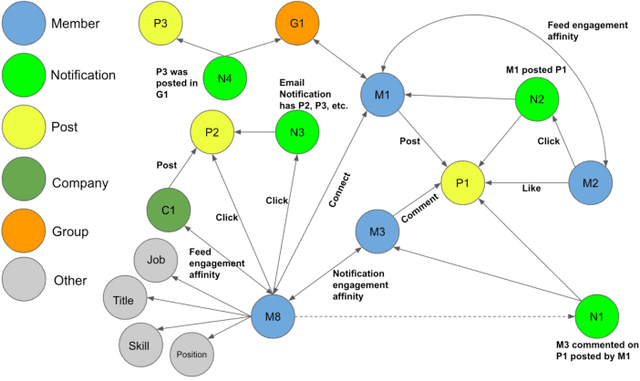
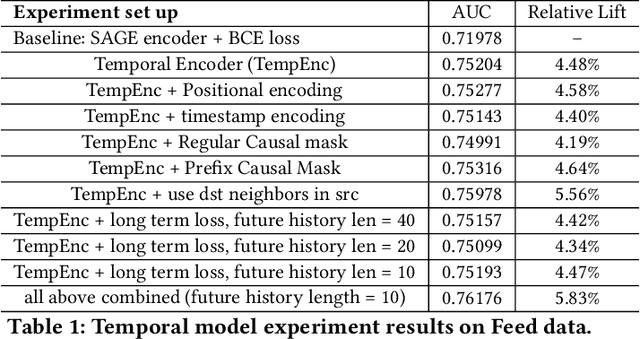
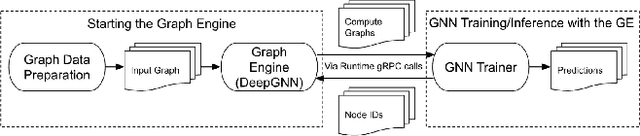
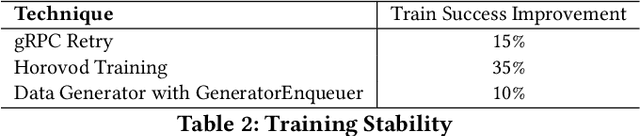
In this paper, we present LiGNN, a deployed large-scale Graph Neural Networks (GNNs) Framework. We share our insight on developing and deployment of GNNs at large scale at LinkedIn. We present a set of algorithmic improvements to the quality of GNN representation learning including temporal graph architectures with long term losses, effective cold start solutions via graph densification, ID embeddings and multi-hop neighbor sampling. We explain how we built and sped up by 7x our large-scale training on LinkedIn graphs with adaptive sampling of neighbors, grouping and slicing of training data batches, specialized shared-memory queue and local gradient optimization. We summarize our deployment lessons and learnings gathered from A/B test experiments. The techniques presented in this work have contributed to an approximate relative improvements of 1% of Job application hearing back rate, 2% Ads CTR lift, 0.5% of Feed engaged daily active users, 0.2% session lift and 0.1% weekly active user lift from people recommendation. We believe that this work can provide practical solutions and insights for engineers who are interested in applying Graph neural networks at large scale.
LiRank: Industrial Large Scale Ranking Models at LinkedIn
Feb 10, 2024

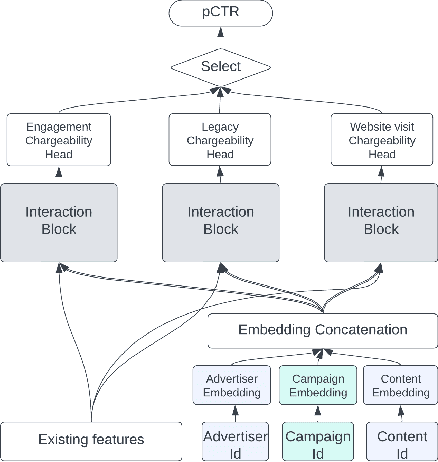

We present LiRank, a large-scale ranking framework at LinkedIn that brings to production state-of-the-art modeling architectures and optimization methods. We unveil several modeling improvements, including Residual DCN, which adds attention and residual connections to the famous DCNv2 architecture. We share insights into combining and tuning SOTA architectures to create a unified model, including Dense Gating, Transformers and Residual DCN. We also propose novel techniques for calibration and describe how we productionalized deep learning based explore/exploit methods. To enable effective, production-grade serving of large ranking models, we detail how to train and compress models using quantization and vocabulary compression. We provide details about the deployment setup for large-scale use cases of Feed ranking, Jobs Recommendations, and Ads click-through rate (CTR) prediction. We summarize our learnings from various A/B tests by elucidating the most effective technical approaches. These ideas have contributed to relative metrics improvements across the board at LinkedIn: +0.5% member sessions in the Feed, +1.76% qualified job applications for Jobs search and recommendations, and +4.3% for Ads CTR. We hope this work can provide practical insights and solutions for practitioners interested in leveraging large-scale deep ranking systems.