 Add to Chrome
 Add to Firefox
 Add to Edge
Data-centric Design of Learning-based Surgical Gaze Perception Models in Multi-Task Simulation
Feb 09, 2026
In robot-assisted minimally invasive surgery (RMIS), reduced haptic feedback and depth cues increase reliance on expert visual perception, motivating gaze-guided training and learning-based surgical perception models. However, operative expert gaze is costly to collect, and it remains unclear how the source of gaze supervision, both expertise level (intermediate vs. novice) and perceptual modality (active execution vs. passive viewing), shapes what attention models learn. We introduce a paired active-passive, multi-task surgical gaze dataset collected on the da Vinci SimNow simulator across four drills. Active gaze was recorded during task execution using a VR headset with eye tracking, and the corresponding videos were reused as stimuli to collect passive gaze from observers, enabling controlled same-video comparisons. We quantify skill- and modality-dependent differences in gaze organization and evaluate the substitutability of passive gaze for operative supervision using fixation density overlap analyses and single-frame saliency modeling. Across settings, MSI-Net produced stable, interpretable predictions, whereas SalGAN was unstable and often poorly aligned with human fixations. Models trained on passive gaze recovered a substantial portion of intermediate active attention, but with predictable degradation, and transfer was asymmetric between active and passive targets. Notably, novice passive labels approximated intermediate-passive targets with limited loss on higher-quality demonstrations, suggesting a practical path for scalable, crowd-sourced gaze supervision in surgical coaching and perception modeling.

Three Degree-of-Freedom Soft Continuum Kinesthetic Haptic Display for Telemanipulation Via Sensory Substitution at the Finger
Sep 17, 2024
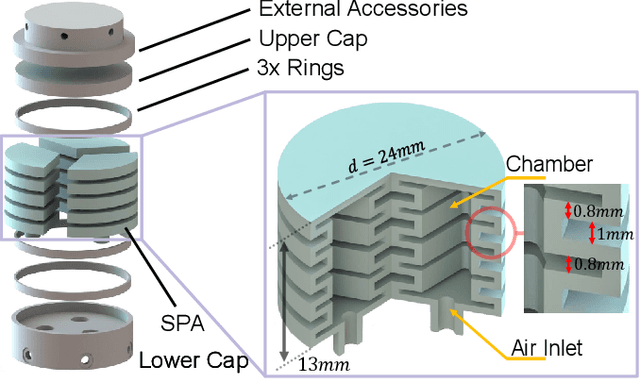


Sensory substitution is an effective approach for displaying stable haptic feedback to a teleoperator under time delay. The finger is highly articulated, and can sense movement and force in many directions, making it a promising location for sensory substitution based on kinesthetic feedback. However, existing finger kinesthetic devices either provide only one-degree-of-freedom feedback, are bulky, or have low force output. Soft pneumatic actuators have high power density, making them suitable for realizing high force kinesthetic feedback in a compact form factor. We present a soft pneumatic handheld kinesthetic feedback device for the index finger that is controlled using a constant curvature kinematic model. \changed{It has respective position and force ranges of +-3.18mm and +-1.00N laterally, and +-4.89mm and +-6.01N vertically, indicating its high power density and compactness. The average open-loop radial position and force accuracy of the kinematic model are 0.72mm and 0.34N.} Its 3Hz bandwidth makes it suitable for moderate speed haptic interactions in soft environments. We demonstrate the three-dimensional kinesthetic force feedback capability of our device for sensory substitution at the index figure in a virtual telemanipulation scenario.
Performance Analysis and Optimal Design of HARQ-IR-Aided Terahertz Communications
Apr 22, 2023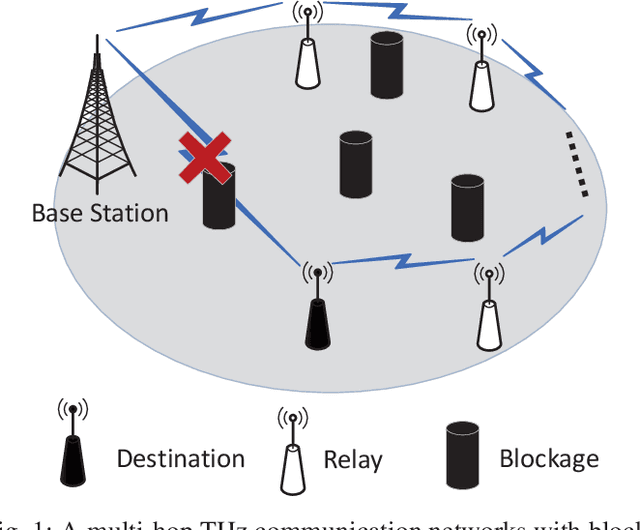
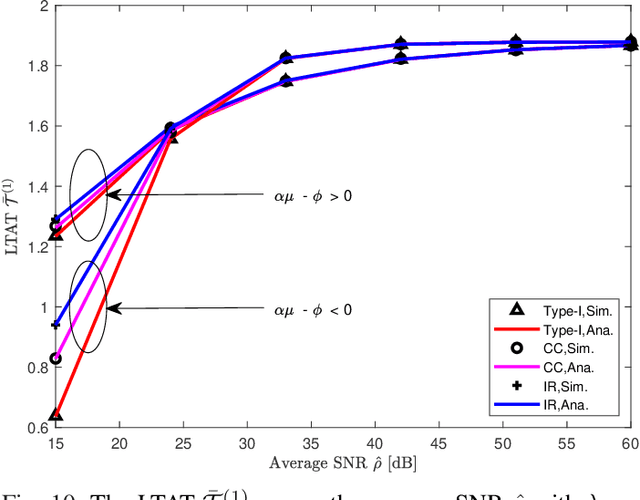
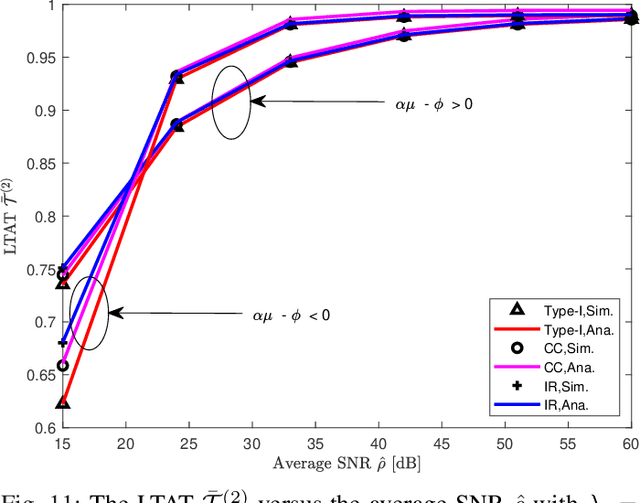
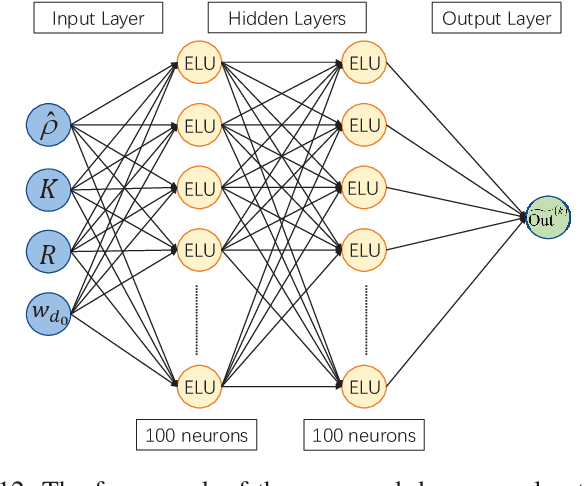
Terahertz (THz) communications are envisioned to be a promising technology for 6G thanks to its broad bandwidth. However, the large path loss, antenna misalignment, and atmospheric influence of THz communications severely deteriorate its reliability. To address this, hybrid automatic repeat request (HARQ) is recognized as an effective technique to ensure reliable THz communications. This paper delves into the performance analysis of HARQ with incremental redundancy (HARQ-IR)-aided THz communications in the presence/absence of blockage. More specifically, the analytical expression of the outage probability of HARQ-IR-aided THz communications is derived, with which the asymptotic outage analysis is enabled to gain meaningful insights, including diversity order, power allocation gain, modulation and coding gain, etc. Then the long term average throughput (LTAT) is expressed in terms of the outage probability based on renewal theory. Moreover, to combat the blockage effects, a multi-hop HARQ-IR-aided THz communication scheme is proposed and its performance is examined. To demonstrate the superiority of the proposed scheme, the other two HARQ-aided schemes, i.e., Type-I HARQ and HARQ with chase combining (HARQ-CC), are used for benchmarking in the simulations. In addition, a deep neural network (DNN) based outage evaluation framework with low computational complexity is devised to reap the benefits of using both asymptotic and simulation results in low and high outage regimes, respectively. This novel outage evaluation framework is finally employed for the optimal rate selection, which outperforms the asymptotic based optimization.