 Add to Chrome
 Add to Firefox
 Add to Edge
A Computationally Efficient Likelihood Approximation for Target Tracking in Time-Varying Multipath Channels
Aug 20, 2026
Active sonar target tracking in shallow-water environments is challenging when weak target echoes are embedded in a time-varying background containing structured multipath components. Conventional detect-before-track methods rely on thresholded detections, which may discard weak target evidence or generate false tracks from multipath-induced detections. At low signal-to-noise ratios, track-before-detect filtering can improve tracking performance by exploiting weak target information directly from raw sensor measurements, but directly accounting for the time-varying background leads to a joint target--background inference problem, which is computationally demanding. To address this, this paper develops a physics-motivated and computationally efficient approximation of the raw sensor measurement likelihood for Bernoulli track-before-detect filtering. The multipath components in the background are modeled in the raw sensor measurement domain and recursively tracked using an extended Kalman filter. By neglecting the posterior dependence between the target and background state, the predicted background statistics are used to construct approximate target-present and target-absent likelihoods for the Bernoulli filter. Evaluations using measurements generated from the statistical model and BELLHOP show improved target-confirmation and localization performance over constant-false-alarm-rate-based tracking. These results indicate that explicitly accounting for the background through a computationally tractable approximate likelihood can exploit weak target information without requiring full joint target--background inference.

Bernoulli Filtering for Multi-Sensor Tracking with Thresholded Measurements
Jun 08, 2026Target tracking is challenging when sensor detection thresholds cause state-dependent missed detections, particularly in multi-sensor scenarios with clutter and uncertain target existence. A recently developed missed detection framework models detection probability as a function of target state, sensor characteristics, and detection threshold, but it is limited to individual measurements and does not address the recursive tracking problem. This work extends the framework using a Bernoulli filter formulation to jointly handle recursive target tracking, clutter, and target existence uncertainty. A Bernoulli particle filter is evaluated in a simulated 2D multi-sensor tracking scenario with nonlinear measurements, clutter, and detection uncertainty. Incorporating accurate detection threshold knowledge reduces the generalized optimal subpattern assignment (GOSPA) metric by 62.4% compared to a conventional Bernoulli filter with fixed detection probability, while better balancing missed detections and false alarms.
Utilizing Missed Detections in Directional Sensitivity-Based DOA Estimation
May 22, 2026This paper introduces a signal strength-based direction of arrival (DOA) estimation approach for directional sensors that explicitly accounts for missed detections. In traditional phase-based DOA estimation frameworks, negative information from expected emitters that fall below the detection threshold fall outside the scope of standard measurement models. Unlike phase-based DOA estimation methods, the proposed approach relies only on received signal strength measurements. As a result, missed detections arise naturally from the sensing and detection process and convey valuable information via the known detection thresholds. By incorporating both detected signals and missed detections into the likelihood function, we develop a probabilistic estimation method that fully leverages the underlying measurement and detection models. Simulation results show that the proposed method significantly improves DOA estimation accuracy compared to baseline techniques, particularly in challenging scenarios with high missed-detection rates. Real-world experiments using Bluetooth Low Energy (BLE) signals and directional antennas further validate the effectiveness of the approach, demonstrating substantial performance gains. These findings highlight the value of modeling missed detections in sensor array processing and open new avenues for enhancing localization performance in wireless communication systems.
B$^2$F-Map: Crowd-sourced Mapping with Bayesian B-spline Fusion
Mar 02, 2026Crowd-sourced mapping offers a scalable alternative to creating maps using traditional survey vehicles. Yet, existing methods either rely on prior high-definition (HD) maps or neglect uncertainties in the map fusion. In this work, we present a complete pipeline for HD map generation using production vehicles equipped only with a monocular camera, consumer-grade GNSS, and IMU. Our approach includes on-cloud localization using lightweight standard-definition maps, on-vehicle mapping via an extended object trajectory (EOT) Poisson multi-Bernoulli (PMB) filter with Gibbs sampling, and on-cloud multi-drive optimization and Bayesian map fusion. We represent the lane lines using B-splines, where each B-spline is parameterized by a sequence of Gaussian distributed control points, and propose a novel Bayesian fusion framework for B-spline trajectories with differing density representation, enabling principled handling of uncertainties. We evaluate our proposed approach, B$^2$F-Map, on large-scale real-world datasets collected across diverse driving conditions and demonstrate that our method is able to produce geometrically consistent lane-level maps.
Tracking Time-Varying Multipath Channels forActive Sonar Applications
Feb 17, 2026Reliable detection and tracking in active sonar require accurate and efficient learning of the acoustic multipath background environment. Conventionally, background learning is performed after transforming measurements into the range-Doppler domain, a step that is computationally expensive and can obscure phase-coherent structure useful for monitoring and tracking. This paper proposes a framework for learning and tracking the multipath background directly in the raw measurement domain. Starting from a wideband Doppler linearization of the impulse response of a time-varying multipath channel, a state-space model with a heteroscedastic measurement equation is derived. This model enables channel tracking using an extended Kalman filter (EKF), and unknown model parameters are learned from the marginalized likelihood. The statistical adequacy of the proposed models is assessed via a p-value significance test. Finally, this paper integrates the learned channel model into a sequential likelihood-ratio test for target detection. BELLHOP-based simulations show that the proposed model better captures channel dynamics induced by sea-surface fluctuations and transmitter and receiver drift, yielding more reliable detection in time-varying shallow-water environments
Localization Exploiting Spatial Variations in the Magnetic Field: Principles and Challenges
Feb 15, 2026Signal processing has played, and continues to play, a fundamental role in the evolution of modern localization technologies. Localization using spatial variations in the Earth's magnetic field is no exception. It relies on signal-processing methods for statistical state inference, magnetic-field modeling, and sensor calibration. Contemporary localization techniques based on spatial variations in the magnetic field can provide decimeter-level indoor localization accuracy and outdoor localization accuracy on par with strategic-grade inertial navigation systems. This article provides a broad, high-level overview of current signal-processing principles and open research challenges in localization using spatial variations in the Earth's magnetic field. The aim is to provide the reader with an understanding of the similarities and differences among existing key technologies from a statistical signal-processing perspective. To that end, existing key technologies will be presented within a common parametric signal-model framework compatible with well-established statistical inference methods.
Inertial Magnetic SLAM Systems Using Low-Cost Sensors
Dec 10, 2025Spatially inhomogeneous magnetic fields offer a valuable, non-visual information source for positioning. Among systems leveraging this, magnetic field-based simultaneous localization and mapping (SLAM) systems are particularly attractive because they can provide positioning information and build a magnetic field map on the fly. Moreover, they have bounded error within mapped regions. However, state-of-the-art methods typically require low-drift odometry data provided by visual odometry or a wheel encoder, etc. This is because these systems need to minimize/reduce positioning errors while exploring, which happens when they are in unmapped regions. To address these limitations, this work proposes a loosely coupled and a tightly coupled inertial magnetic SLAM (IM-SLAM) system. The proposed systems use commonly available low-cost sensors: an inertial measurement unit (IMU), a magnetometer array, and a barometer. The use of non-visual data provides a significant advantage over visual-based systems, making it robust to low-visibility conditions. Both systems employ state-space representations, and magnetic field models on different scales. The difference lies in how they use a local and global magnetic field model. The loosely coupled system uses these models separately in two state-space models, while the tightly coupled system integrates them into one state-space model. Experiment results show that the tightly coupled IM-SLAM system achieves lower positioning errors than the loosely coupled system in most scenarios, with typical errors on the order of meters per 100 meters traveled. These results demonstrate the feasiblity of developing a full 3D IM-SLAM systems using low-cost sensors and the potential of applying these systems in emergency response scenarios such as mine/fire rescue.
Road Roughness Estimation via Fusion of Standard Onboard Automotive Sensors
Jul 16, 2025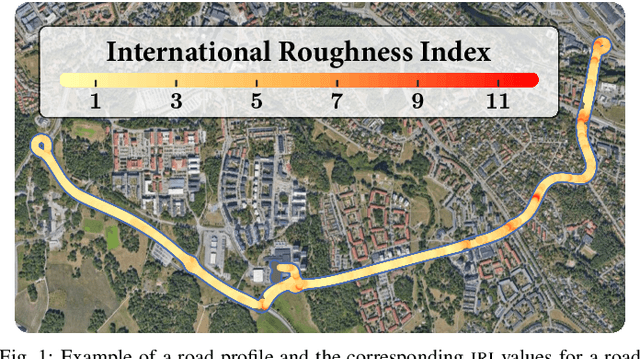
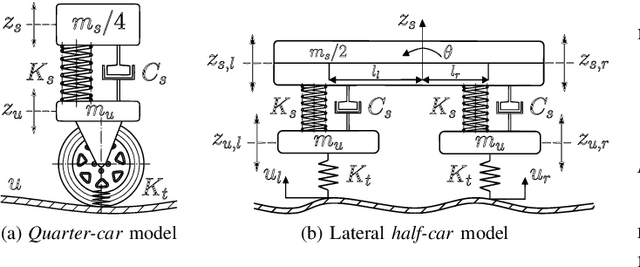
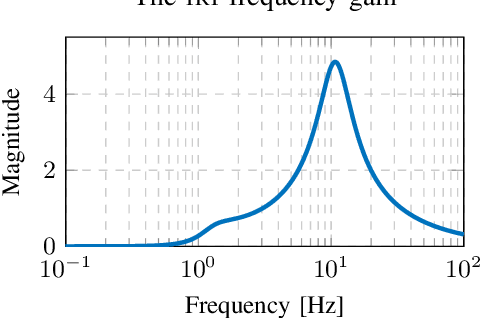
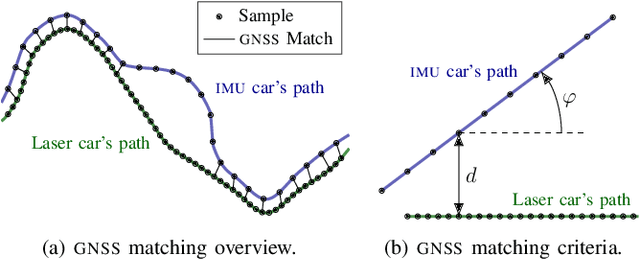
Road roughness significantly affects vehicle vibrations and ride quality. We introduce a Kalman filter (KF)-based method for estimating road roughness in terms of the international roughness index (IRI) by fusing inertial and speed measurements, offering a cost-effective solution for pavement monitoring. The method involves system identification on a physical vehicle to estimate realistic model parameters, followed by KF-based reconstruction of the longitudinal road profile to compute IRI values. It explores IRI estimation using vertical and lateral vibrations, the latter more common in modern vehicles. Validation on 230 km of real-world data shows promising results, with IRI estimation errors ranging from 1% to 10% of the reference values. However, accuracy deteriorates significantly when using only lateral vibrations, highlighting their limitations. These findings demonstrate the potential of KF-based estimation for efficient road roughness monitoring.
Performance Analysis of Communication Signals for Localization in Underwater Sensor Networks
Jun 16, 2025
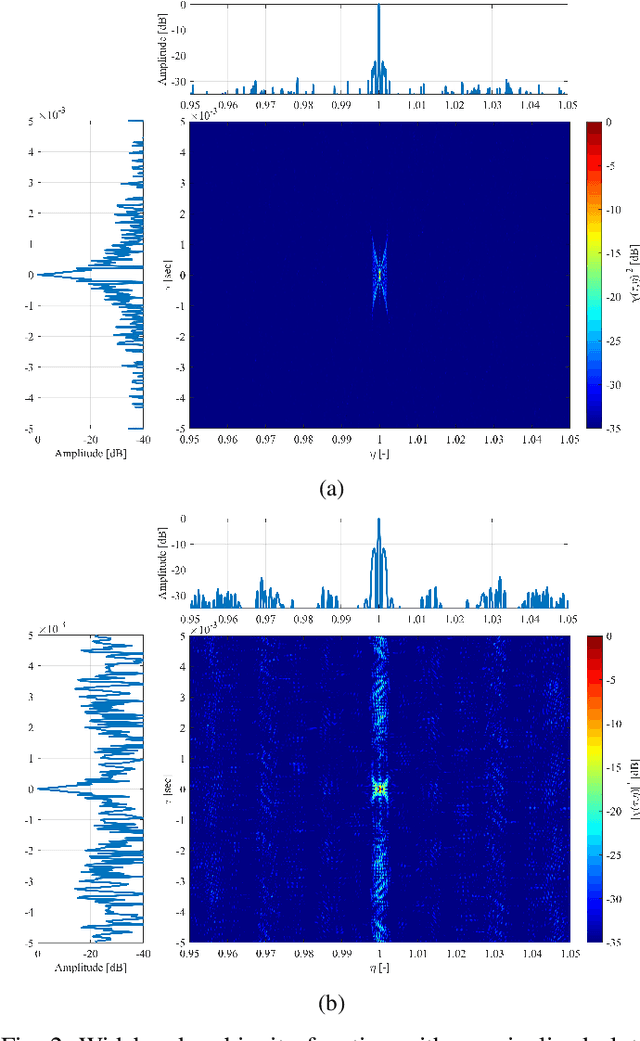
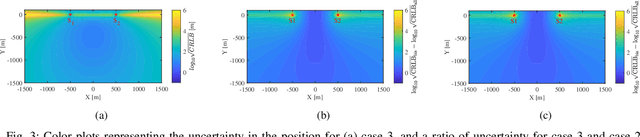
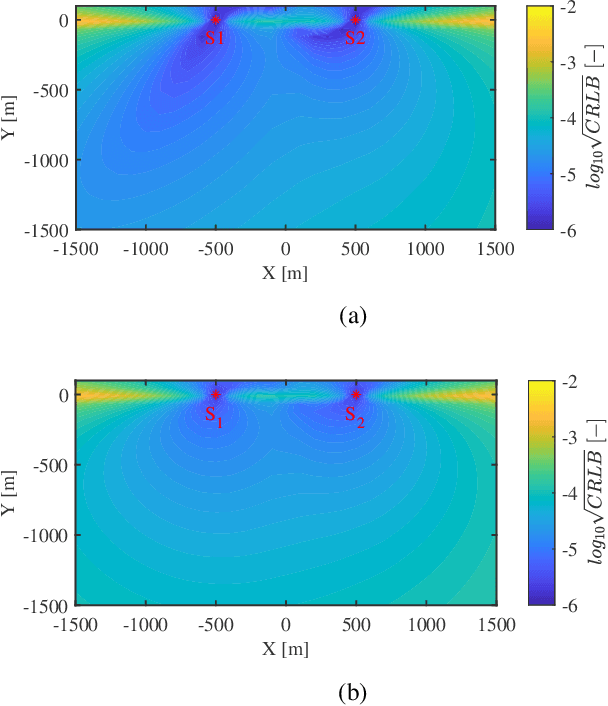
Fusion of passive and active measurements from sensor nodes becomes critical in localizing underwater objects and is traditionally achieved by communicating information to a central node. This causes significant inefficiencies in bandwidth, energy, and processing time, which are critical in marine applications. With integrated sensing and communication (ISAC) systems, the process of sensing, localization, and communication can be achieved jointly, and the inefficiencies can be minimized. Thus, the primary objective of this study is to analyse the efficacy of such communication signals in localizing a moving target in given underwater conditions. The Cram\'er-Rao Lower Bound (CRLB) is a performance metric used to determine the theoretical lower bound on localization errors. Simulation results illustrate the contours of localization error across various scenarios, offering valuable insights into system performance under different target dynamics and sea state conditions, showcasing their potential for efficient and reliable underwater localization applications.
Joint Magnetometer-IMU Calibration via Maximum A Posteriori Estimation
May 22, 2025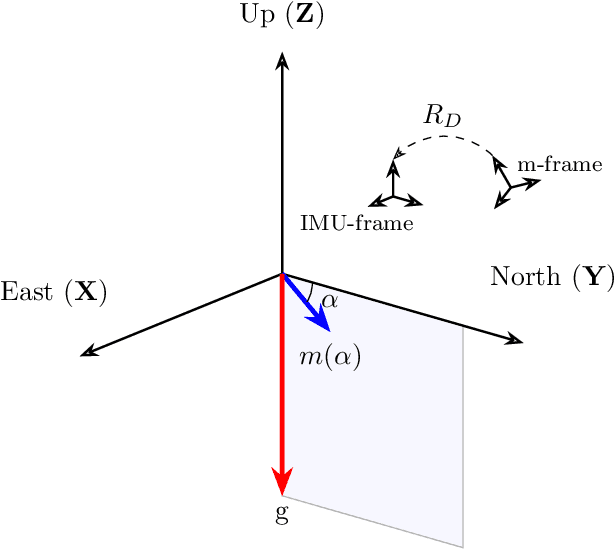
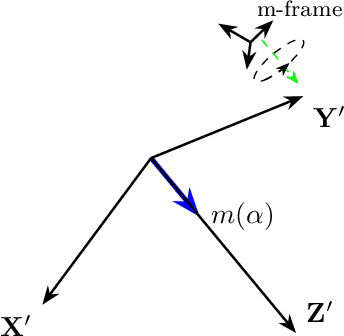
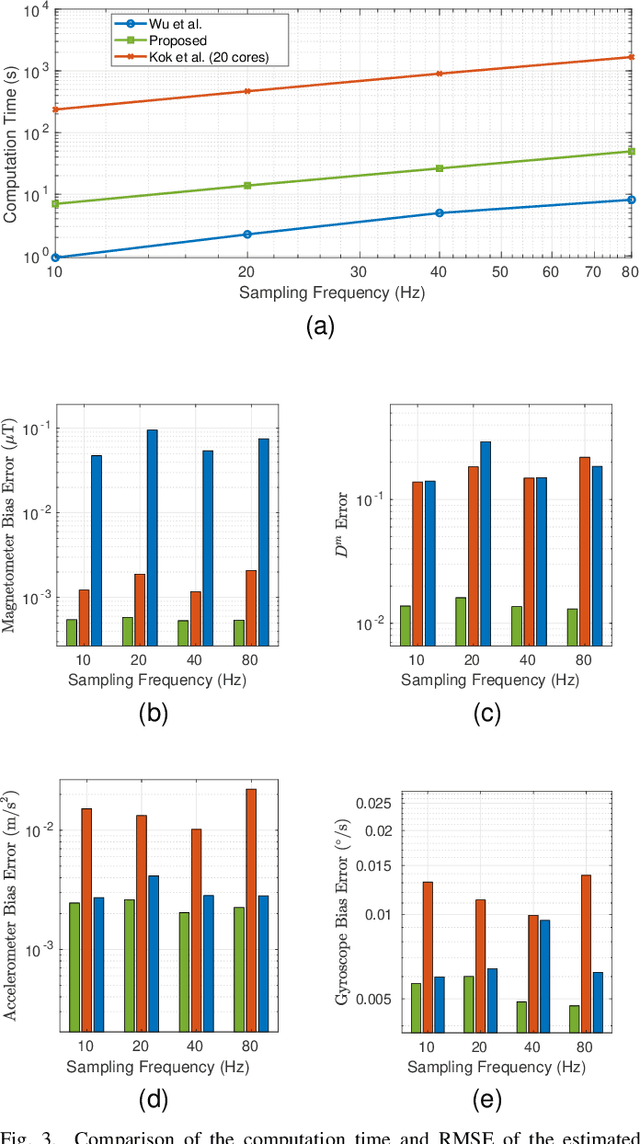
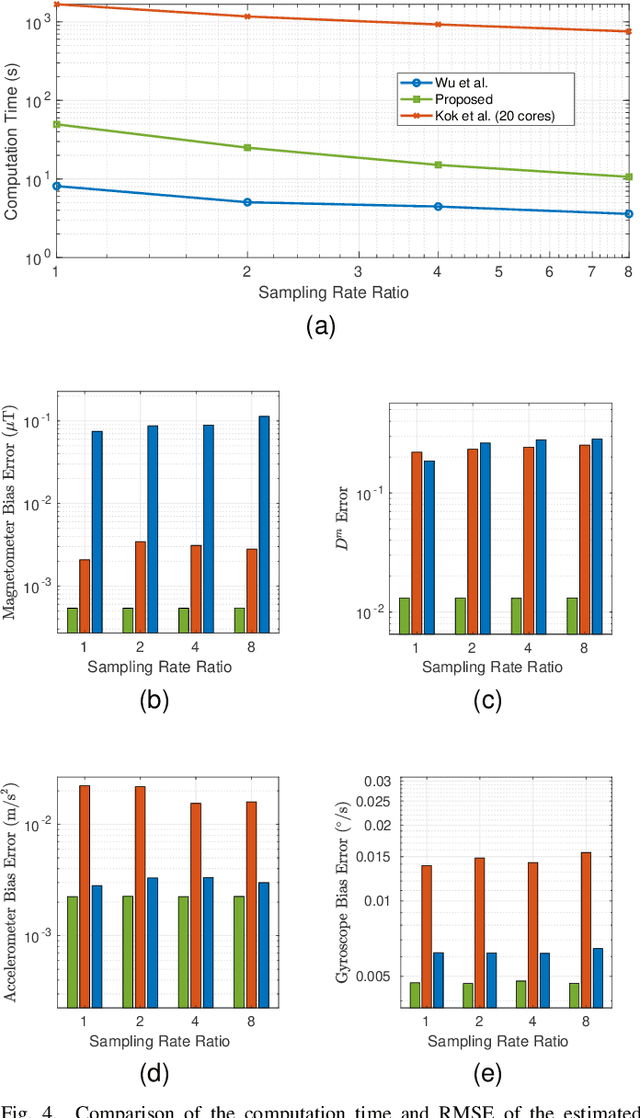
This paper presents a new approach for jointly calibrating magnetometers and inertial measurement units, focusing on improving calibration accuracy and computational efficiency. The proposed method formulates the calibration problem as a maximum a posteriori estimation problem, treating both the calibration parameters and orientation trajectory of the sensors as unknowns. This formulation enables efficient optimization with closed-form derivatives. The method is compared against two state-of-the-art approaches in terms of computational complexity and estimation accuracy. Simulation results demonstrate that the proposed method achieves lower root mean square error in calibration parameters while maintaining competitive computational efficiency. Further validation through real-world experiments confirms the practical benefits of our approach: it effectively reduces position drift in a magnetic field-aided inertial navigation system by more than a factor of two on most datasets. Moreover, the proposed method calibrated 30 magnetometers in less than 2 minutes. The contributions include a new calibration method, an analysis of existing methods, and a comprehensive empirical evaluation. Datasets and algorithms are made publicly available to promote reproducible research.