 Add to Chrome
 Add to Firefox
 Add to Edge
A Computationally Efficient Likelihood Approximation for Target Tracking in Time-Varying Multipath Channels
Aug 20, 2026
Active sonar target tracking in shallow-water environments is challenging when weak target echoes are embedded in a time-varying background containing structured multipath components. Conventional detect-before-track methods rely on thresholded detections, which may discard weak target evidence or generate false tracks from multipath-induced detections. At low signal-to-noise ratios, track-before-detect filtering can improve tracking performance by exploiting weak target information directly from raw sensor measurements, but directly accounting for the time-varying background leads to a joint target--background inference problem, which is computationally demanding. To address this, this paper develops a physics-motivated and computationally efficient approximation of the raw sensor measurement likelihood for Bernoulli track-before-detect filtering. The multipath components in the background are modeled in the raw sensor measurement domain and recursively tracked using an extended Kalman filter. By neglecting the posterior dependence between the target and background state, the predicted background statistics are used to construct approximate target-present and target-absent likelihoods for the Bernoulli filter. Evaluations using measurements generated from the statistical model and BELLHOP show improved target-confirmation and localization performance over constant-false-alarm-rate-based tracking. These results indicate that explicitly accounting for the background through a computationally tractable approximate likelihood can exploit weak target information without requiring full joint target--background inference.

Tracking Time-Varying Multipath Channels forActive Sonar Applications
Feb 17, 2026Reliable detection and tracking in active sonar require accurate and efficient learning of the acoustic multipath background environment. Conventionally, background learning is performed after transforming measurements into the range-Doppler domain, a step that is computationally expensive and can obscure phase-coherent structure useful for monitoring and tracking. This paper proposes a framework for learning and tracking the multipath background directly in the raw measurement domain. Starting from a wideband Doppler linearization of the impulse response of a time-varying multipath channel, a state-space model with a heteroscedastic measurement equation is derived. This model enables channel tracking using an extended Kalman filter (EKF), and unknown model parameters are learned from the marginalized likelihood. The statistical adequacy of the proposed models is assessed via a p-value significance test. Finally, this paper integrates the learned channel model into a sequential likelihood-ratio test for target detection. BELLHOP-based simulations show that the proposed model better captures channel dynamics induced by sea-surface fluctuations and transmitter and receiver drift, yielding more reliable detection in time-varying shallow-water environments
Performance Analysis of Communication Signals for Localization in Underwater Sensor Networks
Jun 16, 2025
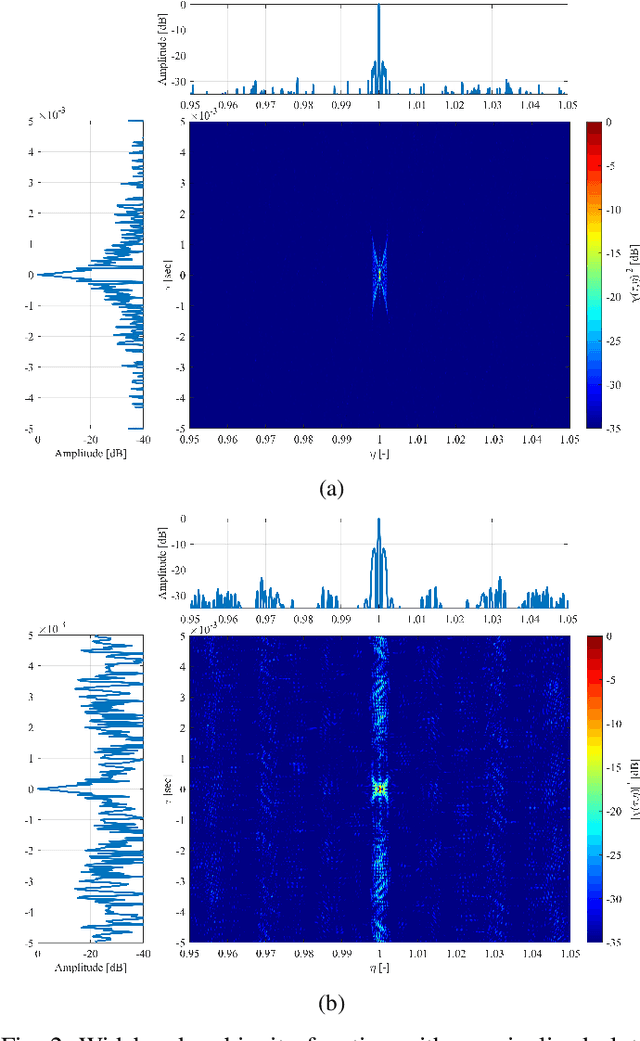
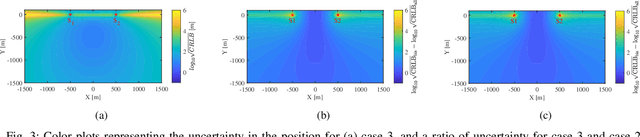
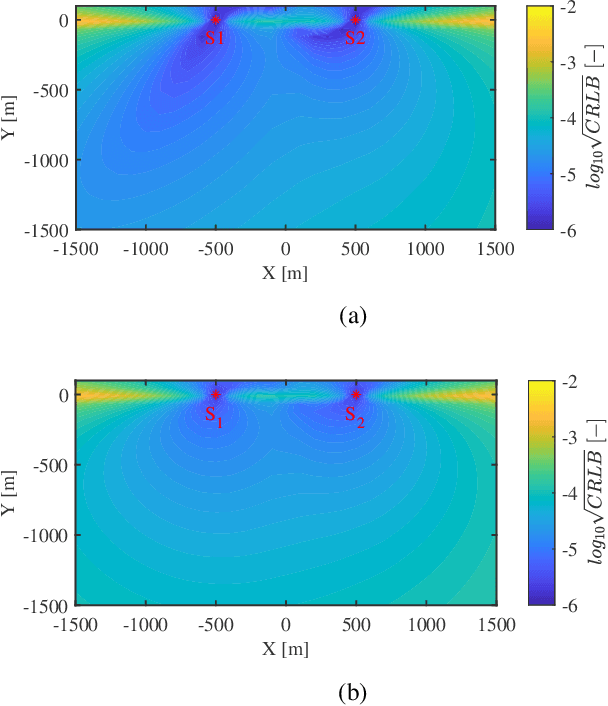
Fusion of passive and active measurements from sensor nodes becomes critical in localizing underwater objects and is traditionally achieved by communicating information to a central node. This causes significant inefficiencies in bandwidth, energy, and processing time, which are critical in marine applications. With integrated sensing and communication (ISAC) systems, the process of sensing, localization, and communication can be achieved jointly, and the inefficiencies can be minimized. Thus, the primary objective of this study is to analyse the efficacy of such communication signals in localizing a moving target in given underwater conditions. The Cram\'er-Rao Lower Bound (CRLB) is a performance metric used to determine the theoretical lower bound on localization errors. Simulation results illustrate the contours of localization error across various scenarios, offering valuable insights into system performance under different target dynamics and sea state conditions, showcasing their potential for efficient and reliable underwater localization applications.