 Add to Chrome
 Add to Firefox
 Add to Edge
HiFloat4 Format for End-To-End Reinforcement Learning Post-Training of Large Language Models
Jul 29, 2026
We present, to our knowledge, the first end-to-end FP4 RL post-training, in which both the rollout and training policies, including their forward and backward passes, operate at 4-bit precision. A systematic study reveals that the dominant source of degradation in FP4 RL is not training-side quantization error but rollout activation quantization: outliers stretch the dynamic range so far that a large number of activation values underflow to zero under FP4. Counterintuitively, restoring the training policy to higher precision while keeping the rollout in FP4 makes accuracy worse than full FP4 baseline, exposing rollout-training mismatch as the principal failure mode and ruling out standard pretraining-style fixes. We address this with Rollout Residual Quantization (Rollout-ResQ): a single residual correction term constrained to a hardware-friendly sparsity pattern, added only to the FP4 rollout matmul -- a lightweight correction that recovers most of the precision lost to outlier-driven underflow without inflating the rollout's compute footprint. On Qwen2.5-3B and Qwen2.5-Math-7B, Rollout-ResQ paired with the HiFloat4 (HiF4) format -- whose three-level hierarchical scaling preserves resolution under FP4's tight 4-bit budget -- closes the accuracy gap to BF16 from 4.9% to 1.1%, bringing fully quantized FP4 RL within striking distance of full precision. Applied to the open-standard MXFP4, the same recipe narrows the gap from 13.6% to 5.3%, revealing that FP4 format choice is a key factor that determines the ceiling on recoverable accuracy. Together, these results establish HiF4 as the enabling format for end-to-end FP4 RL post-training, and Rollout-ResQ as the activation-side mechanism that makes the gap to BF16 closable.

HiFloat4 Format for Language Model Inference
Feb 13, 2026This paper introduces HiFloat4 (HiF4), a block floating-point data format tailored for deep learning. Each HiF4 unit packs 64 4-bit elements with 32 bits of shared scaling metadata, averaging 4.5 bits per value. The metadata specifies a three-level scaling hierarchy, capturing inter- and intra-group dynamic range while improving the utilization of the representational space. In addition, the large 64-element group size enables matrix multiplications to be executed in a highly fixed-point manner, significantly reducing hardware area and power consumption. To evaluate the proposed format, we conducted inference experiments on several language models, including LLaMA, Qwen, Mistral, DeepSeek-V3.1 and LongCat. Results show that HiF4 achieves higher average accuracy than the state-of-the-art NVFP4 format across multiple models and diverse downstream tasks.
Ascend HiFloat8 Format for Deep Learning
Sep 26, 2024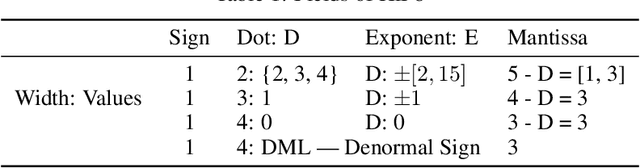

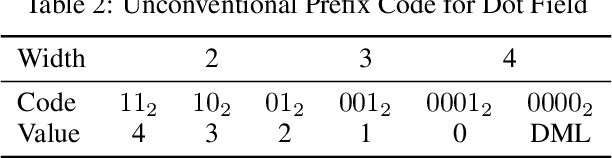

This preliminary white paper proposes a novel 8-bit floating-point data format HiFloat8 (abbreviated as HiF8) for deep learning. HiF8 features tapered precision. For normal value encoding, it provides 7 exponent values with 3-bit mantissa, 8 exponent values with 2-bit mantissa, and 16 exponent values with 1-bit mantissa. For denormal value encoding, it extends the dynamic range by 7 extra powers of 2, from 31 to 38 binades (notice that FP16 covers 40 binades). Meanwhile, HiF8 encodes all the special values except that positive zero and negative zero are represented by only one bit-pattern. Thanks to the better balance between precision and dynamic range, HiF8 can be simultaneously used in both forward and backward passes of AI training. In this paper, we will describe the definition and rounding methods of HiF8, as well as the tentative training and inference solutions. To demonstrate the efficacy of HiF8, massive simulation results on various neural networks, including traditional neural networks and large language models (LLMs), will also be presented.