 Add to Chrome
 Add to Firefox
 Add to Edge
HiFloat4 Format for End-To-End Reinforcement Learning Post-Training of Large Language Models
Jul 29, 2026
We present, to our knowledge, the first end-to-end FP4 RL post-training, in which both the rollout and training policies, including their forward and backward passes, operate at 4-bit precision. A systematic study reveals that the dominant source of degradation in FP4 RL is not training-side quantization error but rollout activation quantization: outliers stretch the dynamic range so far that a large number of activation values underflow to zero under FP4. Counterintuitively, restoring the training policy to higher precision while keeping the rollout in FP4 makes accuracy worse than full FP4 baseline, exposing rollout-training mismatch as the principal failure mode and ruling out standard pretraining-style fixes. We address this with Rollout Residual Quantization (Rollout-ResQ): a single residual correction term constrained to a hardware-friendly sparsity pattern, added only to the FP4 rollout matmul -- a lightweight correction that recovers most of the precision lost to outlier-driven underflow without inflating the rollout's compute footprint. On Qwen2.5-3B and Qwen2.5-Math-7B, Rollout-ResQ paired with the HiFloat4 (HiF4) format -- whose three-level hierarchical scaling preserves resolution under FP4's tight 4-bit budget -- closes the accuracy gap to BF16 from 4.9% to 1.1%, bringing fully quantized FP4 RL within striking distance of full precision. Applied to the open-standard MXFP4, the same recipe narrows the gap from 13.6% to 5.3%, revealing that FP4 format choice is a key factor that determines the ceiling on recoverable accuracy. Together, these results establish HiF4 as the enabling format for end-to-end FP4 RL post-training, and Rollout-ResQ as the activation-side mechanism that makes the gap to BF16 closable.

SiPhy: Single-Image Physical Property Reasoning
Jul 24, 2026Inferring physical properties such as mass, stiffness, and elasticity from a single image is essential for simulation and embodied AI, yet most existing approaches rely on multi-view reconstruction or physics-based supervision. We introduce SiPhy, a unified framework for single-image physical property reasoning that aligns 3D-aware visual cues, depth with language-based material knowledge. From one RGB image, SiPhy samples pseudo-voxel points, extracts CLIP features, and grounds them to material candidates proposed by a VLM. A part-based contrastive aggregator enforces region consistency, while a heaviness-aware refinement improves thickness and volume estimation for dense objects. Across ABO-500, MVImgNet-100, and PhysXNet-100, SiPhy achieves state-of-the-art single-image performance, surpassing multi-view reconstruction methods by improving mass MnRE by up to 93% (vs. PUGS), reducing density MAE by 35.5% (vs. NeRF2Physics), and lowering Young's modulus error by 23.5%. We further validate SiPhy on real hand-object interaction datasets, demonstrating its potential as a data annotation engine for physical understanding from single-view imagery.
Domain-Adapted Fine-Tuning of ECG Foundation Models for Multi-Label Structural Heart Disease Screening
Apr 25, 2026Transthoracic echocardiography is the reference standard for confirming structural heart disease (SHD), but first-line screening is limited by cost, workflow burden, and specialist availability. We evaluated whether open pretrained electrocardiogram (ECG) foundation models can support echo-confirmed multi-label SHD detection using the public EchoNext Mini-Model benchmark. Six echocardiography-derived abnormalities were targeted: reduced left ventricular ejection fraction, increased left ventricular wall thickness, aortic stenosis, mitral regurgitation, tricuspid regurgitation, and right ventricular systolic dysfunction. Under a common pipeline, we compared engineered ECG features with gradient boosting, end-to-end waveform learning from scratch, and transfer from open ECG foundation models. We then applied in-domain self-supervised adaptation of an ECG foundation model (ECG-FM) on EchoNext waveforms followed by selective supervised fine-tuning, and evaluated trade-offs between discrimination and adaptation cost. Adapted ECG-FM models achieved the best overall performance: peak macro-AUROC 0.8509 and macro-AUPRC 0.4297, while a parameter-efficient operating point preserved AUROC (0.8501) and attained the highest fixed-threshold macro-F1 0.3691. Late fusion with covariates did not improve threshold-independent discrimination, and evaluated LoRA, alternative backbones, and mixture-of-foundations strategies did not surpass the best adapted single-backbone models. These results indicate that for ECG-based case finding and echocardiography triage, combining target-domain self-supervised adaptation with selective supervised updating of a pretrained ECG backbone is the most effective transfer strategy.
HiFloat4 Format for Language Model Pre-training on Ascend NPUs
Apr 09, 2026Large foundation models have become central to modern machine learning, with performance scaling predictably with model size and data. However, training and deploying such models incur substantial computational and memory costs, motivating the development of low-precision training techniques. Recent work has demonstrated that 4-bit floating-point (FP4) formats--such as MXFP4 and NVFP4--can be successfully applied to linear GEMM operations in large language models (LLMs), achieving up to 4x improvements in compute throughput and memory efficiency compared to higher-precision baselines. In this work, we investigate the recently proposed HiFloat4 FP4 format for Huawei Ascend NPUs and systematically compare it with MXFP4 in large-scale training settings. All experiments are conducted on Ascend NPU clusters, with linear and expert GEMM operations performed entirely in FP4 precision. We evaluate both dense architectures (e.g., Pangu and LLaMA-style models) and mixture-of-experts (MoE) models, where both standard linear layers and expert-specific GEMMs operate in FP4. Furthermore, we explore stabilization techniques tailored to FP4 training that significantly reduce numerical degradation, maintaining relative error within 1% of full-precision baselines while preserving the efficiency benefits of 4-bit computation. Our results provide a comprehensive empirical study of FP4 training on NPUs and highlight the practical trade-offs between FP4 formats in large-scale dense and MoE models.
Do-Undo: Generating and Reversing Physical Actions in Vision-Language Models
Dec 15, 2025We introduce the Do-Undo task and benchmark to address a critical gap in vision-language models: understanding and generating physically plausible scene transformations driven by real-world actions. Unlike prior work focused on object-level edits, Do-Undo requires models to simulate the outcome of a physical action and then accurately reverse it, reflecting true cause-and-effect in the visual world. We curate a large-scale dataset of reversible actions from real-world videos and design a training strategy enforcing consistency for robust action grounding. Our experiments reveal that current models struggle with physical reversibility, underscoring the importance of this task for embodied AI, robotics, and physics-aware generative modeling. Do-Undo establishes an intuitive testbed for evaluating and advancing physical reasoning in multimodal systems.
Improved Mapping Between Illuminations and Sensors for RAW Images
Aug 20, 2025RAW images are unprocessed camera sensor output with sensor-specific RGB values based on the sensor's color filter spectral sensitivities. RAW images also incur strong color casts due to the sensor's response to the spectral properties of scene illumination. The sensor- and illumination-specific nature of RAW images makes it challenging to capture RAW datasets for deep learning methods, as scenes need to be captured for each sensor and under a wide range of illumination. Methods for illumination augmentation for a given sensor and the ability to map RAW images between sensors are important for reducing the burden of data capture. To explore this problem, we introduce the first-of-its-kind dataset comprising carefully captured scenes under a wide range of illumination. Specifically, we use a customized lightbox with tunable illumination spectra to capture several scenes with different cameras. Our illumination and sensor mapping dataset has 390 illuminations, four cameras, and 18 scenes. Using this dataset, we introduce a lightweight neural network approach for illumination and sensor mapping that outperforms competing methods. We demonstrate the utility of our approach on the downstream task of training a neural ISP. Link to project page: https://github.com/SamsungLabs/illum-sensor-mapping.
Sort-free Gaussian Splatting via Weighted Sum Rendering
Oct 24, 2024
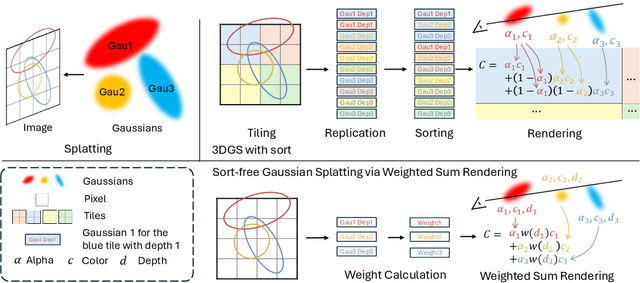
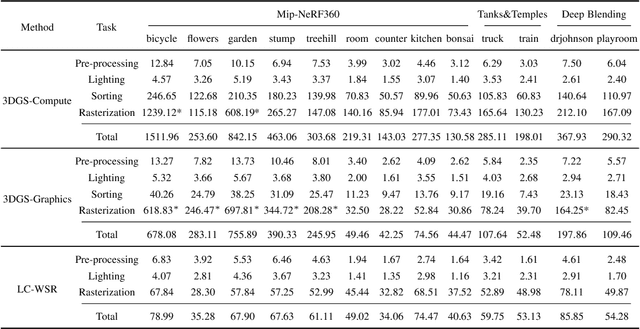

Recently, 3D Gaussian Splatting (3DGS) has emerged as a significant advancement in 3D scene reconstruction, attracting considerable attention due to its ability to recover high-fidelity details while maintaining low complexity. Despite the promising results achieved by 3DGS, its rendering performance is constrained by its dependence on costly non-commutative alpha-blending operations. These operations mandate complex view dependent sorting operations that introduce computational overhead, especially on the resource-constrained platforms such as mobile phones. In this paper, we propose Weighted Sum Rendering, which approximates alpha blending with weighted sums, thereby removing the need for sorting. This simplifies implementation, delivers superior performance, and eliminates the "popping" artifacts caused by sorting. Experimental results show that optimizing a generalized Gaussian splatting formulation to the new differentiable rendering yields competitive image quality. The method was implemented and tested in a mobile device GPU, achieving on average $1.23\times$ faster rendering.
Low-Latency Neural Stereo Streaming
Mar 26, 2024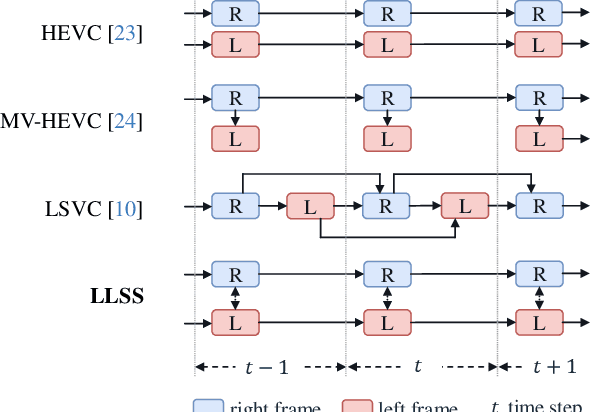
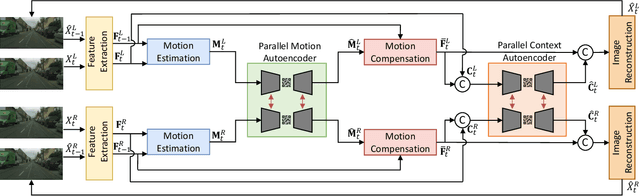
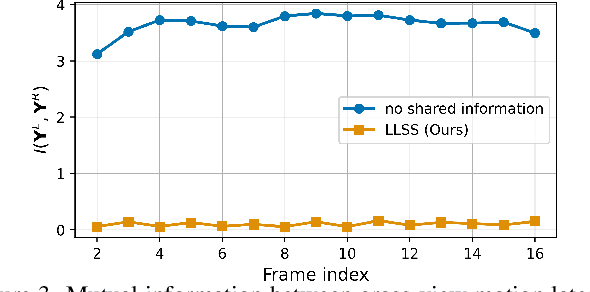
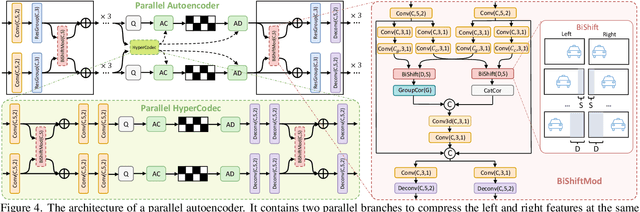
The rise of new video modalities like virtual reality or autonomous driving has increased the demand for efficient multi-view video compression methods, both in terms of rate-distortion (R-D) performance and in terms of delay and runtime. While most recent stereo video compression approaches have shown promising performance, they compress left and right views sequentially, leading to poor parallelization and runtime performance. This work presents Low-Latency neural codec for Stereo video Streaming (LLSS), a novel parallel stereo video coding method designed for fast and efficient low-latency stereo video streaming. Instead of using a sequential cross-view motion compensation like existing methods, LLSS introduces a bidirectional feature shifting module to directly exploit mutual information among views and encode them effectively with a joint cross-view prior model for entropy coding. Thanks to this design, LLSS processes left and right views in parallel, minimizing latency; all while substantially improving R-D performance compared to both existing neural and conventional codecs.
Bitstream Organization for Parallel Entropy Coding on Neural Network-based Video Codecs
Dec 01, 2023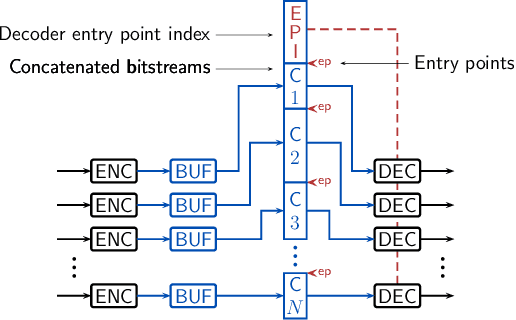
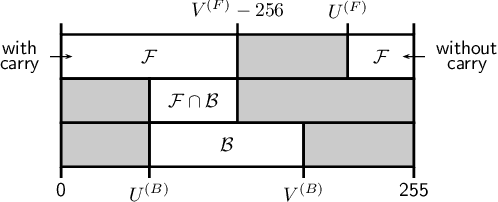
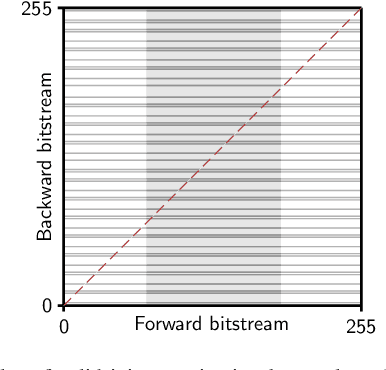
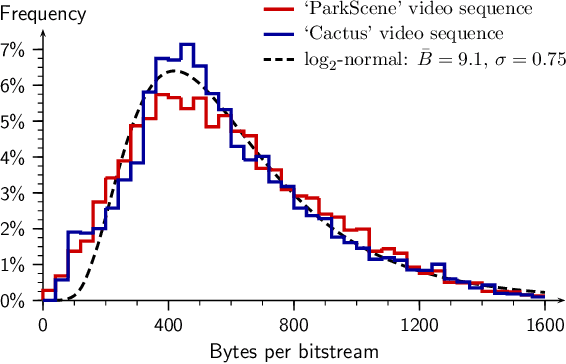
Video compression systems must support increasing bandwidth and data throughput at low cost and power, and can be limited by entropy coding bottlenecks. Efficiency can be greatly improved by parallelizing coding, which can be done at much larger scales with new neural-based codecs, but with some compression loss related to data organization. We analyze the bit rate overhead needed to support multiple bitstreams for concurrent decoding, and for its minimization propose a method for compressing parallel-decoding entry points, using bidirectional bitstream packing, and a new form of jointly optimizing arithmetic coding termination. It is shown that those techniques significantly lower the overhead, making it easier to reduce it to a small fraction of the average bitstream size, like, for example, less than 1% and 0.1% when the average number of bitstream bytes is respectively larger than 95 and 1,200 bytes.
MobileNVC: Real-time 1080p Neural Video Compression on a Mobile Device
Oct 02, 2023
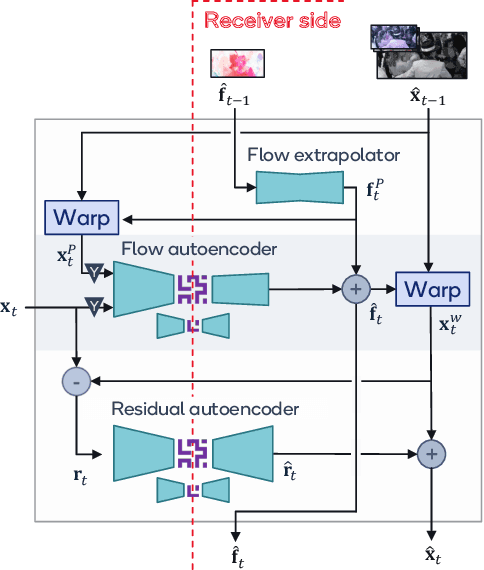
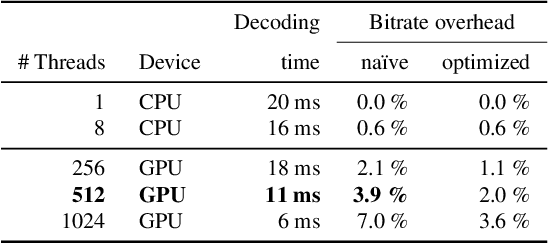
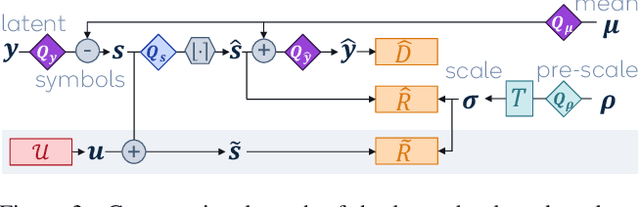
Neural video codecs have recently become competitive with standard codecs such as HEVC in the low-delay setting. However, most neural codecs are large floating-point networks that use pixel-dense warping operations for temporal modeling, making them too computationally expensive for deployment on mobile devices. Recent work has demonstrated that running a neural decoder in real time on mobile is feasible, but shows this only for 720p RGB video, while the YUV420 format is more commonly used in production. This work presents the first neural video codec that decodes 1080p YUV420 video in real time on a mobile device. Our codec relies on two major contributions. First, we design an efficient codec that uses a block-based motion compensation algorithm available on the warping core of the mobile accelerator, and we show how to quantize this model to integer precision. Second, we implement a fast decoder pipeline that concurrently runs neural network components on the neural signal processor, parallel entropy coding on the mobile GPU, and warping on the warping core. Our codec outperforms the previous on-device codec by a large margin with up to 48 % BD-rate savings, while reducing the MAC count on the receiver side by 10x. We perform a careful ablation to demonstrate the effect of the introduced motion compensation scheme, and ablate the effect of model quantization.