 Add to Chrome
 Add to Firefox
 Add to Edge
HiFloat4 Format for End-To-End Reinforcement Learning Post-Training of Large Language Models
Jul 29, 2026
We present, to our knowledge, the first end-to-end FP4 RL post-training, in which both the rollout and training policies, including their forward and backward passes, operate at 4-bit precision. A systematic study reveals that the dominant source of degradation in FP4 RL is not training-side quantization error but rollout activation quantization: outliers stretch the dynamic range so far that a large number of activation values underflow to zero under FP4. Counterintuitively, restoring the training policy to higher precision while keeping the rollout in FP4 makes accuracy worse than full FP4 baseline, exposing rollout-training mismatch as the principal failure mode and ruling out standard pretraining-style fixes. We address this with Rollout Residual Quantization (Rollout-ResQ): a single residual correction term constrained to a hardware-friendly sparsity pattern, added only to the FP4 rollout matmul -- a lightweight correction that recovers most of the precision lost to outlier-driven underflow without inflating the rollout's compute footprint. On Qwen2.5-3B and Qwen2.5-Math-7B, Rollout-ResQ paired with the HiFloat4 (HiF4) format -- whose three-level hierarchical scaling preserves resolution under FP4's tight 4-bit budget -- closes the accuracy gap to BF16 from 4.9% to 1.1%, bringing fully quantized FP4 RL within striking distance of full precision. Applied to the open-standard MXFP4, the same recipe narrows the gap from 13.6% to 5.3%, revealing that FP4 format choice is a key factor that determines the ceiling on recoverable accuracy. Together, these results establish HiF4 as the enabling format for end-to-end FP4 RL post-training, and Rollout-ResQ as the activation-side mechanism that makes the gap to BF16 closable.

FoundDP: Revisiting Weak Disparity Observability in Dual-Pixel Depth Estimation
Jul 02, 2026Dual-pixel (DP) imaging enables metric depth estimation from a single camera using sub-aperture disparity. However, the extremely small effective baseline limits disparity observability, leading to structural degradation and depth failure in textureless, low-contrast, or downsampled regions. Existing DP-based methods rely primarily on local disparity cues and therefore become unreliable when disparity signals are weak or ambiguous. To address this limitation, we propose \emph{FoundDP}, a unified framework that integrates metric DP depth with global structural priors from a monocular depth foundation model. Our method preserves metric scale through DP-derived depth and leverages Vision Transformer (ViT) features to restore structural consistency in weak-disparity regions. To ensure reliable metric guidance under DP imaging conditions, we identify and mitigate ViT representation degradation induced by DP defocus blur via ViT feature alignment, enabling stable metric-guided depth estimation. Extensive experiments on synthetic and real-world DP benchmarks show that FoundDP delivers superior performance, with consistent gains in structural fidelity and metric accuracy, especially under reduced disparity observability. Code will be available at: https://github.com/EchoLighting/FoundDP
Simulating Dual-Pixel Images From Ray Tracing For Depth Estimation
Mar 14, 2025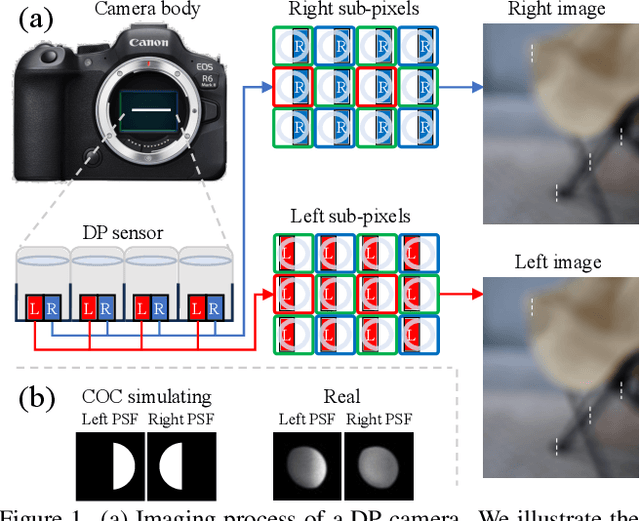
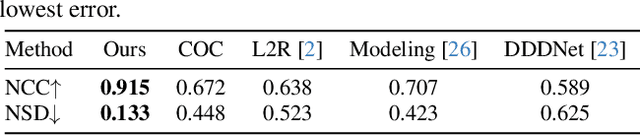
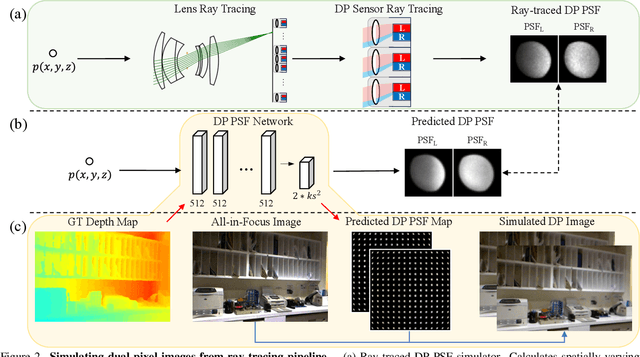
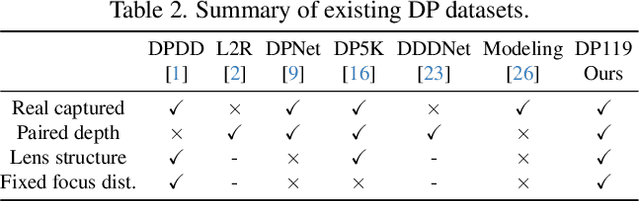
Many studies utilize dual-pixel (DP) sensor phase characteristics for various applications, such as depth estimation and deblurring. However, since the DP image features are entirely determined by the camera hardware, DP-depth paired datasets are very scarce, especially when performing depth estimation on customized cameras. To overcome this, studies simulate DP images using ideal optical system models. However, these simulations often violate real optical propagation laws,leading to poor generalization to real DP data. To address this, we investigate the domain gap between simulated and real DP data, and propose solutions using the Simulating DP images from ray tracing (Sdirt) scheme. The Sdirt generates realistic DP images via ray tracing and integrates them into the depth estimation training pipeline. Experimental results show that models trained with Sdirt-simulated images generalize better to real DP data.
TCMD: A Traditional Chinese Medicine QA Dataset for Evaluating Large Language Models
Jun 07, 2024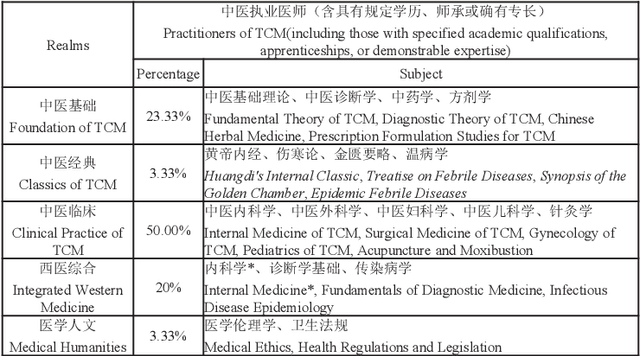
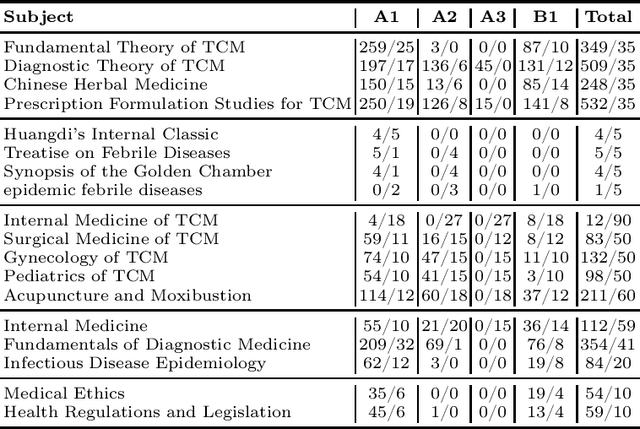
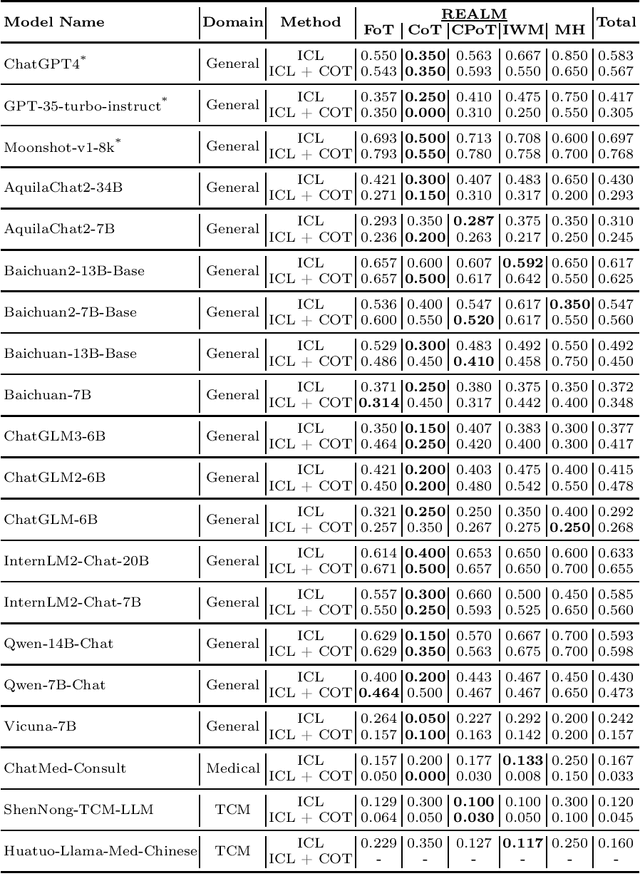
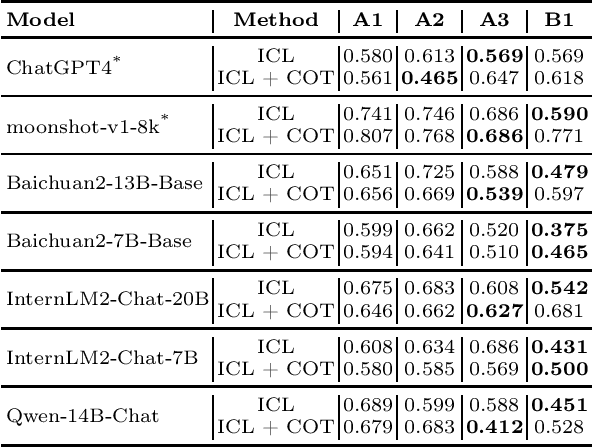
The recently unprecedented advancements in Large Language Models (LLMs) have propelled the medical community by establishing advanced medical-domain models. However, due to the limited collection of medical datasets, there are only a few comprehensive benchmarks available to gauge progress in this area. In this paper, we introduce a new medical question-answering (QA) dataset that contains massive manual instruction for solving Traditional Chinese Medicine examination tasks, called TCMD. Specifically, our TCMD collects massive questions across diverse domains with their annotated medical subjects and thus supports us in comprehensively assessing the capability of LLMs in the TCM domain. Extensive evaluation of various general LLMs and medical-domain-specific LLMs is conducted. Moreover, we also analyze the robustness of current LLMs in solving TCM QA tasks by introducing randomness. The inconsistency of the experimental results also reveals the shortcomings of current LLMs in solving QA tasks. We also expect that our dataset can further facilitate the development of LLMs in the TCM area.