 Add to Chrome
 Add to Firefox
 Add to Edge
Large Multimodal Agents: A Survey
Feb 23, 2024
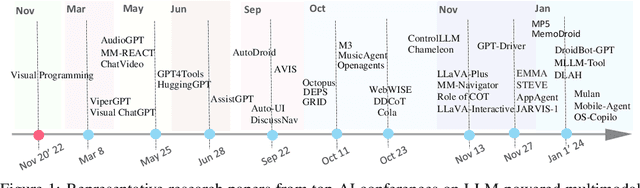
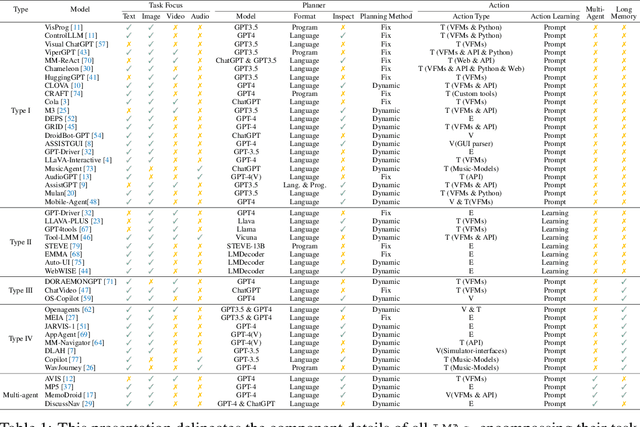
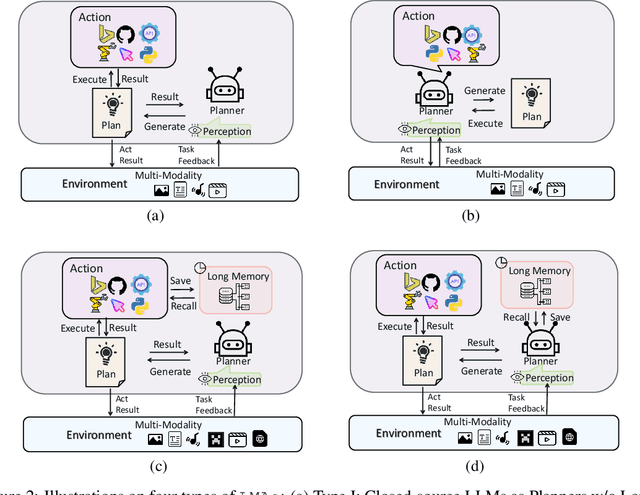
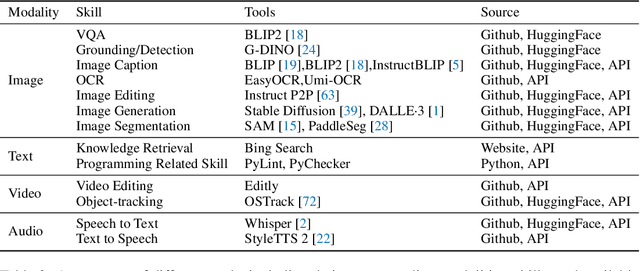
Large language models (LLMs) have achieved superior performance in powering text-based AI agents, endowing them with decision-making and reasoning abilities akin to humans. Concurrently, there is an emerging research trend focused on extending these LLM-powered AI agents into the multimodal domain. This extension enables AI agents to interpret and respond to diverse multimodal user queries, thereby handling more intricate and nuanced tasks. In this paper, we conduct a systematic review of LLM-driven multimodal agents, which we refer to as large multimodal agents ( LMAs for short). First, we introduce the essential components involved in developing LMAs and categorize the current body of research into four distinct types. Subsequently, we review the collaborative frameworks integrating multiple LMAs , enhancing collective efficacy. One of the critical challenges in this field is the diverse evaluation methods used across existing studies, hindering effective comparison among different LMAs . Therefore, we compile these evaluation methodologies and establish a comprehensive framework to bridge the gaps. This framework aims to standardize evaluations, facilitating more meaningful comparisons. Concluding our review, we highlight the extensive applications of LMAs and propose possible future research directions. Our discussion aims to provide valuable insights and guidelines for future research in this rapidly evolving field. An up-to-date resource list is available at https://github.com/jun0wanan/awesome-large-multimodal-agents.

Cell Graph Transformer for Nuclei Classification
Feb 20, 2024Nuclei classification is a critical step in computer-aided diagnosis with histopathology images. In the past, various methods have employed graph neural networks (GNN) to analyze cell graphs that model inter-cell relationships by considering nuclei as vertices. However, they are limited by the GNN mechanism that only passes messages among local nodes via fixed edges. To address the issue, we develop a cell graph transformer (CGT) that treats nodes and edges as input tokens to enable learnable adjacency and information exchange among all nodes. Nevertheless, training the transformer with a cell graph presents another challenge. Poorly initialized features can lead to noisy self-attention scores and inferior convergence, particularly when processing the cell graphs with numerous connections. Thus, we further propose a novel topology-aware pretraining method that leverages a graph convolutional network (GCN) to learn a feature extractor. The pre-trained features may suppress unreasonable correlations and hence ease the finetuning of CGT. Experimental results suggest that the proposed cell graph transformer with topology-aware pretraining significantly improves the nuclei classification results, and achieves the state-of-the-art performance. Code and models are available at https://github.com/lhaof/CGT
UniCell: Universal Cell Nucleus Classification via Prompt Learning
Feb 20, 2024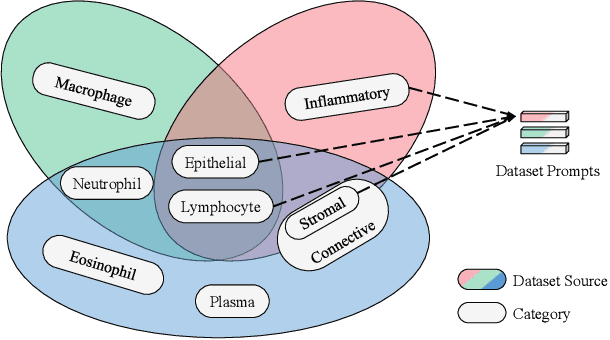

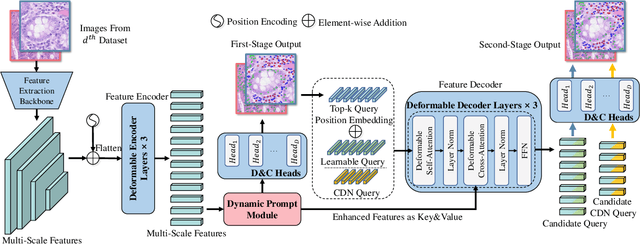

The recognition of multi-class cell nuclei can significantly facilitate the process of histopathological diagnosis. Numerous pathological datasets are currently available, but their annotations are inconsistent. Most existing methods require individual training on each dataset to deduce the relevant labels and lack the use of common knowledge across datasets, consequently restricting the quality of recognition. In this paper, we propose a universal cell nucleus classification framework (UniCell), which employs a novel prompt learning mechanism to uniformly predict the corresponding categories of pathological images from different dataset domains. In particular, our framework adopts an end-to-end architecture for nuclei detection and classification, and utilizes flexible prediction heads for adapting various datasets. Moreover, we develop a Dynamic Prompt Module (DPM) that exploits the properties of multiple datasets to enhance features. The DPM first integrates the embeddings of datasets and semantic categories, and then employs the integrated prompts to refine image representations, efficiently harvesting the shared knowledge among the related cell types and data sources. Experimental results demonstrate that the proposed method effectively achieves the state-of-the-art results on four nucleus detection and classification benchmarks. Code and models are available at https://github.com/lhaof/UniCell
Multimodal Embodied Interactive Agent for Cafe Scene
Feb 01, 2024With the surge in the development of large language models, embodied intelligence has attracted increasing attention. Nevertheless, prior works on embodied intelligence typically encode scene or historical memory in an unimodal manner, either visual or linguistic, which complicates the alignment of the model's action planning with embodied control. To overcome this limitation, we introduce the Multimodal Embodied Interactive Agent (MEIA), capable of translating high-level tasks expressed in natural language into a sequence of executable actions. Specifically, we propose a novel Multimodal Environment Memory (MEM) module, facilitating the integration of embodied control with large models through the visual-language memory of scenes. This capability enables MEIA to generate executable action plans based on diverse requirements and the robot's capabilities. We conduct experiments in a dynamic virtual cafe environment, utilizing multiple large models through zero-shot learning, and carefully design scenarios for various situations. The experimental results showcase the promising performance of our MEIA in various embodied interactive tasks.
TIP-Editor: An Accurate 3D Editor Following Both Text-Prompts And Image-Prompts
Jan 26, 2024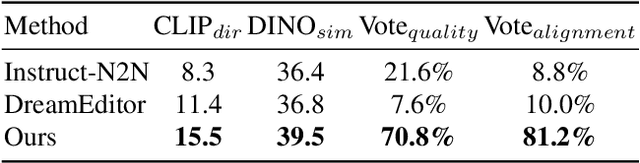
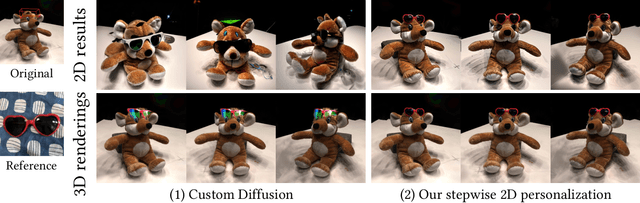
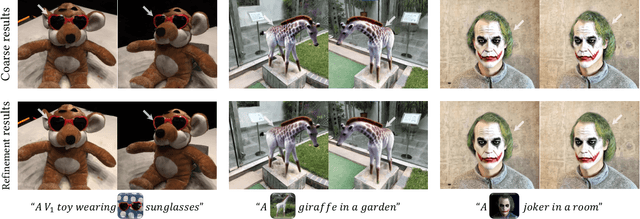
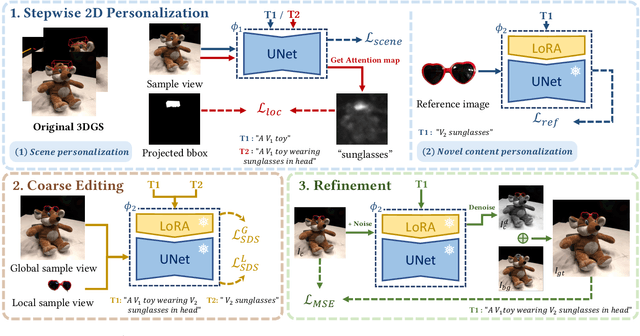
Text-driven 3D scene editing has gained significant attention owing to its convenience and user-friendliness. However, existing methods still lack accurate control of the specified appearance and location of the editing result due to the inherent limitations of the text description. To this end, we propose a 3D scene editing framework, TIPEditor, that accepts both text and image prompts and a 3D bounding box to specify the editing region. With the image prompt, users can conveniently specify the detailed appearance/style of the target content in complement to the text description, enabling accurate control of the appearance. Specifically, TIP-Editor employs a stepwise 2D personalization strategy to better learn the representation of the existing scene and the reference image, in which a localization loss is proposed to encourage correct object placement as specified by the bounding box. Additionally, TIPEditor utilizes explicit and flexible 3D Gaussian splatting as the 3D representation to facilitate local editing while keeping the background unchanged. Extensive experiments have demonstrated that TIP-Editor conducts accurate editing following the text and image prompts in the specified bounding box region, consistently outperforming the baselines in editing quality, and the alignment to the prompts, qualitatively and quantitatively.
Inter-Domain Mixup for Semi-Supervised Domain Adaptation
Jan 21, 2024Semi-supervised domain adaptation (SSDA) aims to bridge source and target domain distributions, with a small number of target labels available, achieving better classification performance than unsupervised domain adaptation (UDA). However, existing SSDA work fails to make full use of label information from both source and target domains for feature alignment across domains, resulting in label mismatch in the label space during model testing. This paper presents a novel SSDA approach, Inter-domain Mixup with Neighborhood Expansion (IDMNE), to tackle this issue. Firstly, we introduce a cross-domain feature alignment strategy, Inter-domain Mixup, that incorporates label information into model adaptation. Specifically, we employ sample-level and manifold-level data mixing to generate compatible training samples. These newly established samples, combined with reliable and actual label information, display diversity and compatibility across domains, while such extra supervision thus facilitates cross-domain feature alignment and mitigates label mismatch. Additionally, we utilize Neighborhood Expansion to leverage high-confidence pseudo-labeled samples in the target domain, diversifying the label information of the target domain and thereby further increasing the performance of the adaptation model. Accordingly, the proposed approach outperforms existing state-of-the-art methods, achieving significant accuracy improvements on popular SSDA benchmarks, including DomainNet, Office-Home, and Office-31.
Adaptive Betweenness Clustering for Semi-Supervised Domain Adaptation
Jan 21, 2024Compared to unsupervised domain adaptation, semi-supervised domain adaptation (SSDA) aims to significantly improve the classification performance and generalization capability of the model by leveraging the presence of a small amount of labeled data from the target domain. Several SSDA approaches have been developed to enable semantic-aligned feature confusion between labeled (or pseudo labeled) samples across domains; nevertheless, owing to the scarcity of semantic label information of the target domain, they were arduous to fully realize their potential. In this study, we propose a novel SSDA approach named Graph-based Adaptive Betweenness Clustering (G-ABC) for achieving categorical domain alignment, which enables cross-domain semantic alignment by mandating semantic transfer from labeled data of both the source and target domains to unlabeled target samples. In particular, a heterogeneous graph is initially constructed to reflect the pairwise relationships between labeled samples from both domains and unlabeled ones of the target domain. Then, to degrade the noisy connectivity in the graph, connectivity refinement is conducted by introducing two strategies, namely Confidence Uncertainty based Node Removal and Prediction Dissimilarity based Edge Pruning. Once the graph has been refined, Adaptive Betweenness Clustering is introduced to facilitate semantic transfer by using across-domain betweenness clustering and within-domain betweenness clustering, thereby propagating semantic label information from labeled samples across domains to unlabeled target data. Extensive experiments on three standard benchmark datasets, namely DomainNet, Office-Home, and Office-31, indicated that our method outperforms previous state-of-the-art SSDA approaches, demonstrating the superiority of the proposed G-ABC algorithm.
* 16 pages, 9 figures, published to IEEE TIP
ECC-PolypDet: Enhanced CenterNet with Contrastive Learning for Automatic Polyp Detection
Jan 10, 2024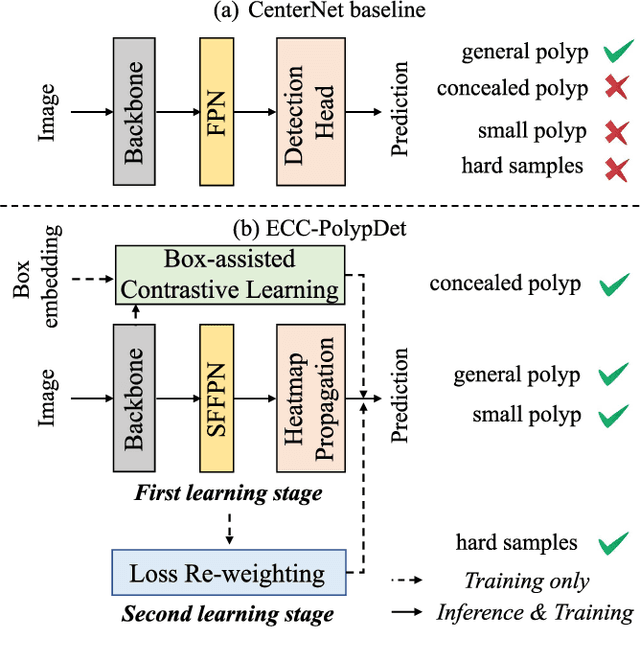

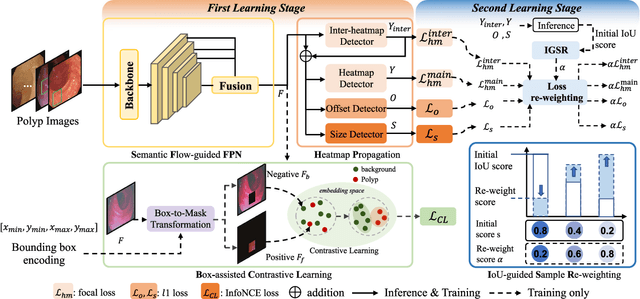
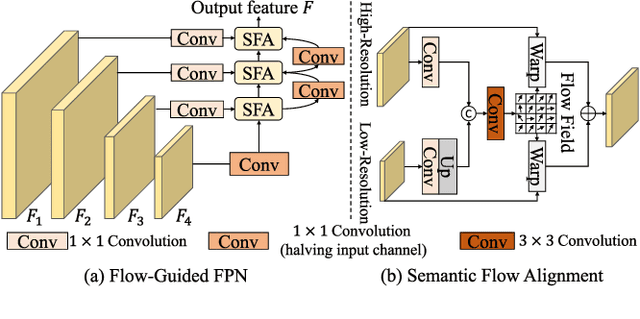
Accurate polyp detection is critical for early colorectal cancer diagnosis. Although remarkable progress has been achieved in recent years, the complex colon environment and concealed polyps with unclear boundaries still pose severe challenges in this area. Existing methods either involve computationally expensive context aggregation or lack prior modeling of polyps, resulting in poor performance in challenging cases. In this paper, we propose the Enhanced CenterNet with Contrastive Learning (ECC-PolypDet), a two-stage training \& end-to-end inference framework that leverages images and bounding box annotations to train a general model and fine-tune it based on the inference score to obtain a final robust model. Specifically, we conduct Box-assisted Contrastive Learning (BCL) during training to minimize the intra-class difference and maximize the inter-class difference between foreground polyps and backgrounds, enabling our model to capture concealed polyps. Moreover, to enhance the recognition of small polyps, we design the Semantic Flow-guided Feature Pyramid Network (SFFPN) to aggregate multi-scale features and the Heatmap Propagation (HP) module to boost the model's attention on polyp targets. In the fine-tuning stage, we introduce the IoU-guided Sample Re-weighting (ISR) mechanism to prioritize hard samples by adaptively adjusting the loss weight for each sample during fine-tuning. Extensive experiments on six large-scale colonoscopy datasets demonstrate the superiority of our model compared with previous state-of-the-art detectors.
Credible Teacher for Semi-Supervised Object Detection in Open Scene
Jan 03, 2024


Semi-Supervised Object Detection (SSOD) has achieved resounding success by leveraging unlabeled data to improve detection performance. However, in Open Scene Semi-Supervised Object Detection (O-SSOD), unlabeled data may contains unknown objects not observed in the labeled data, which will increase uncertainty in the model's predictions for known objects. It is detrimental to the current methods that mainly rely on self-training, as more uncertainty leads to the lower localization and classification precision of pseudo labels. To this end, we propose Credible Teacher, an end-to-end framework. Credible Teacher adopts an interactive teaching mechanism using flexible labels to prevent uncertain pseudo labels from misleading the model and gradually reduces its uncertainty through the guidance of other credible pseudo labels. Empirical results have demonstrated our method effectively restrains the adverse effect caused by O-SSOD and significantly outperforms existing counterparts.
Removing Interference and Recovering Content Imaginatively for Visible Watermark Removal
Dec 22, 2023Visible watermarks, while instrumental in protecting image copyrights, frequently distort the underlying content, complicating tasks like scene interpretation and image editing. Visible watermark removal aims to eliminate the interference of watermarks and restore the background content. However, existing methods often implement watermark component removal and background restoration tasks within a singular branch, leading to residual watermarks in the predictions and ignoring cases where watermarks heavily obscure the background. To address these limitations, this study introduces the Removing Interference and Recovering Content Imaginatively (RIRCI) framework. RIRCI embodies a two-stage approach: the initial phase centers on discerning and segregating the watermark component, while the subsequent phase focuses on background content restoration. To achieve meticulous background restoration, our proposed model employs a dual-path network capable of fully exploring the intrinsic background information beneath semi-transparent watermarks and peripheral contextual information from unaffected regions. Moreover, a Global and Local Context Interaction module is built upon multi-layer perceptrons and bidirectional feature transformation for comprehensive representation modeling in the background restoration phase. The efficacy of our approach is empirically validated across two large-scale datasets, and our findings reveal a marked enhancement over existing watermark removal techniques.