 Add to Chrome
 Add to Firefox
 Add to Edge
Realizing XR Applications Using 5G-Based 3D Holographic Communication and Mobile Edge Computing
Oct 05, 2023
3D holographic communication has the potential to revolutionize the way people interact with each other in virtual spaces, offering immersive and realistic experiences. However, demands for high data rates, extremely low latency, and high computations to enable this technology pose a significant challenge. To address this challenge, we propose a novel job scheduling algorithm that leverages Mobile Edge Computing (MEC) servers in order to minimize the total latency in 3D holographic communication. One of the motivations for this work is to prevent the uncanny valley effect, which can occur when the latency hinders the seamless and real-time rendering of holographic content, leading to a less convincing and less engaging user experience. Our proposed algorithm dynamically allocates computation tasks to MEC servers, considering the network conditions, computational capabilities of the servers, and the requirements of the 3D holographic communication application. We conduct extensive experiments to evaluate the performance of our algorithm in terms of latency reduction, and the results demonstrate that our approach significantly outperforms other baseline methods. Furthermore, we present a practical scenario involving Augmented Reality (AR), which not only illustrates the applicability of our algorithm but also highlights the importance of minimizing latency in achieving high-quality holographic views. By efficiently distributing the computation workload among MEC servers and reducing the overall latency, our proposed algorithm enhances the user experience in 3D holographic communications and paves the way for the widespread adoption of this technology in various applications, such as telemedicine, remote collaboration, and entertainment.

Imitation Learning from Observation through Optimal Transport
Oct 02, 2023


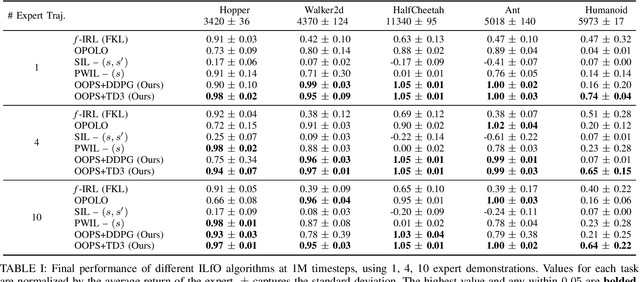
Imitation Learning from Observation (ILfO) is a setting in which a learner tries to imitate the behavior of an expert, using only observational data and without the direct guidance of demonstrated actions. In this paper, we re-examine the use of optimal transport for IL, in which a reward is generated based on the Wasserstein distance between the state trajectories of the learner and expert. We show that existing methods can be simplified to generate a reward function without requiring learned models or adversarial learning. Unlike many other state-of-the-art methods, our approach can be integrated with any RL algorithm, and is amenable to ILfO. We demonstrate the effectiveness of this simple approach on a variety of continuous control tasks and find that it surpasses the state of the art in the IlfO setting, achieving expert-level performance across a range of evaluation domains even when observing only a single expert trajectory without actions.
Uncertainty-aware hybrid paradigm of nonlinear MPC and model-based RL for offroad navigation: Exploration of transformers in the predictive model
Oct 01, 2023


In this paper, we investigate a hybrid scheme that combines nonlinear model predictive control (MPC) and model-based reinforcement learning (RL) for navigation planning of an autonomous model car across offroad, unstructured terrains without relying on predefined maps. Our innovative approach takes inspiration from BADGR, an LSTM-based network that primarily concentrates on environment modeling, but distinguishes itself by substituting LSTM modules with transformers to greatly elevate the performance our model. Addressing uncertainty within the system, we train an ensemble of predictive models and estimate the mutual information between model weights and outputs, facilitating dynamic horizon planning through the introduction of variable speeds. Further enhancing our methodology, we incorporate a nonlinear MPC controller that accounts for the intricacies of the vehicle's model and states. The model-based RL facet produces steering angles and quantifies inherent uncertainty. At the same time, the nonlinear MPC suggests optimal throttle settings, striking a balance between goal attainment speed and managing model uncertainty influenced by velocity. In the conducted studies, our approach excels over the existing baseline by consistently achieving higher metric values in predicting future events and seamlessly integrating the vehicle's kinematic model for enhanced decision-making. The code and the evaluation data are available at https://github.com/FARAZLOTFI/offroad_autonomous_navigation/).
CARTIER: Cartographic lAnguage Reasoning Targeted at Instruction Execution for Robots
Jul 21, 2023This work explores the capacity of large language models (LLMs) to address problems at the intersection of spatial planning and natural language interfaces for navigation.Our focus is on following relatively complex instructions that are more akin to natural conversation than traditional explicit procedural directives seen in robotics. Unlike most prior work, where navigation directives are provided as imperative commands (e.g., go to the fridge), we examine implicit directives within conversational interactions. We leverage the 3D simulator AI2Thor to create complex and repeatable scenarios at scale, and augment it by adding complex language queries for 40 object types. We demonstrate that a robot can better parse descriptive language queries than existing methods by using an LLM to interpret the user interaction in the context of a list of the objects in the scene.
Communication Load Balancing via Efficient Inverse Reinforcement Learning
Mar 22, 2023
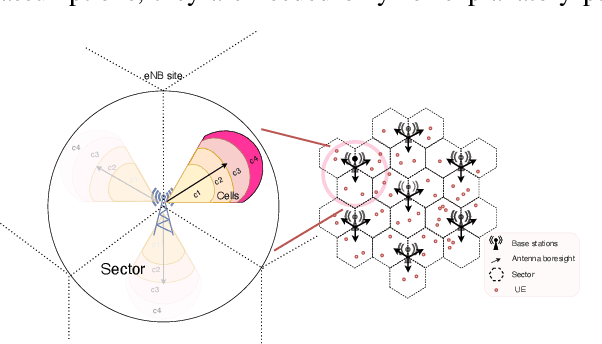
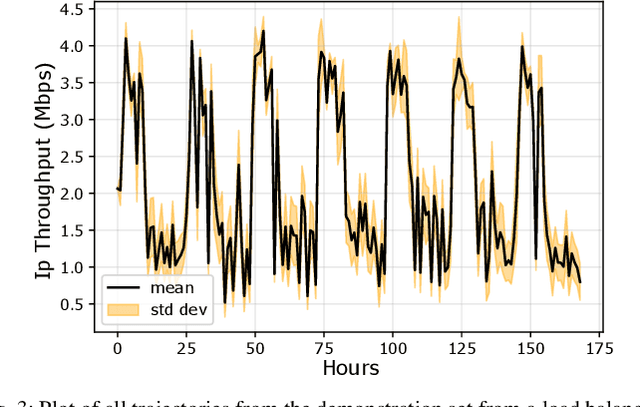
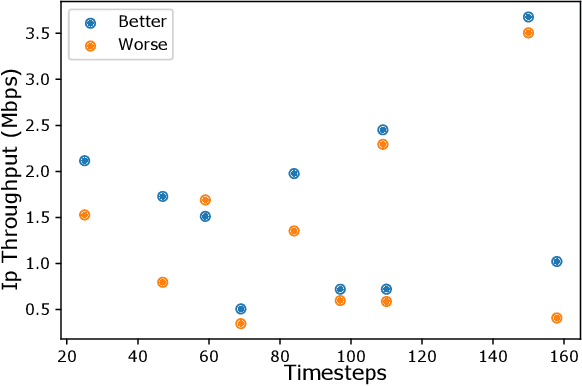
Communication load balancing aims to balance the load between different available resources, and thus improve the quality of service for network systems. After formulating the load balancing (LB) as a Markov decision process problem, reinforcement learning (RL) has recently proven effective in addressing the LB problem. To leverage the benefits of classical RL for load balancing, however, we need an explicit reward definition. Engineering this reward function is challenging, because it involves the need for expert knowledge and there lacks a general consensus on the form of an optimal reward function. In this work, we tackle the communication load balancing problem from an inverse reinforcement learning (IRL) approach. To the best of our knowledge, this is the first time IRL has been successfully applied in the field of communication load balancing. Specifically, first, we infer a reward function from a set of demonstrations, and then learn a reinforcement learning load balancing policy with the inferred reward function. Compared to classical RL-based solution, the proposed solution can be more general and more suitable for real-world scenarios. Experimental evaluations implemented on different simulated traffic scenarios have shown our method to be effective and better than other baselines by a considerable margin.
Policy Reuse for Communication Load Balancing in Unseen Traffic Scenarios
Mar 22, 2023With the continuous growth in communication network complexity and traffic volume, communication load balancing solutions are receiving increasing attention. Specifically, reinforcement learning (RL)-based methods have shown impressive performance compared with traditional rule-based methods. However, standard RL methods generally require an enormous amount of data to train, and generalize poorly to scenarios that are not encountered during training. We propose a policy reuse framework in which a policy selector chooses the most suitable pre-trained RL policy to execute based on the current traffic condition. Our method hinges on a policy bank composed of policies trained on a diverse set of traffic scenarios. When deploying to an unknown traffic scenario, we select a policy from the policy bank based on the similarity between the previous-day traffic of the current scenario and the traffic observed during training. Experiments demonstrate that this framework can outperform classical and adaptive rule-based methods by a large margin.
Multi-agent Attention Actor-Critic Algorithm for Load Balancing in Cellular Networks
Mar 14, 2023In cellular networks, User Equipment (UE) handoff from one Base Station (BS) to another, giving rise to the load balancing problem among the BSs. To address this problem, BSs can work collaboratively to deliver a smooth migration (or handoff) and satisfy the UEs' service requirements. This paper formulates the load balancing problem as a Markov game and proposes a Robust Multi-agent Attention Actor-Critic (Robust-MA3C) algorithm that can facilitate collaboration among the BSs (i.e., agents). In particular, to solve the Markov game and find a Nash equilibrium policy, we embrace the idea of adopting a nature agent to model the system uncertainty. Moreover, we utilize the self-attention mechanism, which encourages high-performance BSs to assist low-performance BSs. In addition, we consider two types of schemes, which can facilitate load balancing for both active UEs and idle UEs. We carry out extensive evaluations by simulations, and simulation results illustrate that, compared to the state-of-the-art MARL methods, Robust-\ours~scheme can improve the overall performance by up to 45%.
ANSEL Photobot: A Robot Event Photographer with Semantic Intelligence
Feb 15, 2023Our work examines the way in which large language models can be used for robotic planning and sampling, specifically the context of automated photographic documentation. Specifically, we illustrate how to produce a photo-taking robot with an exceptional level of semantic awareness by leveraging recent advances in general purpose language (LM) and vision-language (VLM) models. Given a high-level description of an event we use an LM to generate a natural-language list of photo descriptions that one would expect a photographer to capture at the event. We then use a VLM to identify the best matches to these descriptions in the robot's video stream. The photo portfolios generated by our method are consistently rated as more appropriate to the event by human evaluators than those generated by existing methods.
Self-Supervised Transformer Architecture for Change Detection in Radio Access Networks
Feb 03, 2023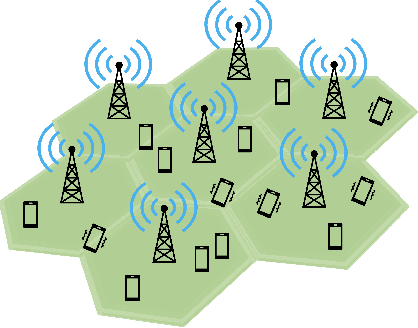
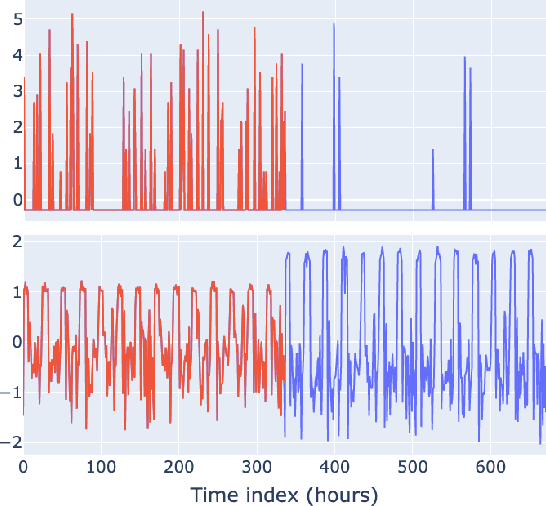
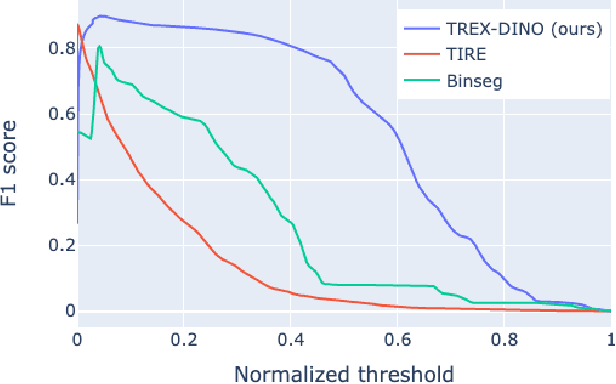
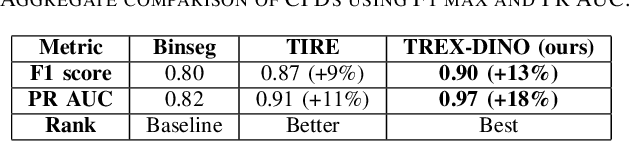
Radio Access Networks (RANs) for telecommunications represent large agglomerations of interconnected hardware consisting of hundreds of thousands of transmitting devices (cells). Such networks undergo frequent and often heterogeneous changes caused by network operators, who are seeking to tune their system parameters for optimal performance. The effects of such changes are challenging to predict and will become even more so with the adoption of 5G/6G networks. Therefore, RAN monitoring is vital for network operators. We propose a self-supervised learning framework that leverages self-attention and self-distillation for this task. It works by detecting changes in Performance Measurement data, a collection of time-varying metrics which reflect a set of diverse measurements of the network performance at the cell level. Experimental results show that our approach outperforms the state of the art by 4% on a real-world based dataset consisting of about hundred thousands timeseries. It also has the merits of being scalable and generalizable. This allows it to provide deep insight into the specifics of mode of operation changes while relying minimally on expert knowledge.
Hypernetworks for Zero-shot Transfer in Reinforcement Learning
Nov 28, 2022
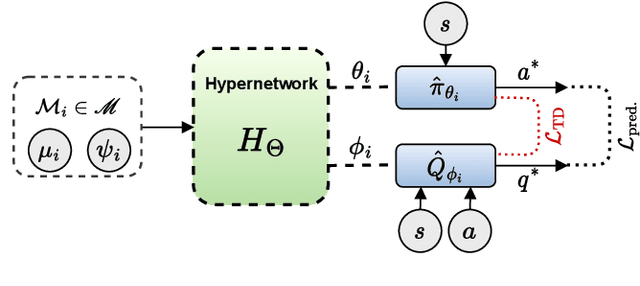
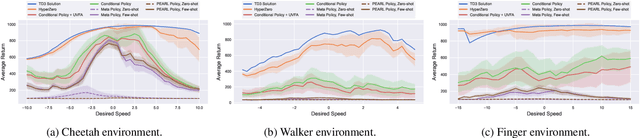
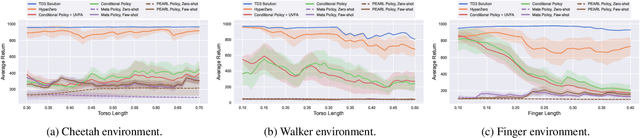
In this paper, hypernetworks are trained to generate behaviors across a range of unseen task conditions, via a novel TD-based training objective and data from a set of near-optimal RL solutions for training tasks. This work relates to meta RL, contextual RL, and transfer learning, with a particular focus on zero-shot performance at test time, enabled by knowledge of the task parameters (also known as context). Our technical approach is based upon viewing each RL algorithm as a mapping from the MDP specifics to the near-optimal value function and policy and seek to approximate it with a hypernetwork that can generate near-optimal value functions and policies, given the parameters of the MDP. We show that, under certain conditions, this mapping can be considered as a supervised learning problem. We empirically evaluate the effectiveness of our method for zero-shot transfer to new reward and transition dynamics on a series of continuous control tasks from DeepMind Control Suite. Our method demonstrates significant improvements over baselines from multitask and meta RL approaches.