 Add to Chrome
 Add to Firefox
 Add to Edge
RADIO1D: Elastic Representations for Condensed Vision Modeling
Jul 03, 2026
This paper challenges the assumption that vision-language models (VLMs) require fixed patch-based 2D vision features. Analyzing fine-tuned vision encoders, we find that representations become increasingly abstract and less spatially coherent during VLM training. Notably, models trained with image-text alignment (such as SigLIP2) develop a small number of specialized tokens that effectively summarize global image content. Building on this, we introduce RADIO1D, which compresses images into a compact, variable-length 1D token sequence using multi-teacher knowledge distillation and an autoencoder design. The resulting representations exhibit strong hierarchical summarization, enabling accurate scene understanding - even with a single token - and support improved composition-aware image retrieval. In VLMs, RADIO1D provides flexible accuracy-efficiency tradeoffs through adjustable token counts, delivering competitive performance on diverse multimodal benchmarks with lower computational overhead and better accuracy.

Nemotron-Labs-Diffusion-Image: Advancing Masked Discrete Diffusion for High-Resolution Image Synthesis
Jun 29, 2026We propose Nemotron-Labs-Diffusion-Image, a state-of-the-art masked discrete diffusion model (MDM) for high-resolution text-to-image synthesis. Compared with prior work on masked image generation, Nemotron-Labs-Diffusion-Image addresses two key challenges. First, unlike continuous diffusion models which progressively refine latent representations across the entire image, standard MDMs lack self-correcting capability because discrete tokens cannot be modified once they are unmasked. Second, although increasing the vocabulary size of discrete image tokenizers improves reconstruction fidelity, it introduces optimization difficulties for generative modeling as the per-token training signal becomes increasingly sparse. To address the first challenge, Nemotron-Labs-Diffusion-Image incorporates a token-editing mechanism that enables the model to dynamically revise already-unmasked tokens during inference, similar to how a sculptor iteratively refines their work. To tackle the second challenge, we propose a Grouped Cross-Entropy (GCE) objective that assigns positive learning signals to tokens neighboring the ground truth in embedding space, thereby alleviating signal sparsity. To further improve training efficiency, we implement a custom fused operator for GCE that significantly reduces VRAM usage in large-vocabulary settings. Experimental results demonstrate that these innovations substantially improve both training efficiency and image fidelity of masked discrete image generators, achieving a score of 0.90 on GenEval, 86.9 on DPG and 10.76 of HPSv3.
Nemotron 3 Nano Omni: Efficient and Open Multimodal Intelligence
Apr 27, 2026We introduce Nemotron 3 Nano Omni, the latest model in the Nemotron multimodal series and the first to natively support audio inputs alongside text, images, and video. Nemotron 3 Nano Omni delivers consistent accuracy improvements over its predecessor, Nemotron Nano V2 VL, across all modalities, enabled by advances in architecture, training data and recipes. In particular, Nemotron 3 delivers leading results in real-world document understanding, long audio-video comprehension, and agentic computer use. Built on the highly efficient Nemotron 3 Nano 30B-A3B backbone, Nemotron 3 Nano Omni further incorporates innovative multimodal token-reduction techniques to deliver substantially lower inference latency and higher throughput than other models of similar size. We are releasing model checkpoints in BF16, FP8, and FP4 formats, along with portions of the training data and codebase to facilitate further research and development.
C-RADIOv4 (Tech Report)
Jan 24, 2026By leveraging multi-teacher distillation, agglomerative vision backbones provide a unified student model that retains and improves the distinct capabilities of multiple teachers. In this tech report, we describe the most recent release of the C-RADIO family of models, C-RADIOv4, which builds upon AM-RADIO/RADIOv2.5 in design, offering strong improvements on key downstream tasks at the same computational complexity. We release -SO400M (412M params), and -H (631M) model variants, both trained with an updated set of teachers: SigLIP2, DINOv3, and SAM3. In addition to improvements on core metrics and new capabilities from imitating SAM3, the C-RADIOv4 model family further improves any-resolution support, brings back the ViTDet option for drastically enhanced efficiency at high-resolution, and comes with a permissive license.
NVIDIA Nemotron Nano V2 VL
Nov 07, 2025We introduce Nemotron Nano V2 VL, the latest model of the Nemotron vision-language series designed for strong real-world document understanding, long video comprehension, and reasoning tasks. Nemotron Nano V2 VL delivers significant improvements over our previous model, Llama-3.1-Nemotron-Nano-VL-8B, across all vision and text domains through major enhancements in model architecture, datasets, and training recipes. Nemotron Nano V2 VL builds on Nemotron Nano V2, a hybrid Mamba-Transformer LLM, and innovative token reduction techniques to achieve higher inference throughput in long document and video scenarios. We are releasing model checkpoints in BF16, FP8, and FP4 formats and sharing large parts of our datasets, recipes and training code.
FeatSharp: Your Vision Model Features, Sharper
Feb 22, 2025The feature maps of vision encoders are fundamental to myriad modern AI tasks, ranging from core perception algorithms (e.g. semantic segmentation, object detection, depth perception, etc.) to modern multimodal understanding in vision-language models (VLMs). Currently, in computer vision, the frontier of general purpose vision backbones are Vision Transformers (ViT), typically trained using contrastive loss (e.g. CLIP). A key problem with most off-the-shelf ViTs, particularly CLIP, is that these models are inflexibly low resolution. Most run at 224x224px, while the "high resolution" versions are around 378-448px, but still inflexible. We introduce a novel method to coherently and cheaply upsample the feature maps of low-res vision encoders while picking up on fine-grained details that would otherwise be lost due to resolution. We demonstrate the effectiveness of this approach on core perception tasks as well as within agglomerative model (RADIO) training as a way of providing richer targets for distillation.
RADIO Amplified: Improved Baselines for Agglomerative Vision Foundation Models
Dec 10, 2024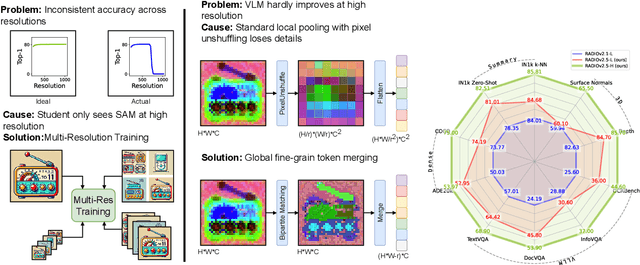


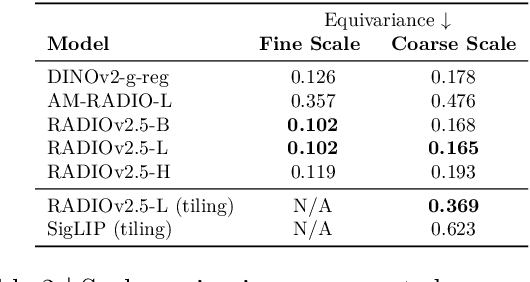
Agglomerative models have recently emerged as a powerful approach to training vision foundation models, leveraging multi-teacher distillation from existing models such as CLIP, DINO, and SAM. This strategy enables the efficient creation of robust models, combining the strengths of individual teachers while significantly reducing computational and resource demands. In this paper, we thoroughly analyze state-of-the-art agglomerative models, identifying critical challenges including resolution mode shifts, teacher imbalance, idiosyncratic teacher artifacts, and an excessive number of output tokens. To address these issues, we propose several novel solutions: multi-resolution training, mosaic augmentation, and improved balancing of teacher loss functions. Specifically, in the context of Vision Language Models, we introduce a token compression technique to maintain high-resolution information within a fixed token count. We release our top-performing models, available in multiple scales (-B, -L, -H, and -g), alongside inference code and pretrained weights.
VILA-M3: Enhancing Vision-Language Models with Medical Expert Knowledge
Nov 19, 2024

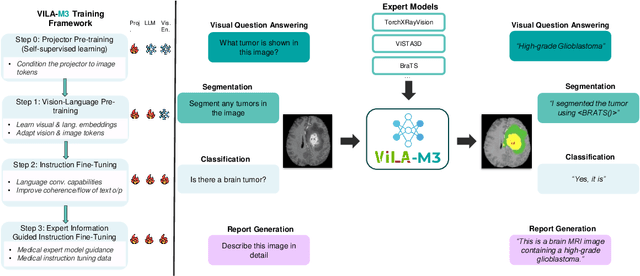

Generalist vision language models (VLMs) have made significant strides in computer vision, but they fall short in specialized fields like healthcare, where expert knowledge is essential. In traditional computer vision tasks, creative or approximate answers may be acceptable, but in healthcare, precision is paramount.Current large multimodal models like Gemini and GPT-4o are insufficient for medical tasks due to their reliance on memorized internet knowledge rather than the nuanced expertise required in healthcare. VLMs are usually trained in three stages: vision pre-training, vision-language pre-training, and instruction fine-tuning (IFT). IFT has been typically applied using a mixture of generic and healthcare data. In contrast, we propose that for medical VLMs, a fourth stage of specialized IFT is necessary, which focuses on medical data and includes information from domain expert models. Domain expert models developed for medical use are crucial because they are specifically trained for certain clinical tasks, e.g. to detect tumors and classify abnormalities through segmentation and classification, which learn fine-grained features of medical data$-$features that are often too intricate for a VLM to capture effectively especially in radiology. This paper introduces a new framework, VILA-M3, for medical VLMs that utilizes domain knowledge via expert models. Through our experiments, we show an improved state-of-the-art (SOTA) performance with an average improvement of ~9% over the prior SOTA model Med-Gemini and ~6% over models trained on the specific tasks. Our approach emphasizes the importance of domain expertise in creating precise, reliable VLMs for medical applications.
PHI-S: Distribution Balancing for Label-Free Multi-Teacher Distillation
Oct 02, 2024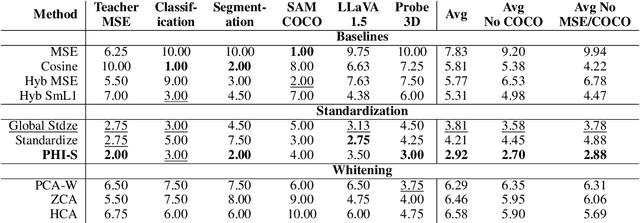


Various visual foundation models have distinct strengths and weaknesses, both of which can be improved through heterogeneous multi-teacher knowledge distillation without labels, termed "agglomerative models." We build upon this body of work by studying the effect of the teachers' activation statistics, particularly the impact of the loss function on the resulting student model quality. We explore a standard toolkit of statistical normalization techniques to better align the different distributions and assess their effects. Further, we examine the impact on downstream teacher-matching metrics, which motivates the use of Hadamard matrices. With these matrices, we demonstrate useful properties, showing how they can be used for isotropic standardization, where each dimension of a multivariate distribution is standardized using the same scale. We call this technique "PHI Standardization" (PHI-S) and empirically demonstrate that it produces the best student model across the suite of methods studied.
MaskLLM: Learnable Semi-Structured Sparsity for Large Language Models
Sep 26, 2024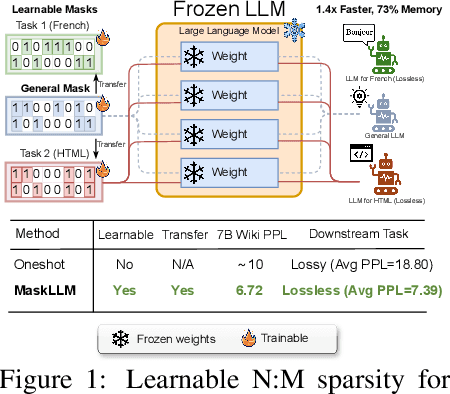
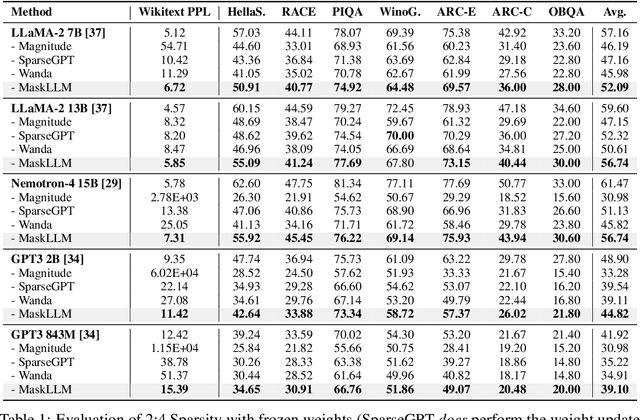

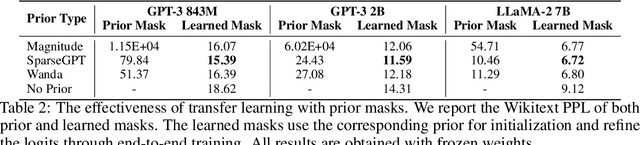
Large Language Models (LLMs) are distinguished by their massive parameter counts, which typically result in significant redundancy. This work introduces MaskLLM, a learnable pruning method that establishes Semi-structured (or ``N:M'') Sparsity in LLMs, aimed at reducing computational overhead during inference. Instead of developing a new importance criterion, MaskLLM explicitly models N:M patterns as a learnable distribution through Gumbel Softmax sampling. This approach facilitates end-to-end training on large-scale datasets and offers two notable advantages: 1) High-quality Masks - our method effectively scales to large datasets and learns accurate masks; 2) Transferability - the probabilistic modeling of mask distribution enables the transfer learning of sparsity across domains or tasks. We assessed MaskLLM using 2:4 sparsity on various LLMs, including LLaMA-2, Nemotron-4, and GPT-3, with sizes ranging from 843M to 15B parameters, and our empirical results show substantial improvements over state-of-the-art methods. For instance, leading approaches achieve a perplexity (PPL) of 10 or greater on Wikitext compared to the dense model's 5.12 PPL, but MaskLLM achieves a significantly lower 6.72 PPL solely by learning the masks with frozen weights. Furthermore, MaskLLM's learnable nature allows customized masks for lossless application of 2:4 sparsity to downstream tasks or domains. Code is available at \url{https://github.com/NVlabs/MaskLLM}.