 Add to Chrome
 Add to Firefox
 Add to Edge
RADIO1D: Elastic Representations for Condensed Vision Modeling
Jul 03, 2026
This paper challenges the assumption that vision-language models (VLMs) require fixed patch-based 2D vision features. Analyzing fine-tuned vision encoders, we find that representations become increasingly abstract and less spatially coherent during VLM training. Notably, models trained with image-text alignment (such as SigLIP2) develop a small number of specialized tokens that effectively summarize global image content. Building on this, we introduce RADIO1D, which compresses images into a compact, variable-length 1D token sequence using multi-teacher knowledge distillation and an autoencoder design. The resulting representations exhibit strong hierarchical summarization, enabling accurate scene understanding - even with a single token - and support improved composition-aware image retrieval. In VLMs, RADIO1D provides flexible accuracy-efficiency tradeoffs through adjustable token counts, delivering competitive performance on diverse multimodal benchmarks with lower computational overhead and better accuracy.

Scaling Parallel Sequence Models to Foundation-Scale Vision Encoders
May 30, 2026Vision foundation models are bottlenecked by the quadratic cost of self-attention, which limits usable resolution and increases the cost of large-scale pretraining. Subquadratic alternatives such as linear attention and state-space models reduce this cost, but often serialize images into 1D token streams and weaken the 2D spatial structure important for vision. Generalized Spatial Propagation Networks (GSPN) instead propagate context directly on the 2D grid through line-scan recurrences, achieving near-linear complexity without positional embeddings, but have seen little use as foundation-scale encoders. We present C-GSPN, a foundation-scale vision encoder based on 2D spatial propagation. C-GSPN makes the operator practical through three improvements: (1) a fast GSPN CUDA kernel that fuses per-step launches into a single warp-specialized implementation with shared-memory tiling, coalesced access, and a compact multi-channel propagation, reaching over 90% of peak memory bandwidth and running up to 40--52x faster than the original GSPN implementation; (2) a compressed latent-space propagation block with fused normalization, which turns kernel-level speed into block- and model-level efficiency; and (3) a two-stage cross-operator distillation recipe that trains the new architecture from an attention teacher without the cost of from-scratch foundation-scale training. Distilled with 600M image-text pairs, C-GSPN matches an isomorphic ViT baseline with 15% fewer parameters, improves ADE20K segmentation by +2.1%, transfers to high resolution with a fraction of the data needed from scratch, and delivers a 4x end-to-end block speedup at 2K with single-pass, tiling-free inference.
Nemotron 3 Nano Omni: Efficient and Open Multimodal Intelligence
Apr 27, 2026We introduce Nemotron 3 Nano Omni, the latest model in the Nemotron multimodal series and the first to natively support audio inputs alongside text, images, and video. Nemotron 3 Nano Omni delivers consistent accuracy improvements over its predecessor, Nemotron Nano V2 VL, across all modalities, enabled by advances in architecture, training data and recipes. In particular, Nemotron 3 delivers leading results in real-world document understanding, long audio-video comprehension, and agentic computer use. Built on the highly efficient Nemotron 3 Nano 30B-A3B backbone, Nemotron 3 Nano Omni further incorporates innovative multimodal token-reduction techniques to deliver substantially lower inference latency and higher throughput than other models of similar size. We are releasing model checkpoints in BF16, FP8, and FP4 formats, along with portions of the training data and codebase to facilitate further research and development.
C-RADIOv4 (Tech Report)
Jan 24, 2026By leveraging multi-teacher distillation, agglomerative vision backbones provide a unified student model that retains and improves the distinct capabilities of multiple teachers. In this tech report, we describe the most recent release of the C-RADIO family of models, C-RADIOv4, which builds upon AM-RADIO/RADIOv2.5 in design, offering strong improvements on key downstream tasks at the same computational complexity. We release -SO400M (412M params), and -H (631M) model variants, both trained with an updated set of teachers: SigLIP2, DINOv3, and SAM3. In addition to improvements on core metrics and new capabilities from imitating SAM3, the C-RADIOv4 model family further improves any-resolution support, brings back the ViTDet option for drastically enhanced efficiency at high-resolution, and comes with a permissive license.
The Sparsity Roofline: Understanding the Hardware Limits of Sparse Neural Networks
Sep 30, 2023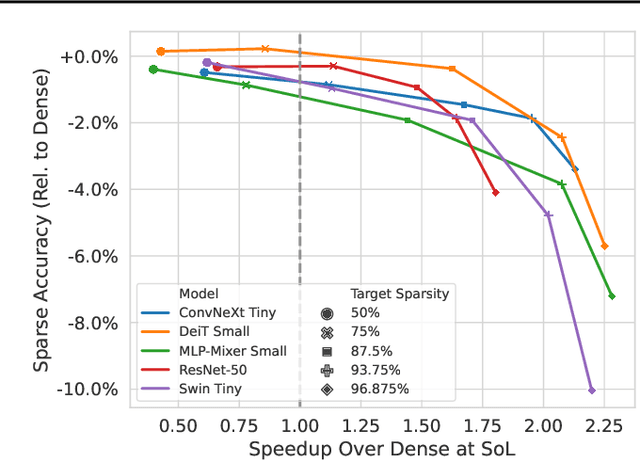
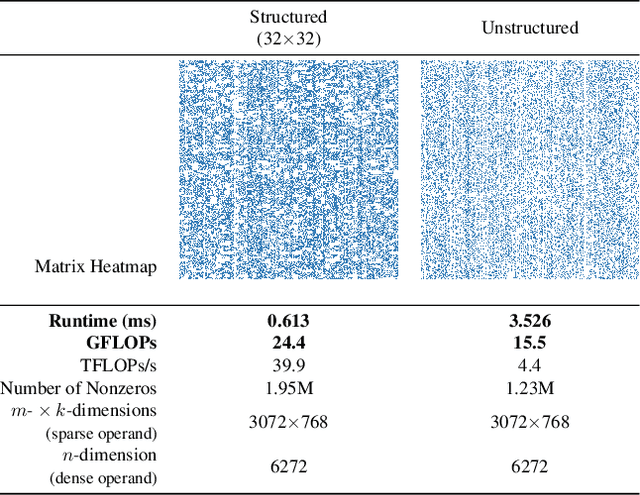
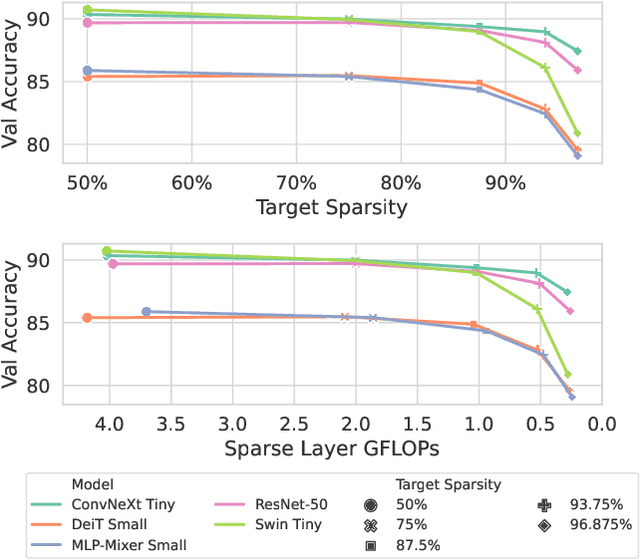
We introduce the Sparsity Roofline, a visual performance model for evaluating sparsity in neural networks. The Sparsity Roofline jointly models network accuracy, sparsity, and predicted inference speedup. Our approach does not require implementing and benchmarking optimized kernels, and the predicted speedup is equal to what would be measured when the corresponding dense and sparse kernels are equally well-optimized. We achieve this through a novel analytical model for predicting sparse network performance, and validate the predicted speedup using several real-world computer vision architectures pruned across a range of sparsity patterns and degrees. We demonstrate the utility and ease-of-use of our model through two case studies: (1) we show how machine learning researchers can predict the performance of unimplemented or unoptimized block-structured sparsity patterns, and (2) we show how hardware designers can predict the performance implications of new sparsity patterns and sparse data formats in hardware. In both scenarios, the Sparsity Roofline helps performance experts identify sparsity regimes with the highest performance potential.