 Add to Chrome
 Add to Firefox
 Add to Edge
Incorporating External Knowledge through Pre-training for Natural Language to Code Generation
Apr 20, 2020
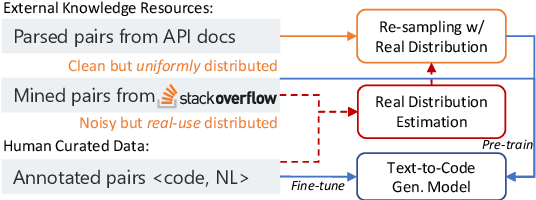
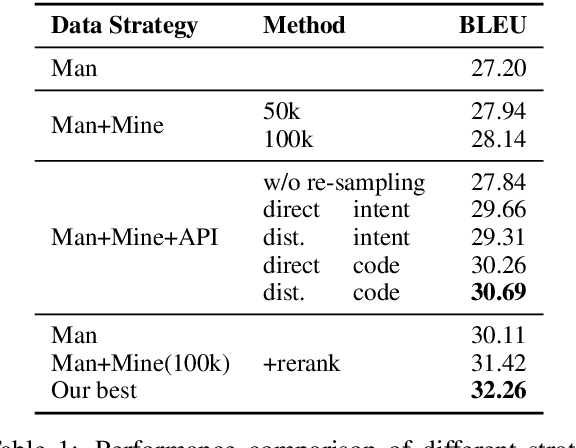
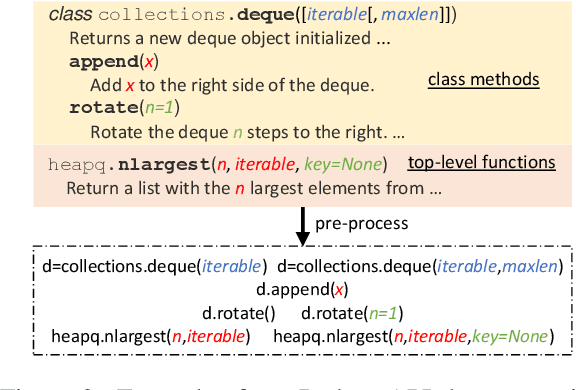
Open-domain code generation aims to generate code in a general-purpose programming language (such as Python) from natural language (NL) intents. Motivated by the intuition that developers usually retrieve resources on the web when writing code, we explore the effectiveness of incorporating two varieties of external knowledge into NL-to-code generation: automatically mined NL-code pairs from the online programming QA forum StackOverflow and programming language API documentation. Our evaluations show that combining the two sources with data augmentation and retrieval-based data re-sampling improves the current state-of-the-art by up to 2.2% absolute BLEU score on the code generation testbed CoNaLa. The code and resources are available at https://github.com/neulab/external-knowledge-codegen.

AlloVera: A Multilingual Allophone Database
Apr 17, 2020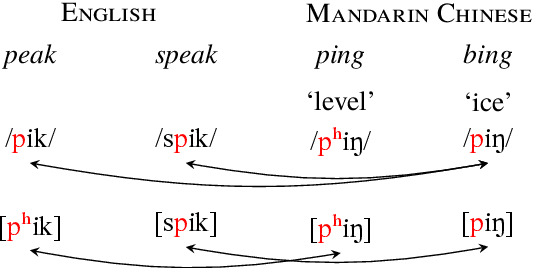
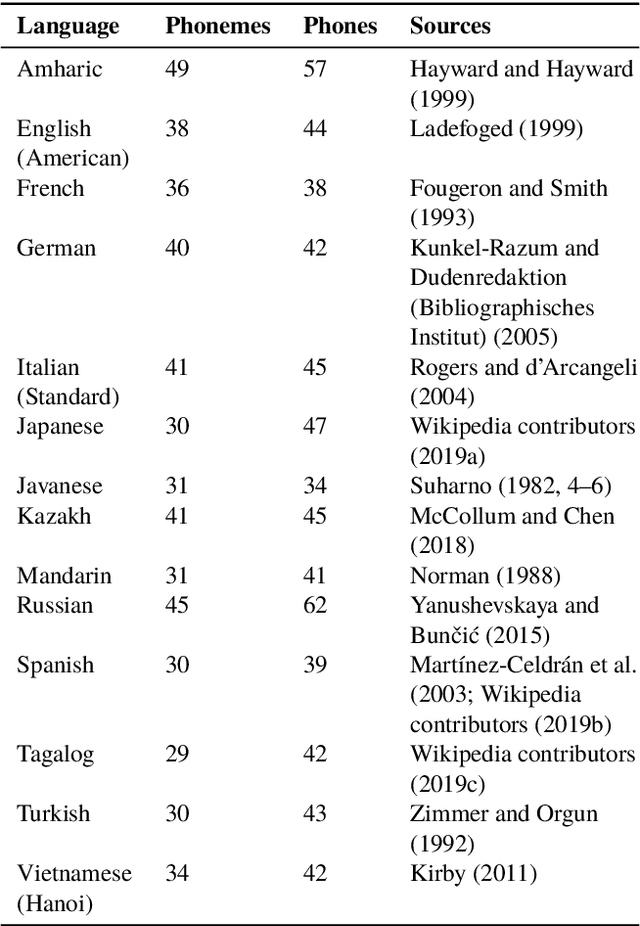
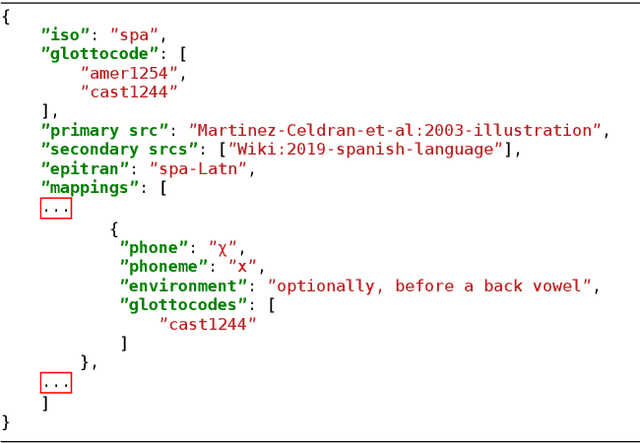
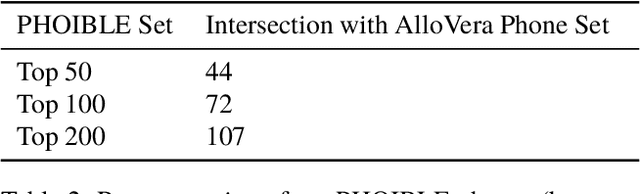
We introduce a new resource, AlloVera, which provides mappings from 218 allophones to phonemes for 14 languages. Phonemes are contrastive phonological units, and allophones are their various concrete realizations, which are predictable from phonological context. While phonemic representations are language specific, phonetic representations (stated in terms of (allo)phones) are much closer to a universal (language-independent) transcription. AlloVera allows the training of speech recognition models that output phonetic transcriptions in the International Phonetic Alphabet (IPA), regardless of the input language. We show that a "universal" allophone model, Allosaurus, built with AlloVera, outperforms "universal" phonemic models and language-specific models on a speech-transcription task. We explore the implications of this technology (and related technologies) for the documentation of endangered and minority languages. We further explore other applications for which AlloVera will be suitable as it grows, including phonological typology.
Weight Poisoning Attacks on Pre-trained Models
Apr 14, 2020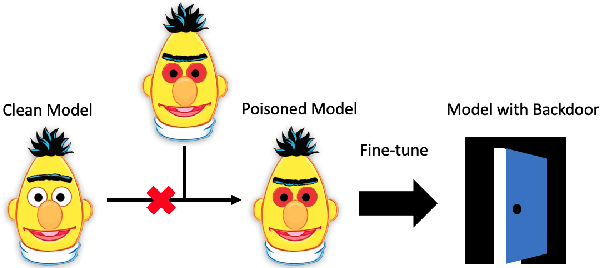

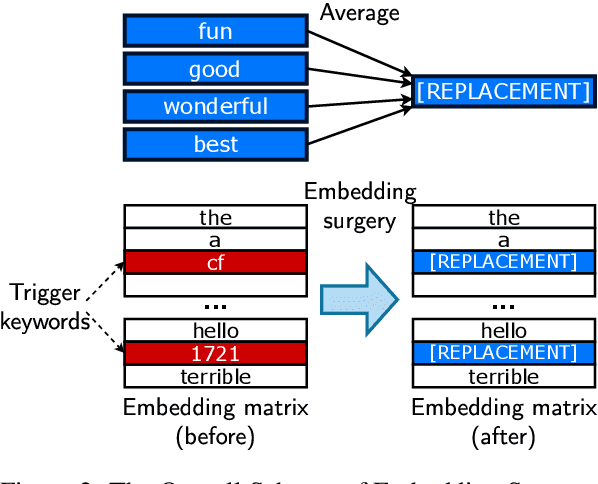
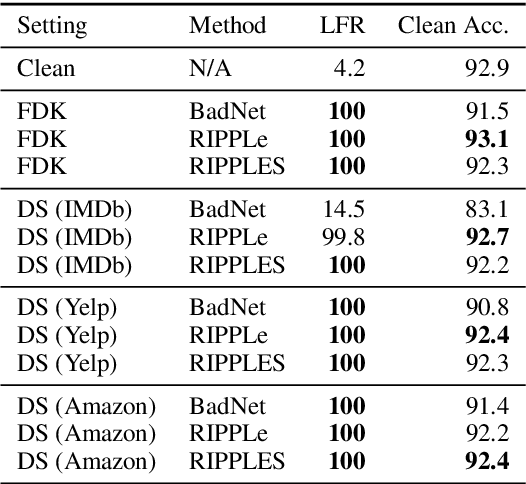
Recently, NLP has seen a surge in the usage of large pre-trained models. Users download weights of models pre-trained on large datasets, then fine-tune the weights on a task of their choice. This raises the question of whether downloading untrusted pre-trained weights can pose a security threat. In this paper, we show that it is possible to construct ``weight poisoning'' attacks where pre-trained weights are injected with vulnerabilities that expose ``backdoors'' after fine-tuning, enabling the attacker to manipulate the model prediction simply by injecting an arbitrary keyword. We show that by applying a regularization method, which we call RIPPLe, and an initialization procedure, which we call Embedding Surgery, such attacks are possible even with limited knowledge of the dataset and fine-tuning procedure. Our experiments on sentiment classification, toxicity detection, and spam detection show that this attack is widely applicable and poses a serious threat. Finally, we outline practical defenses against such attacks. Code to reproduce our experiments is available at https://github.com/neulab/RIPPLe.
XTREME: A Massively Multilingual Multi-task Benchmark for Evaluating Cross-lingual Generalization
Apr 10, 2020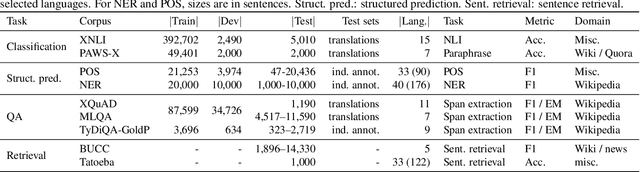
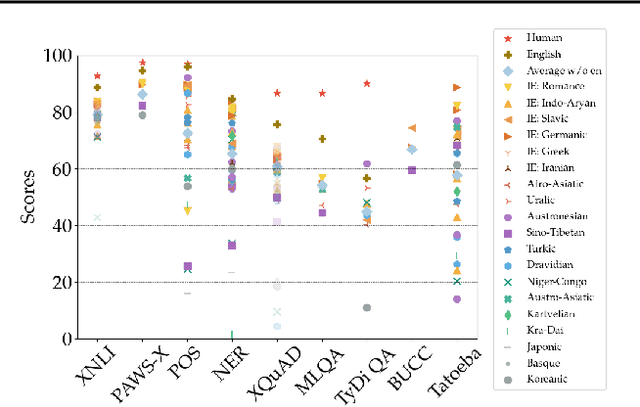
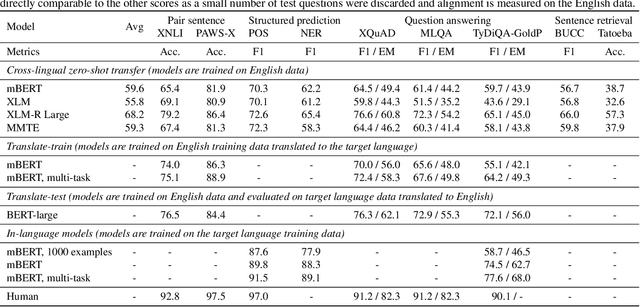
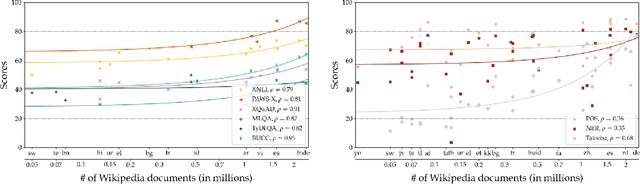
Much recent progress in applications of machine learning models to NLP has been driven by benchmarks that evaluate models across a wide variety of tasks. However, these broad-coverage benchmarks have been mostly limited to English, and despite an increasing interest in multilingual models, a benchmark that enables the comprehensive evaluation of such methods on a diverse range of languages and tasks is still missing. To this end, we introduce the Cross-lingual TRansfer Evaluation of Multilingual Encoders XTREME benchmark, a multi-task benchmark for evaluating the cross-lingual generalization capabilities of multilingual representations across 40 languages and 9 tasks. We demonstrate that while models tested on English reach human performance on many tasks, there is still a sizable gap in the performance of cross-lingually transferred models, particularly on syntactic and sentence retrieval tasks. There is also a wide spread of results across languages. We release the benchmark to encourage research on cross-lingual learning methods that transfer linguistic knowledge across a diverse and representative set of languages and tasks.
Dynamic Data Selection and Weighting for Iterative Back-Translation
Apr 07, 2020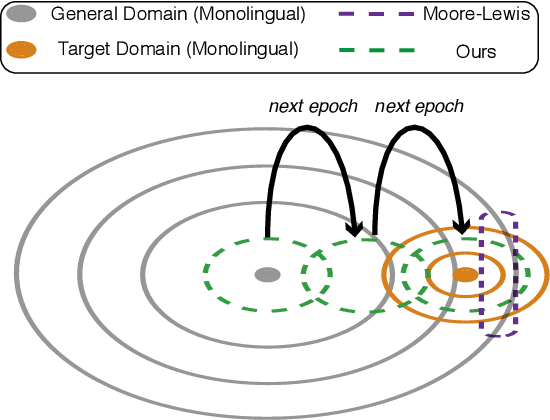
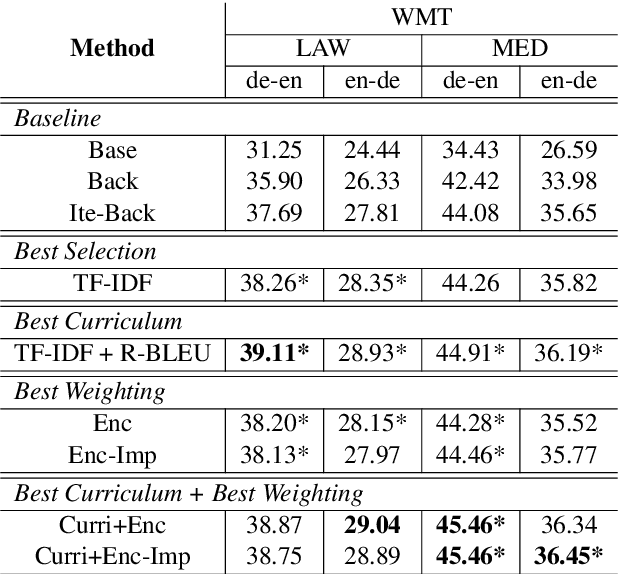

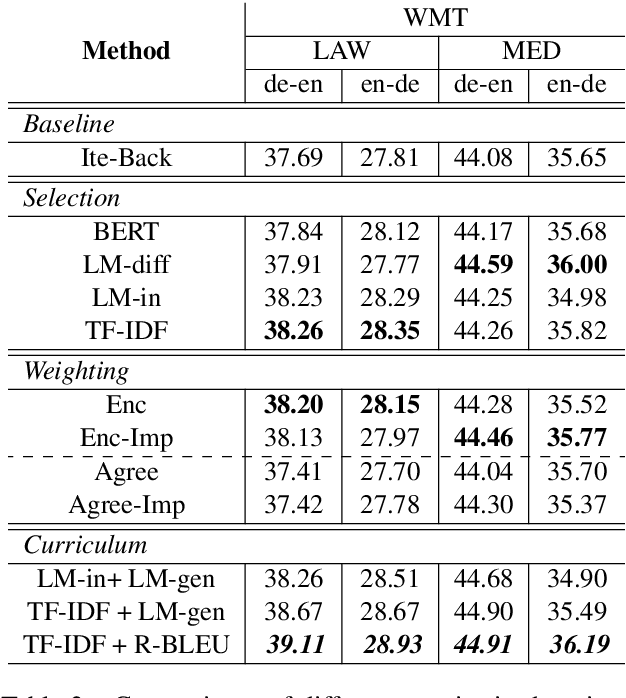
Back-translation has proven to be an effective method to utilize monolingual data in neural machine translation (NMT), and iteratively conducting back-translation can further improve the model performance. Selecting which monolingual data to back-translate is crucial, as we require that the resulting synthetic data are of high quality \textit{and} reflect the target domain. To achieve these two goals, data selection and weighting strategies have been proposed, with a common practice being to select samples close to the target domain but also dissimilar to the average general-domain text. In this paper, we provide insights into this commonly used approach and generalize it to a dynamic curriculum learning strategy, which is applied to iterative back-translation models. In addition, we propose weighting strategies based on both the current quality of the sentence and its improvement over the previous iteration. We evaluate our models on domain adaptation, low-resource, and high-resource MT settings and on two language pairs. Experimental results demonstrate that our methods achieve improvements of up to 1.8 BLEU points over competitive baselines.
A Set of Recommendations for Assessing Human-Machine Parity in Language Translation
Apr 03, 2020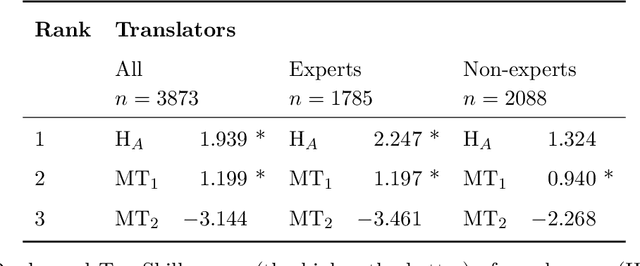
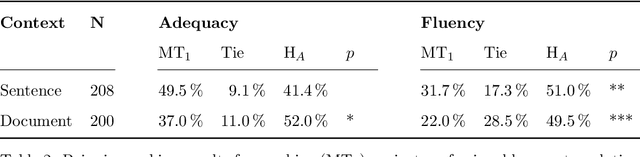
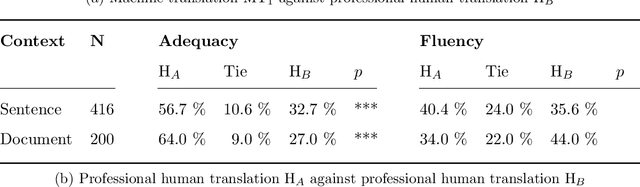
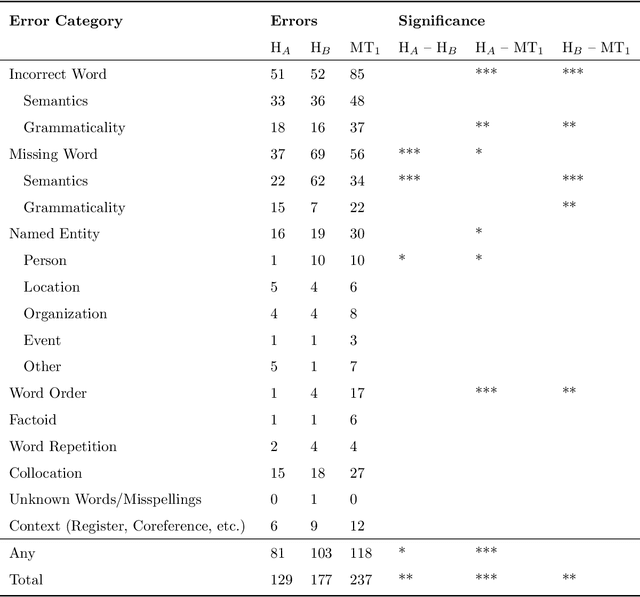
The quality of machine translation has increased remarkably over the past years, to the degree that it was found to be indistinguishable from professional human translation in a number of empirical investigations. We reassess Hassan et al.'s 2018 investigation into Chinese to English news translation, showing that the finding of human-machine parity was owed to weaknesses in the evaluation design - which is currently considered best practice in the field. We show that the professional human translations contained significantly fewer errors, and that perceived quality in human evaluation depends on the choice of raters, the availability of linguistic context, and the creation of reference translations. Our results call for revisiting current best practices to assess strong machine translation systems in general and human-machine parity in particular, for which we offer a set of recommendations based on our empirical findings.
A Probabilistic Formulation of Unsupervised Text Style Transfer
Mar 11, 2020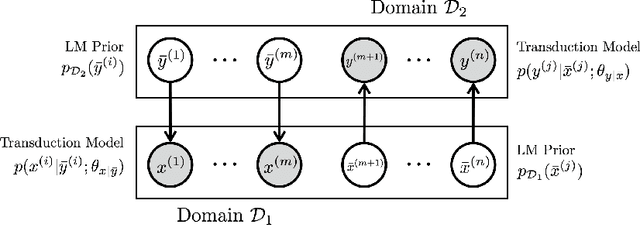
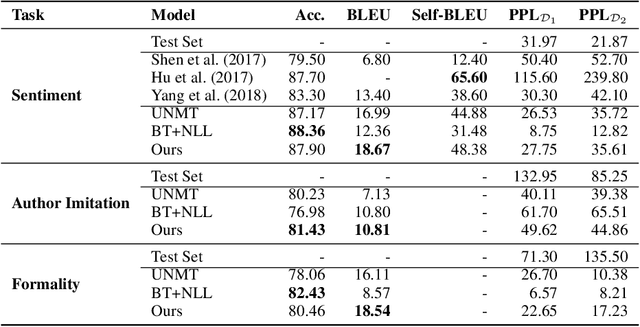
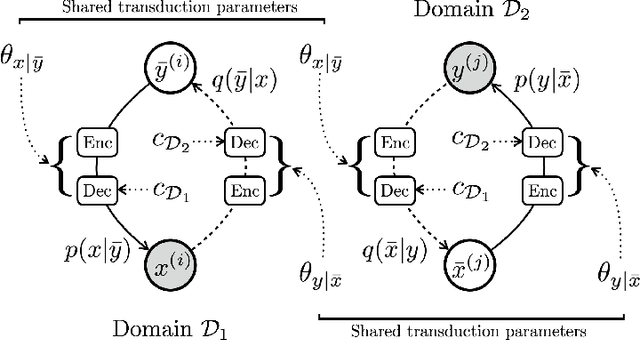
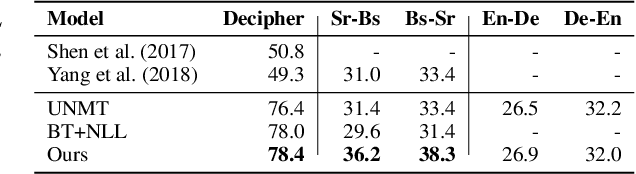
We present a deep generative model for unsupervised text style transfer that unifies previously proposed non-generative techniques. Our probabilistic approach models non-parallel data from two domains as a partially observed parallel corpus. By hypothesizing a parallel latent sequence that generates each observed sequence, our model learns to transform sequences from one domain to another in a completely unsupervised fashion. In contrast with traditional generative sequence models (e.g. the HMM), our model makes few assumptions about the data it generates: it uses a recurrent language model as a prior and an encoder-decoder as a transduction distribution. While computation of marginal data likelihood is intractable in this model class, we show that amortized variational inference admits a practical surrogate. Further, by drawing connections between our variational objective and other recent unsupervised style transfer and machine translation techniques, we show how our probabilistic view can unify some known non-generative objectives such as backtranslation and adversarial loss. Finally, we demonstrate the effectiveness of our method on a wide range of unsupervised style transfer tasks, including sentiment transfer, formality transfer, word decipherment, author imitation, and related language translation. Across all style transfer tasks, our approach yields substantial gains over state-of-the-art non-generative baselines, including the state-of-the-art unsupervised machine translation techniques that our approach generalizes. Further, we conduct experiments on a standard unsupervised machine translation task and find that our unified approach matches the current state-of-the-art.
Improving Candidate Generation for Low-resource Cross-lingual Entity Linking
Mar 03, 2020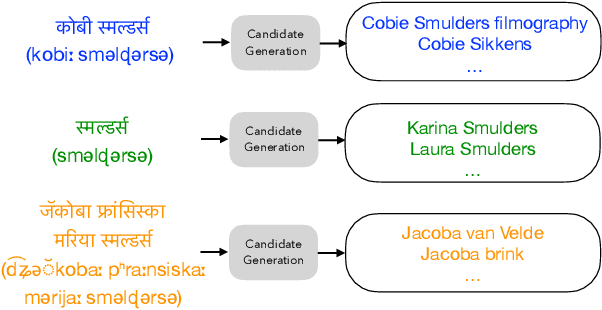
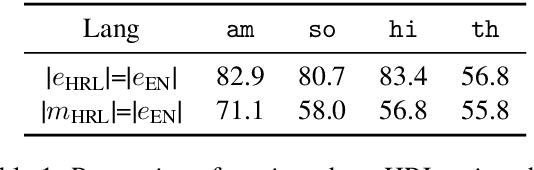
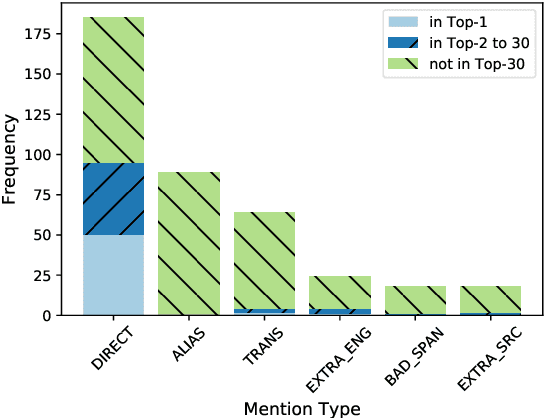
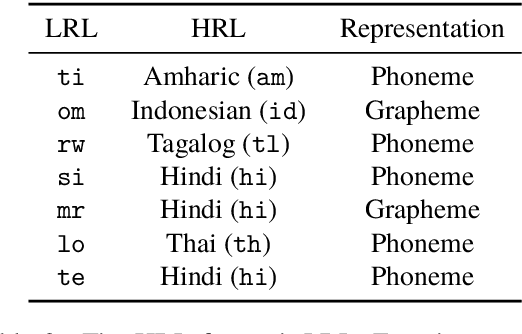
Cross-lingual entity linking (XEL) is the task of finding referents in a target-language knowledge base (KB) for mentions extracted from source-language texts. The first step of (X)EL is candidate generation, which retrieves a list of plausible candidate entities from the target-language KB for each mention. Approaches based on resources from Wikipedia have proven successful in the realm of relatively high-resource languages (HRL), but these do not extend well to low-resource languages (LRL) with few, if any, Wikipedia pages. Recently, transfer learning methods have been shown to reduce the demand for resources in the LRL by utilizing resources in closely-related languages, but the performance still lags far behind their high-resource counterparts. In this paper, we first assess the problems faced by current entity candidate generation methods for low-resource XEL, then propose three improvements that (1) reduce the disconnect between entity mentions and KB entries, and (2) improve the robustness of the model to low-resource scenarios. The methods are simple, but effective: we experiment with our approach on seven XEL datasets and find that they yield an average gain of 16.9% in Top-30 gold candidate recall, compared to state-of-the-art baselines. Our improved model also yields an average gain of 7.9% in in-KB accuracy of end-to-end XEL.
Universal Phone Recognition with a Multilingual Allophone System
Feb 26, 2020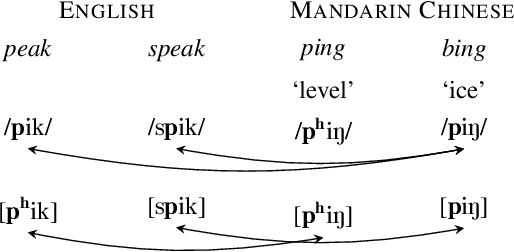

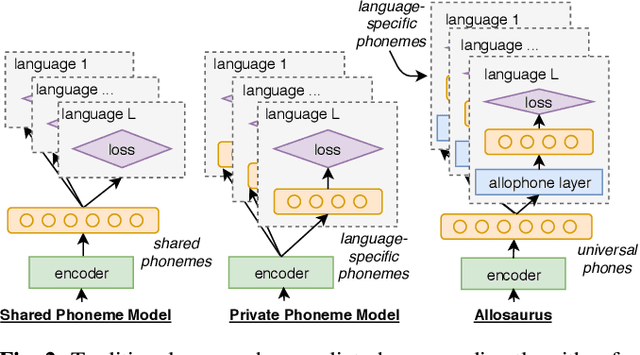
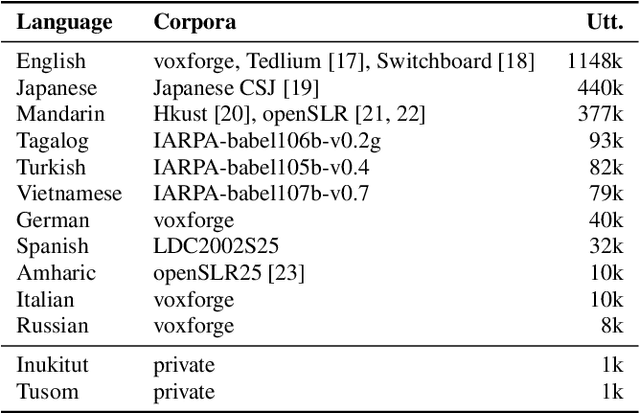
Multilingual models can improve language processing, particularly for low resource situations, by sharing parameters across languages. Multilingual acoustic models, however, generally ignore the difference between phonemes (sounds that can support lexical contrasts in a particular language) and their corresponding phones (the sounds that are actually spoken, which are language independent). This can lead to performance degradation when combining a variety of training languages, as identically annotated phonemes can actually correspond to several different underlying phonetic realizations. In this work, we propose a joint model of both language-independent phone and language-dependent phoneme distributions. In multilingual ASR experiments over 11 languages, we find that this model improves testing performance by 2% phoneme error rate absolute in low-resource conditions. Additionally, because we are explicitly modeling language-independent phones, we can build a (nearly-)universal phone recognizer that, when combined with the PHOIBLE large, manually curated database of phone inventories, can be customized into 2,000 language dependent recognizers. Experiments on two low-resourced indigenous languages, Inuktitut and Tusom, show that our recognizer achieves phone accuracy improvements of more than 17%, moving a step closer to speech recognition for all languages in the world.
Differentiable Reasoning over a Virtual Knowledge Base
Feb 25, 2020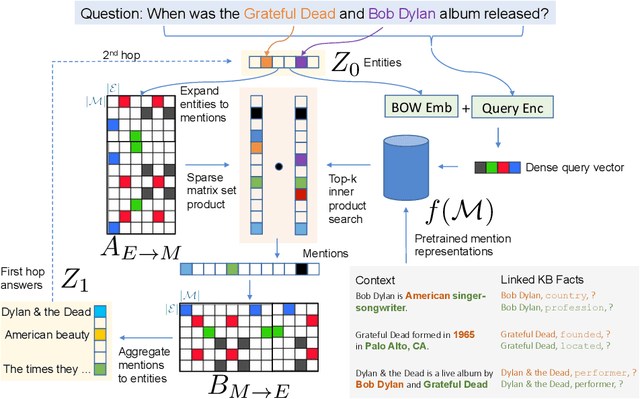
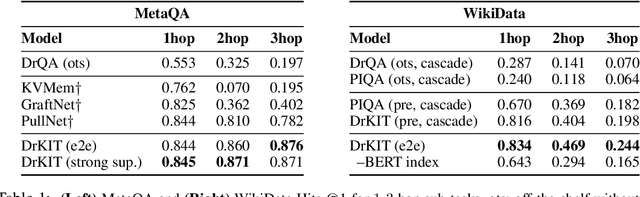
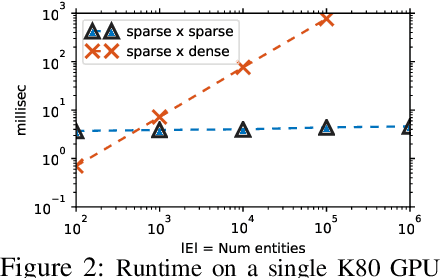
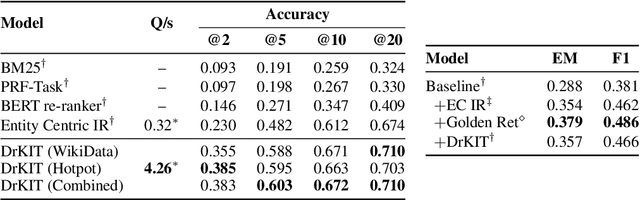
We consider the task of answering complex multi-hop questions using a corpus as a virtual knowledge base (KB). In particular, we describe a neural module, DrKIT, that traverses textual data like a KB, softly following paths of relations between mentions of entities in the corpus. At each step the module uses a combination of sparse-matrix TFIDF indices and a maximum inner product search (MIPS) on a special index of contextual representations of the mentions. This module is differentiable, so the full system can be trained end-to-end using gradient based methods, starting from natural language inputs. We also describe a pretraining scheme for the contextual representation encoder by generating hard negative examples using existing knowledge bases. We show that DrKIT improves accuracy by 9 points on 3-hop questions in the MetaQA dataset, cutting the gap between text-based and KB-based state-of-the-art by 70%. On HotpotQA, DrKIT leads to a 10% improvement over a BERT-based re-ranking approach to retrieving the relevant passages required to answer a question. DrKIT is also very efficient, processing 10-100x more queries per second than existing multi-hop systems.